Greek Orthodox Church
Cartes Postales from GreeceThe Greek Orthodox Church appears as a durable presence in a country under economic strain, but not as an abstraction: it is encountered through open doors, crowded services, sacred objects, the labour of a cleaner, and rituals that draw whole communities to the water. Its reach is especially clear in the movement between ordinary life and ceremonial time. The church offers continuity, yet its public rites also expose old wounds and make room for a changed understanding of the past.
Public Presence and Sacred Space
The narrator observes shut-up shops in Patras but never a closed church. The contrast is not merely architectural: in a period when pensions have fallen below subsistence and people go through bins, the churches remain open, bright with treasure, and attended by priests and worshippers. That visible continuity does not erase hardship, but it places religious life alongside it as a persistent feature of the country’s public landscape.
The scale of the Basilica of Saint Andrew, Patras makes that presence impossible to miss. Consecrated in 1974, it is vast and white, compared to a giant cake and described as one of the biggest churches in Greece. Its monumental exterior initially puts the narrator off visiting. The older Byzantine church beside it, which had housed a relic of Saint Andrew’s finger, offered a smaller, darker, more intimate alternative; some elderly women still preferred it. The two buildings embody different experiences of devotion: one familiar and easy to care for, the other imposing, newly built, and difficult to approach on foot.
Inside the basilica, however, the impression changes. Its architect intended it to express the Light of the World: daylight enters through windows in the dome, lower walls, and doors, while gold-leaf mosaics return that light across the interior. More than five hundred bulbs burn on a central candelabra. Images of animals, birds, flowers, and Saint Andrew’s life animate its surfaces. The city that had once martyred the saint now honours him in an immense building whose visual splendour seems to turn historical violence into an appeal for forgiveness. Silver reliquaries holding his crumbling bones draw thousands of pilgrims, who come to venerate the remains and their closeness to the apostle.
Worship, Work, and Local Change
The new basilica changes more than the city’s skyline. When it first opened, older worshippers complained about the long walk across the marble forecourt and the time needed to reach the candle box and then the icon. They nevertheless felt obliged to fulfil their duty there. What visitors experienced as wonder could therefore also mean effort for people whose devotional habits were shaped by a smaller church.
That change affects Maria Leontidis materially. For years she had cleaned the old Byzantine church, where low light concealed dust and cobwebs. In summer she spent time on its bench with a cigarette and a frappé; in winter she dusted around the reliquary and warmed herself in a nearby cake shop until it was time to lock up. When invited to clean the new church at the age of sixty, she accepted with pride rather than treating the change as a reason to retire. The basilica’s opening thus transfers both worship and work from one sacred space to another.
The church’s presence is also heard beyond its walls. In Preveza, on 6 January, bells wake the narrator at dawn, followed by a priest broadcasting the liturgy through loudspeakers fixed to a nearby belltower. The church is packed, with hundreds of people craning to see from outside. The scene makes religious observance part of the town’s public soundscape and establishes the day’s ceremony before its meaning has been explained.
Theophany and the Sea
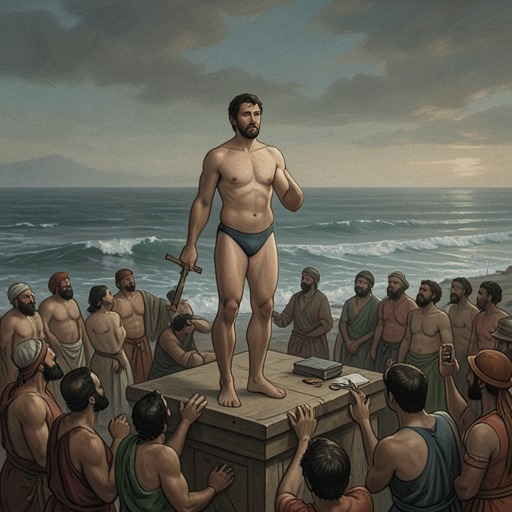
The ceremony is Theophany in the Greek Orthodox Church, celebrated here as the baptism of Christ and his first appearance as God. A priest blesses the water by throwing a cross into the sea. The narrator learns that the rite is also associated with driving away the Kallikantzaroi, goblins said to cause trouble during the Christmas period, so that sailing can begin again. For Leonidas, a local lawyer and former participant, the sea is bound to Greek identity; he once dived for the cross with his school friend Giorgos Ziras.
The ritual’s public sequence draws church and harbour into a single event. In the late 1970s, clergy, municipal officials, and representatives of the army and navy process toward the water with the town band. The senior priest casts a gold cross attached to a ribbon into the sea, immersing it twice before releasing it on the third. The waiting young men then dive to retrieve it. The winner receives a special blessing and the status of a local hero. Giorgos, who had competed alongside Mihalis for years, enters the water amid shoving, loses his goggles, and is buffeted by the other swimmers. The ceremony is both a religious act and a contest for recognition before the community.
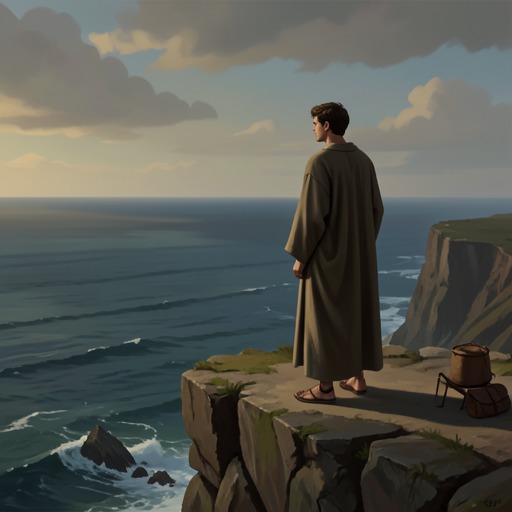
That shared spectacle becomes inseparable from a long private ordeal. After Mihalis is presumed dead, Giorgos lives under the stigma of suspicion, works at a feta-cheese packing and export company an hour away, and avoids the town centre. He continues to swim alone on a deserted beach from spring through autumn. For nearly forty years, attending Theophany is the one day on which he can try to hold his head high. When the truth eventually brings him exoneration, Leonidas supports him as he sobs; the priest’s words over the water give the moment a language of absolution. The service does not merely repeat a familiar rite: it becomes the setting in which an old accusation can finally be answered.
Sacraments and the Religious Calendar
The book also presents the Church through individual acts of spiritual care. In a chapel, Dimitris places the holy stole around his neck before hearing a woman’s confession. The garment marks his role in the encounter: he can absolve her, and at its end he will place it over her head and read the prayer of forgiveness. Her quiet admission of shame stands in contrast to the crowded public ceremonies elsewhere. Religious life encompasses both the spectacle of a town gathered at the sea and the privacy of a person seeking forgiveness.
The calendar shapes experience beyond the church itself. In a village, Sylvie and Jean-Luc discover that they have misunderstood the date of Greek Orthodox Easter, which falls at a different time from Catholic Easter. Their error has practical consequences: they have arrived on a holiday weekend without understanding the additional car-hire charge. Later, at the Easter celebration, fireworks and firecrackers accompany the lighting of a thousand candles along the waterfront. A woman shares her flame with Sylvie and greets her with “Christos Anesti!” The ritual turns a stranger’s candle into a moment of participation, while showing how a religious calendar governs local time, commerce, and communal celebration.
Across these episodes, the Greek Orthodox Church is neither detached from material circumstances nor confined to doctrine. Its buildings organize labour and devotional habit; its calendar affects travel and business; its rites gather generations into public view. Most significantly, the Theophany cross links the sacred act of blessing water to the town’s judgement of Giorgos, allowing a recurring ceremony to carry both collective memory and the possibility of release.