Greek War of Independence
Cartes Postales from GreeceThe Greek War of Independence appears as a defining struggle for liberation and as a story repeatedly retold through national ritual. At the 25 March parade, an elderly man presents the uprising against Ottoman rule as a fight sustained by faith, language, tradition, and resolve. The flag in his hand makes that history visible, while a later revelation in Evangelia’s family exposes the tension between national belonging and the ideal of purity attached to it.
Background and Commemoration
The parade takes place on 25 March, a warm spring day when the narrator finds Thessaloniki crowded with flags and spectators. The occasion marks the Greeks’ liberation from Ottoman rule, which the narrator contrasts with the German occupation of the twentieth century: the Ottomans ruled for nearly four centuries, while the German occupation lasted three years. The date is also the Feast of the Annunciation, giving the commemoration a religious significance that the book places alongside its national one.
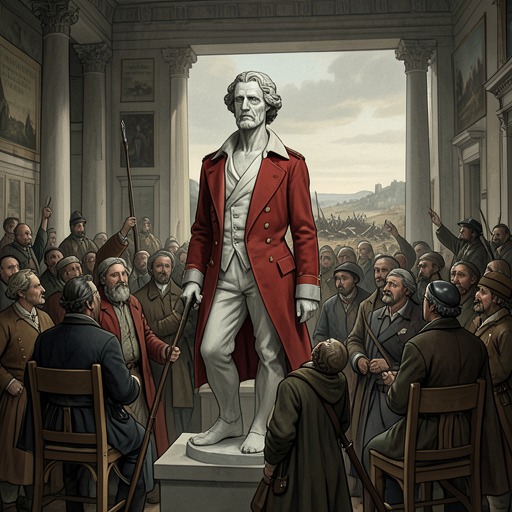
An elderly spectator explains the connection between the date and the war as he watches the parade. In his account, a bishop chose the Feast of the Annunciation as the day to raise the Greek flag and proclaim freedom. The choice makes the uprising seem not only politically decisive but sacred: the old man links the announcement of Christ’s birth with the beginning of the struggle against Ottoman rule. The narrator understands the conflict, as the man presents it, as a holy war.
The Old Man’s Account
The old man recalls the Greeks as hopelessly outnumbered by the Ottoman forces, but insists that God’s support mattered more than the imbalance. He describes a people who had not relinquished their language, traditions, or religion despite centuries of rule. In his telling, the decision to rise was the beginning of a nine-year fight that ended in freedom.
His manner makes the past feel close without changing the parade into a literal battlefield. He raises a small flag and speaks with such excitement that the narrator sees him reliving the struggle as though he had taken part himself. His family has heard these stories many times, but he welcomes the narrator as a fresh audience. People nearby also turn to listen; a young woman holding her child nods in approval. The scene shows how commemoration passes between generations through repeated speech, attentive listening, and the shared presence of the flag.
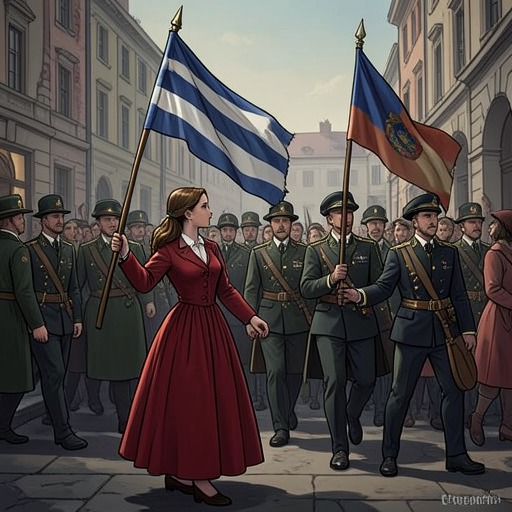
The parade supplies a public counterpoint to his story. Schoolchildren, soldiers, and people in regional costume march past, while the old man’s daughter gently touches his arm to draw his attention back to the procession. The event thus joins a remembered declaration of freedom to a present-day ceremony: the account is personal and animated, but the marching crowds make clear that it belongs to a continuing national observance.
The Flag and Its Meaning
The flag’s blue-and-white design carries a specific memory of the struggle. Evangelia reflects that its nine horizontal stripes recall the nine-syllable rallying cry used to free the country from Ottoman rule: “El-ef-the-ri-a i Tha-na-tos! Freedom or Death!” For her, as for many others, the flag embodies the conviction that God helped the Greeks throw off Ottoman oppression. Its appearance at the parade therefore gathers together a political demand, a religious interpretation, and a claim to cultural continuity.
The image recurs across different generations. Evangelia remembers having been a flag-bearer when she was young, a privilege awarded to the top student in the class. Decades later, she anticipates seeing her granddaughter, also named Evangelia, carry the flag. Her pride links her own childhood memory to the younger woman’s public role, showing how national history can be transmitted through family as well as ceremony.
A Private Secret Behind Public Pride
The flag’s promise of belonging becomes more complicated when Evangelia hears a neighbour question whether an Albanian boy should be allowed to carry it. Evangelia feels shame, recognizing that the criticism applies to her own family too: the father of her child spoke little Greek, and, by the standard being invoked, her granddaughter is not of “pure” blood. The public symbol she has long regarded with pride cannot be separated from the question of who is considered entitled to carry it.
That shame reaches back to the German occupation, long after the events commemorated on 25 March. Evangelia was eighteen when German soldiers entered her city. Her father was forced to keep his port-side café, Je Reviens, open, and she helped him there while her brothers joined the resistance. In the devastated years after the occupation, her pregnancy was explained through a fabricated story of a fiancé who had not returned from the front. Her daughter, Efi, was never told the identity of her father. Each 25 March, Evangelia goes to church on her name day and lights a candle for Franz, whom she had loved and still hoped to see again.
The juxtaposition does not undo the war’s place in national memory; it reveals the private histories that a simple story of collective identity can leave unspoken. The parade’s account celebrates a people preserving its language, traditions, and religion through occupation. Evangelia’s hidden history, and her fear that it disqualifies her descendants from the national symbol, expose the cost of treating belonging as a matter of blood. The war is therefore remembered both as liberation from foreign rule and as a powerful standard against which later generations judge who belongs.