Greek identity, ancestry, and belonging
Cartes Postales from GreeceGreek identity, ancestry, and belonging are tested through a national flag and a secret carried across generations. At a parade, spectators dispute whether a high-achieving boy should bear the flag because they regard his Albanian ancestry as disqualifying. Evangelia, once a flag-bearer herself, feels shame when she realizes that the same standard would also disqualify her granddaughter: the child’s father spoke little Greek, and her ancestry is not “pure.” The public argument exposes a private history in which love, wartime secrecy, and family resemblance have allowed an unacknowledged lineage to remain hidden.
Public Honor and Ancestry
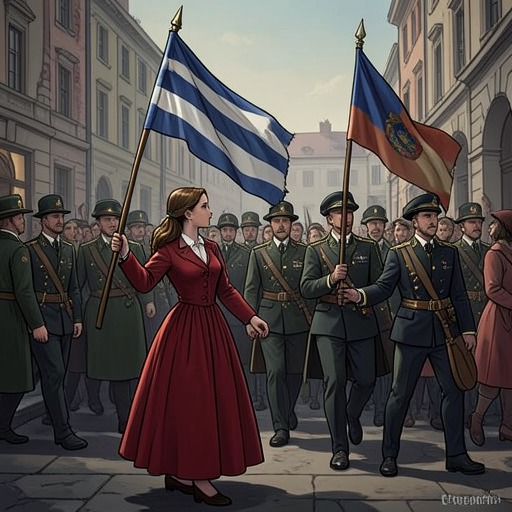
Decades earlier, Evangelia had earned the honor of carrying the national flag by coming top of her class. She relives that moment each year, and at this parade she waits proudly to see her granddaughter, also named Evangelia, carry the flag. The custom presents academic achievement as the qualification for a public honor: the bearer is selected for being top of the class, not for a publicly verified ancestry. Evangelia’s own memories make the younger girl’s place in the procession a continuation of family pride as well as a visible civic distinction.
The parade also displays the flag’s history. Its blue and white design bears nine horizontal stripes, recalling the nine-syllable rallying cry associated with Greeks’ effort to free their country from the Turks. A rain-soaked Albanian seller struggles to pass Evangelia her change for a small flag. Then a tall, black-haired boy from another school marches by carrying the national flag with conviction. Neighbors object to his role on the grounds of his Albanian background and insist that the honor should belong only to someone of unmixed Greek descent. Their objection collides with the explanation that the boy is carrying the flag because he is top of his class. Although the crowd does not cheer his group, the boy smiles at Evangelia and lets the blue-and-white flag unfurl as he continues marching.
The scene sets a rule of merit beside an unwritten test of descent. The boy’s school achievement makes him eligible under the stated custom, yet the spectators’ comments try to make ancestry more decisive than the school’s selection. The Albanian seller stands near the exchange, holding a fistful of flags, and Evangelia wonders what he may have understood. Her discomfort is not simply regret that she failed to support the person defending the boy’s right to carry the flag. She recognizes that the judgments being voiced around her could also be directed at her own family.
The Family Secret Behind the Parade
Evangelia understands that her granddaughter’s father, like the boy’s father, spoke little Greek. The girl is therefore not of wholly Greek ancestry, though only Evangelia knows the concealed history that makes this resemblance between the families more than a passing comparison. The knowledge turns the parade’s public test of belonging inward: if the boy is said to have no right to the flag, Evangelia sees that the same reasoning would deny her granddaughter the honor she has been anticipating with pride. The flag’s blue and white cannot make the family secret disappear; instead, the sight of it brings the secret into focus.
That secret began during the German occupation, when Evangelia was eighteen. Her father owned Je Reviens, a café near the port, and the occupying Germans would not allow him to close it. The establishment became popular with German soldiers. Evangelia’s mother refused to take part in its operation, while her brothers left the city to join the resistance. Evangelia was left to help her father by washing glasses and cleaning tables, but she was not allowed to speak to the soldiers. The wartime setting placed her in an exposed position inside a business serving the occupiers, while the family around her was divided between refusal, resistance, and the necessity of keeping the café open.
After the occupation, survival and reconstruction took precedence over celebration. Hundreds of thousands of Greeks had died, many from starvation, and Evangelia’s family endured further separation as her brothers became caught up in fighting between Left and Right; several years passed before either returned to Thessaloniki. In this period of loss, Evangelia’s pregnancy became noticeable to people outside the family only in its seventh month. Her parents accepted it, and the family invented a fiancé who had supposedly failed to return from the front. A fatherless child was not unusual amid wartime bereavement, so the explanation could pass without revealing the child’s actual parentage.
What Passes to the Next Generation
The baby, Efi, was welcomed and adored by the family. She was never told the identity of her father. As she grew up and later had children of her own, the family’s concealment continued without her knowing what had been concealed. She named her eldest daughter after Evangelia, linking the granddaughter in the parade to the grandmother’s earlier life and to the unresolved history behind the family name.
Efi’s appearance helped preserve the secret. She looked exactly like Evangelia, with none of her father’s blond, Teutonic features. Resemblance thus works as both inheritance and camouflage: Efi visibly resembles the maternal line, while that very likeness prevents her father’s ancestry from being read in her face. The granddaughter’s place in the parade makes the hidden lineage relevant again, even though the public has no access to the history behind it. Evangelia alone can connect the dispute over the boy’s eligibility to the concealed parentage within her own family.
Ritual Memory and Belonging
On the afternoon of 25 March, Evangelia goes to church as she always does on her name day and lights a candle for Franz Dieter, whom she has lost. He had made no promise to return, but she continues to hope that she might see him again. When she encounters a party of German tourists, she searches their faces for the blue eyes and gentle smile she associates with him. Her private remembrance persists alongside the public history of occupation and the family story that could not be openly told.
After the church, she takes a taxi to the port and stands outside the now-abandoned Je Reviens. Each year on this day, she takes a battered old book from her handbag and silently reads a particular poem. The repeated visit joins a name-day ritual, a place bound to the occupation, and a continuing hope of reunion. In a story where ancestry has been hidden to protect a child from the consequences of her origins, Evangelia’s yearly acts of remembrance keep the past present to her, even as Efi remains unaware of her father’s identity.
The Meaning of the Flag
The parade does not resolve the dispute by making ancestry irrelevant; rather, it reveals how selectively ancestry is applied. The neighbors treat the boy’s presumed Albanian background as a reason to withhold a national honor, while the academic rule offers a different measure of qualification. Evangelia’s recognition of her granddaughter’s family history exposes the vulnerability beneath her own pride: the exclusion she witnesses would, by its own logic, exclude the child she loves and celebrates.
The flag gathers these tensions into a single public image. Its stripes recall a struggle for national freedom, but the crowd’s argument turns belonging into a question of who may embody the nation. The boy carries it despite the muttered objections; Evangelia, meanwhile, sees that her family’s claim to the same honor rests on a secret rather than on the purity the spectators demand. Through the contrast between visible ceremony and concealed parentage, the book presents identity as something shaped not only by ancestry, but also by memory, achievement, family silence, and the judgments a community chooses to enforce.