Icarus
Cartes Postales from GreeceIcarus is Daedalus’s son and the young flyer whose death gives Ikaria its name in Ariadne’s account. Imprisoned with his father by Minos, he escapes into the sky on wings made from feathers. The flight carries father and son far across the Aegean Sea, but ends near the island when Icarus rises beyond the limits Daedalus had set. His fall makes freedom and youthful exhilaration inseparable from loss, and his burial becomes the beginning of Ariadne’s enduring duty to remember him.
Identity and Imprisonment
Icarus enters the story as a son caught in the consequences of his father’s ingenuity. Daedalus, an inventive and resourceful man, has been summoned by Minos to build a labyrinth for a monster. After Theseus kills the monster and escapes with Ariadne, Minos imprisons Daedalus in a tower; Icarus is confined there with him. For Daedalus, separation from the world is a severe punishment, and his son shares that isolation. Their captivity is the condition that makes flight not a game or spectacle at first, but their means of escape.
The tower is high above the ground, a location chosen to make escape difficult. For weeks, however, it also gives Daedalus a view of birds in flight. He studies their movement and gradually works out the principles that might let human beings fly. Icarus helps prepare the wings: though initially troubled by the dead birds from which the feathers are taken, he accepts his father’s explanation that they are necessary and begins to arrange the feathers as instructed. His response shifts from unease to excitement as the prospect of flying becomes real.
The Escape and Its Limits
The wings are made for both father and son, with no opportunity for a trial run. Their first attempt will begin at the window ledge, where they must jump into the air and trust Daedalus’s construction. Daedalus gives Icarus strict instructions for the journey: flying too low risks wetting the wings and adding weight, while climbing too high risks the sun melting the wax that holds the feathers together. They must keep a steady course, remain together, and remember that they have a long way to travel. Daedalus plans to go first and tells his son to abandon the attempt if it proves disastrous.
They leave without being noticed until they are already far away. For several hundred kilometres they make steady progress over small islands, where people mistake them for rare eagles. Warm, dry air and a southerly wind help them on their way. Their destination is Athens, and by the time they reach the island where the tragedy unfolds, they are well over halfway there. Daedalus is tiring; Icarus, by contrast, is not. The difference between the father’s caution and the son’s buoyant confidence becomes central to what follows.
The Fall
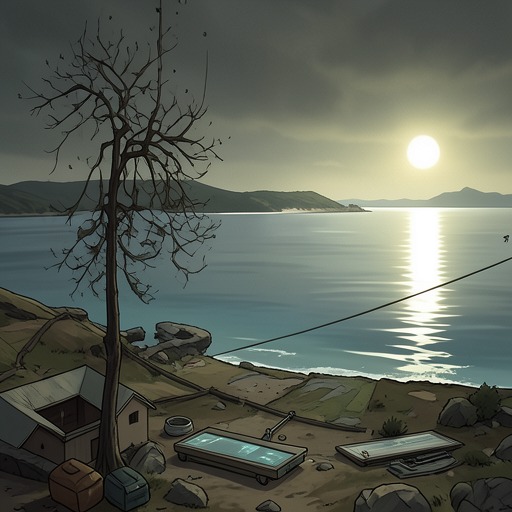
The islanders first see two distant shapes approaching. As they grow clearer, the watchers realize that one is a man in flight. Icarus and Daedalus are no longer merely escaping unseen: they have become a spectacle for the people gathered below. In Ariadne’s later interpretation, the attention of the crowd helps explain Icarus’s change of course. When he recognizes that people are watching, she suspects, he begins to show off, performing for an audience as a teenage boy might. The account presents this as her understanding of the moment, rather than as a motive independently confirmed by Icarus.
Icarus’s delight in flying overwhelms the restraint his father had urged. He rises too high, and the wings fail; he becomes a small speck against the sun before reappearing in a rapid descent. Feathers and sections of wing come away as he falls. Daedalus tries to keep his own position and moves clear, while the people below can do nothing to prevent the fall. Icarus crashes into the sea. The sudden change from distant wonder to helpless alarm turns the watchers’ gathering into a response to catastrophe.
Recovery, Burial, and Remembrance
The boats available in the harbour are small, while many of the larger vessels are away fishing. Three people swim to the place Daedalus indicates. The wooden construction of the wings, light when dry, has become waterlogged and weighs Icarus down. It takes all three swimmers to bring him to the surface and considerable effort to lift him into the boat. Daedalus is already there, grieving. The return to shore is slow, with the character of a funeral procession rather than a rescue.
Icarus’s body is carried to Ariadne’s house and laid on the kitchen table. She washes and prepares him, placing a wreath on his head, scattering flowers, and sealing his mouth with a coin. Daedalus remains in the room, overcome by grief. His loss is deepened by self-blame: he believes he is responsible both for Icarus’s death and for having imagined that the wings could be safe. The story places the gifted inventor’s skill beside its limit. He could design a way out of confinement, but could not control the risks of the flight or his son’s response to freedom.
Daedalus eventually tells Ariadne how he and Icarus came to the island, and leaves by boat the next day. There are rumours that Minos is pursuing him; Daedalus is later reported to have reached Sicily, with no expectation that he will return. Before leaving, he entrusts Ariadne with a duty connected to his son. She continues to visit Icarus’s burial place every day and keeps its location secret so that tourists will not trample it. When she sees a butterfly, she wonders whether it signals that Icarus’s soul has flown, but the sign gives her no certainty. She continues her visits because she promised Daedalus she would. In Ariadne’s telling, the island’s name and her lasting obligation preserve Icarus not as a triumphant aviator, but as a lost boy whose brief flight remains attached to the people who witnessed it.