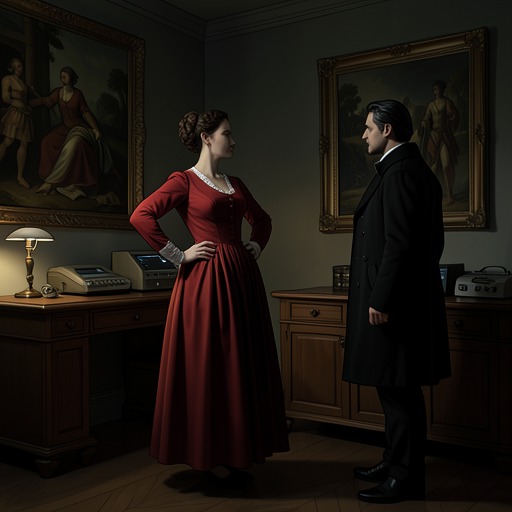
Ismini
Cartes Postales from GreeceIsmini, Antigoni’s younger sister, is presented through the tension between the life she hopes to claim and the way others look at her. Her beauty attracts persistent male attention, while the custom that an older daughter must marry first makes Antigoni’s own marriage a condition of Ismini’s future. Although Ismini is mostly absent from the scenes that follow, her engagement, remembered image, and place in Antigoni’s decisions give her a quiet but consequential presence in the story.
Family and Setting
Ismini grows up with Antigoni in Piraeus. Their mother dies when Antigoni is fifteen, and in the years afterward the sisters enjoy considerable freedom in a city described as growing rapidly and alive with theatre, cinema, and art. The account gives no comparable inventory of Ismini’s private interests: it characterizes her chiefly through her anticipation of marriage and the striking appearance that makes her an object of attention. This contrast matters. Antigoni is content with her life in Piraeus, reading, painting, and beginning to teach; Ismini, by contrast, is said to think about the future and to long to leave home and marry.
The difference between the sisters is intensified by the custom governing the order of their marriages. Ismini is younger but already in demand; nevertheless, she cannot marry before Antigoni. The rule turns the elder sister’s marital status into a practical obstacle to the younger one’s desired future. Ismini does not cause this arrangement, and the narrative does not suggest that she devised it. Rather, her hopes bring into view the social constraint under which both sisters live: the route available to Ismini depends on Antigoni first accepting a match of her own.
Beauty and the Marriage Arrangement
The narrative makes Ismini’s appearance unusually specific: light green eyes, fair silky hair, radiant skin, and freckles across her small nose. It describes her as doll-like and continually subject to male attention. That attention is made visible during a spring walk along the Piraeus waterfront. At a coffee shop, a stocky, middle-aged man passes the sisters and looks in their direction three times. Antigoni assumes he is watching Ismini. The scene does not establish what Ismini thinks about the man, or even whether he is in fact looking at her; its significance lies in how quickly Antigoni reads the repeated glance through her sister’s familiar position as the beautiful one.
Antigoni’s marriage to Christos Vandis is arranged in this context. Her father accepts his proposal when Antigoni is nearly thirty, and she agrees chiefly because she believes she is standing in the way of Ismini’s fulfillment. The decision is therefore a sacrifice of her own settled life in Piraeus for the sake of her sister’s chance to leave home and marry. Ismini’s beauty helps explain the contrast between their positions—she is already sought after—while the marriage custom explains why that advantage cannot yet become a marriage. The story presents Antigoni’s consent as an act shaped by family duty, not as evidence that Ismini asked her to make it.
Engagement and Absence
Later, Ismini becomes engaged to the son of a wealthy tobacco merchant. Antigoni thinks of her sister while walking among fishing boats in the harbor, reading the names on their plaques; one is Ismini’s. The name prompts affectionate thoughts of the woman attached to it and of the forthcoming wedding, which is eight months away. Antigoni looks forward to visiting Piraeus for the ceremony. The moment gives Ismini a definite place in the story’s future, even though she is not present on the walk and the account does not describe the engagement itself.
This news also marks a change from the earlier obstacle that Ismini represented in Antigoni’s decision to marry. She now has a match of her own, and Antigoni can imagine returning to Piraeus as a visitor for the wedding. Yet the sisters’ separation remains palpable. While living apart, Antigoni paints landscapes and finds that the work keeps loneliness at bay. When she spreads her paintings across the dining-room floor, a portrait of Ismini falls from her portfolio. The image brings her sister vividly to mind and reminds Antigoni that her strongest artistic gift is portraiture. Ismini is absent, but her likeness makes absence visible and gives Antigoni a new subject to seek.
The Portrait and Antigoni’s Break
The portrait acquires its sharpest significance when Antigoni’s portfolio is set alight. As the pictures curl and lift from the flames, she sees Ismini’s image burning. At that sight she pulls away from Christos and runs through the house and out the front door. The account does not say that Ismini knows of this act or that the sisters reunite immediately. Its focus is Antigoni’s response: the destruction of her sister’s portrait becomes the moment that precipitates her flight from the marriage.
Ismini’s role in this ending is therefore both intimate and indirect. She has not appeared to direct Antigoni’s escape; instead, the remembered face preserved in the painting makes the loss of Antigoni’s independent life tangible. Earlier, Antigoni accepted marriage in the hope of clearing a path for Ismini. Later, seeing Ismini’s portrait consumed by fire, she leaves her own husband. The paired moments connect the sisters through Antigoni’s choices, while keeping their situations distinct: Ismini’s future is represented by her engagement and expected wedding, and Antigoni’s by the departure she undertakes after the portrait burns. Ismini remains a person with stated hopes and a forthcoming marriage, not simply a symbol, but the story reveals her chiefly through the consequences her presence and image have for her sister.