Je reviens!
Cartes Postales from GreeceThe expression “Je reviens!” (“I will return!”) becomes the enduring refrain of Evangelia’s remembrance of Franz Dieter, the young German soldier she loved during the occupation. Its force rests on a painful distinction: Franz never makes this promise to her. Instead, Evangelia finds the words in a poem, reads them year after year, and keeps alive the hope that his return might still be possible.
The phrase in the farewell
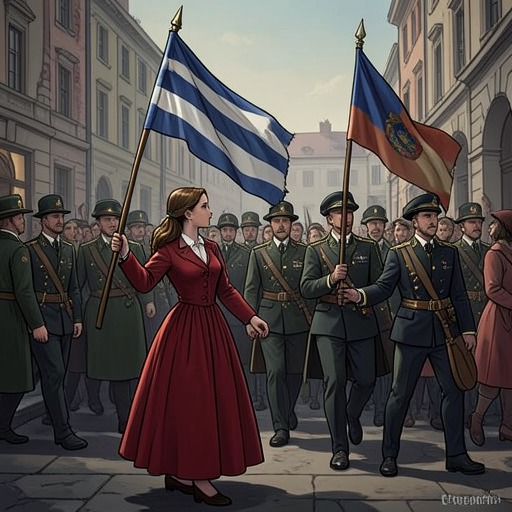
The expression enters the story at the moment of Evangelia and Franz’s last meeting. She understands that she will never see him again, and sorrow overwhelms her. Their parting carries both discovery and panic; in the café, they stand looking at one another until Evangelia takes Franz by the hand and leads him into the shadows, needing to kiss him once more. Her question, “Vous allez revenir?”—“You will come back?”—makes the uncertainty explicit. Franz does not answer.
That silence matters to the later refrain. “Je reviens!” is not a promise Franz gives Evangelia, nor evidence that he intends to return. The words arrive in another voice and another form: the line of a poem she reads in his absence. The gap between her urgent question and the poem’s confident declaration gives the expression its particular poignancy. It supplies the answer she longs for, but cannot turn that answer into a fact about Franz.
A ritual of remembrance
Evangelia’s attachment to the phrase persists across the years. On the afternoon of 25 March, her name day, she goes to church as she always does and lights a candle for Franz. He never promised to return, yet she has continued to hope that one day she will see him again. The annual observance gives that hope a recurring occasion: remembrance is not simply a feeling from the past but an act she renews on a particular day.
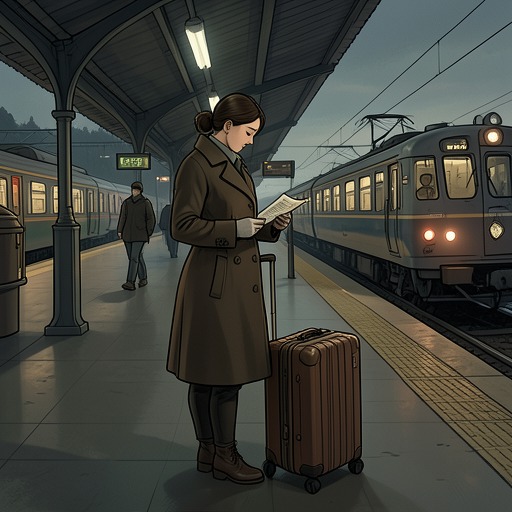
After lighting the candle, Evangelia takes a taxi to the port and stands outside the café, now abandoned. She carries an old, battered book in her handbag and silently reads a particular poem. The repeated journey links church, port, café, and book in a private practice of memory. The places and the worn volume mark the persistence of her grief, while the poem gives her longing words to return to when Franz himself cannot answer.
The refrain is embedded in the poem’s movement from a night beneath the stars to the declaration “Je reviens!” In the English rendering, its closing promise appears as “I will return!” Evangelia’s repeated reading turns that line into the center of her vigil. Yet the annual ritual does not resolve her uncertainty: even after all those years, she still longs for Franz and dreams of his return.
The poem and its historical shadow
The poem is identified as “Présence de Dieu,” rendered in English as “In the Presence of God.” Its line about return therefore reaches Evangelia through a literary voice rather than through a message from her absent lover. The narrator looks up its author, Max Jacob, and learns that he was a Jewish poet and painter, a friend of Apollinaire and Picasso, who died in March 1944 en route to Auschwitz. The narrator imagines that Evangelia learned this, too, but does not establish what she knew.
That context places the private hope within the violence of the occupation and the persecution of Greece’s Jewish population. The narrator describes Thessaloniki as especially scarred by the Holocaust: more than fifty thousand people, the majority of the country’s Jewish population, were deported by train to Auschwitz, and very few escaped. Jacob’s death on the way there gives the poem’s promise a further historical shadow. The text does not say that Evangelia’s reading changes after learning his fate; rather, it places the words she repeatedly reads beside the history that surrounds them.
Meaning and narrative function
“Je reviens!” holds together hope and knowledge without reconciling them. Its literal assurance offers a return, while Evangelia’s experience supplies no confirmation: Franz leaves without answering her question, and the story gives no reunion. The phrase can therefore sustain her longing without fulfilling it. Each recurrence renews the possibility in language, even as the abandoned café and the years of waiting attest to absence.
The expression also connects personal memory to historical loss. Evangelia remembers one German soldier she loved, while the narrative widens to the German retreat from Greece, the devastation of occupation, and the deportation of Thessaloniki’s Jews. These histories are not interchangeable, and the poem does not erase their differences. Instead, the return refrain sits at their intersection: an intimate hope carried forward by repeated reading, set against a history in which return was far from assured. Its significance lies in that unresolved tension, not in a promise kept.