Kostas Arvanitis
Cartes Postales from GreeceKostas Arvanitis is a village smallholder whose sudden death, at sixty-two, casts suspicion over an otherwise ordinary life of steady work. The villagers remember him as vigorous and reliable; the narrator encounters his name on a funeral notice and learns that his death was unexpected. The story then turns from that unanswered death to his last known evening in the fields, where a strange sound from beneath his spade interrupts his routine.
Identity and reputation
The narrator finds Kostas’s name among a dozen funeral notices beside a village church. The notice gives his name as Constantinos Arvanitis and his age as sixty-two. In the nearby taverna, the owner recognizes the name and asks whether the stranger knew him. The question reflects how visible a death is in a small community: notices announce funerals taking place that day or the next, and the people who recognize a face must respond quickly.
The tavern owner’s wife describes Kostas as fit and healthy, slim, vigorous, and without a spare kilo. He worked at his smallholding every day and, in her account, never missed one. This reputation makes the suddenness of his death difficult for the villagers to accept. His death is not presented as the expected end of a long decline; it is a rupture in the image of a man whose daily habits suggested continuing strength.
Death and village suspicion
The immediate circumstances of Kostas’s death remain uncertain in the conversation the narrator overhears. His wife refused a post-mortem, and the doctor issued a death certificate. The owner’s wife objects that the matter was concluded too quickly, particularly because she believes the widow did not shed a tear. Her concern is suspicion, not proof: the account supplies no finding that establishes foul play.
The owner privately insists that there was no foul play, even though his wife doubts the circumstances. He explains that Kostas’s wife had become suspicious because Kostas was often late coming home. She asked the owner to find out whether he was really spending so much time at his garden, or smallholding. The owner went to check, but the narrator’s excerpt does not yet disclose what he discovered. His confidence and his reluctance to speak freely sit beside the wife’s misgivings, leaving the village’s competing interpretations unresolved.
The funeral is to take place the following day, in keeping with the local practice of burying the dead within twenty-four hours. The tavern is preparing the meal afterward, the makaria, so the death is both a private loss and an event organized through communal custom. The owner’s wife mentions this while preparing food; her husband cautions her against saying too much. The ordinary arrangements of funeral and meal therefore proceed even as doubts about the death persist.
The last known evening
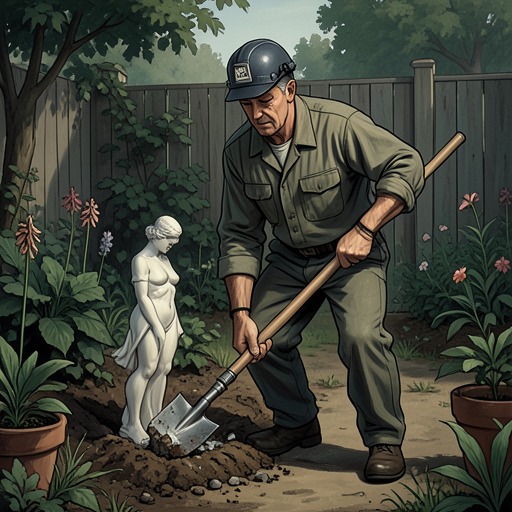
The narrative moves back to Kostas at work during a winter with little rain. The hard ground takes longer than usual to dig, but he is glad to be outside at twilight, as the sun sets and the moon rises over the hills. Cypresses stand out against the slopes. He has been digging all day to prepare the soil for planting on a smallholding of several hectares, about half planted with orange and olive trees.
At around eight, ready to stop, he strikes something with his spade. The sound is unlike the familiar metallic knock of metal against flint, a common irritation in rocky ground that requires him to sift out stones. This impact rings out instead as a bright, clear, bell-like note—an unfamiliar sound that catches his attention. The passage makes this interruption the hinge between his known routine and the mystery that surrounds his death: an ordinary day of labor ends not with the usual noise of rocky soil, but with something he has never heard before.
Narrative role
Kostas is introduced through the gap between public certainty and private doubt. The funeral notice records his name and age; neighbors supply a picture of health and diligence; the tavern conversation raises questions without resolving them. The shift to his final evening narrows that uncertainty to a concrete moment in the earth. His story begins with a death the village cannot explain, then reaches backward to the unusual sound that broke into his work, making the smallholding both the setting of his daily life and the threshold of the unanswered events that follow.