Leonidas
Cartes Postales from GreeceLeonidas is Giorgos Ziras’s schoolfriend, enduring ally, and the one person whose faith in him survives the town’s verdict after Mihalis Nikopoulos vanishes. His loyalty is made visible in two encounters years apart: first, when he helps Giorgos out of the sea after the Theophany swim; later, when he meets his still-isolated friend amid the crowd at the same ceremony. Between those scenes, Leonidas’s refusal to accept gossip as proof gives Giorgos a human connection when the rest of the community has turned suspicion into certainty.
Identity and Introduction
Leonidas is a local lawyer and a former participant in the Theophany cross-diving ceremony. When a visiting narrator asks what is happening at the water, Leonidas’s wife directs the question to him: he had taken part when he was young. He recalls that he competed only once, and that his best friend from school, Giorgos, joined him. The ritual thus carries a personal history for Leonidas, not merely the spectacle of a cross thrown into the sea and young men diving after it.
The narrator first encounters Leonidas beside his wife, Dora, a retired teacher. Their easy teasing and affection make them seem like equals, with a love that remains alive. Dora gently restrains him when he starts to tell Giorgos’s story, asking whether he has to tell it; Leonidas insists that it has a happy ending, “one way and another.” His warmth and his readiness to tell the story establish him as both a witness to the past and a keeper of its local memory.
Friendship and the Disappearance
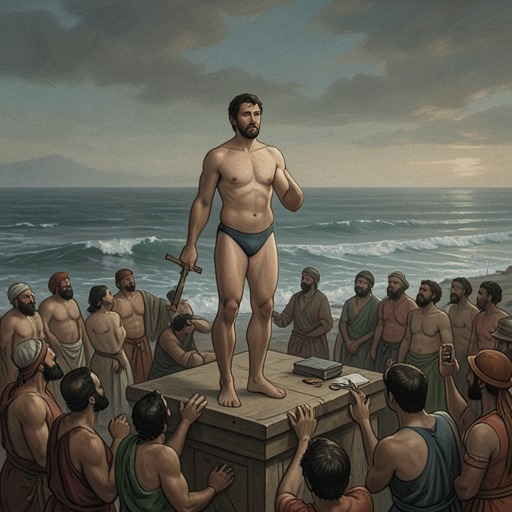
On 6 January 2010, Giorgos retrieves the cross from the water, although the other swimmers and the town have not expected him to win. When he reaches the platform, Leonidas is there with an outstretched hand. Giorgos is exhausted and weak as he struggles out of the sea; his mother waits with a towel. In the confusion that follows, the crowd notices that Mihalis is missing. Leonidas’s presence at Giorgos’s side becomes part of the last public moment before the disappearance changes the meaning of their shared sporting past.
The police question the people present, and Giorgos is questioned last. Although Mihalis has been associated with local crimes, and witnesses to a fatal armed robbery have mentioned a third man, suspicion settles on Giorgos. The town recasts the unexpected victory as evidence that he was a ruthless competitor who might do anything to win. With no body and no evidence, he cannot be formally charged, yet the community treats its conclusion as settled. Leonidas rejects that social verdict. He tells Giorgos, “What people don’t want to hear, they won’t listen to,” naming the refusal that keeps rumor in place even when proof is absent.
Loyalty Amid Isolation
Giorgos cannot bring himself to leave town, because fleeing would look like an admission of guilt and would mean beginning elsewhere without family, friends, or a past. The suspicion reaches so far that he begins to wonder whether he is guilty in some way. His life contracts: he is dropped from the team when it can no longer hold together without the support of its other members, while his former teammates go on to success at national championships and three later compete in the Olympic Games.
Leonidas’s confidence matters against this accumulating exclusion. He remains Giorgos’s loyal schoolfriend and never doubts his innocence, even when the town’s account has become more powerful than the lack of evidence. Giorgos finds work at a feta-packing and export company an hour’s drive away, continues living with his mother, and avoids the town centre. From April through October he stops after work to swim alone on a deserted, inaccessible beach; in winter he goes straight home. Leonidas cannot undo the public consequences of the accusation, but his steadfastness means Giorgos is not entirely without a witness who remembers him differently.
The 2016 Encounter
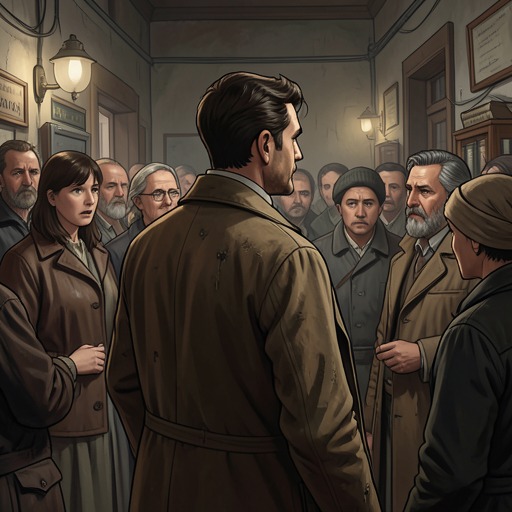
At the next Theophany scene, the crowd is larger than before, and the priests’ words carry over loudspeakers. Before the cross is thrown, Giorgos notices a man in a dark blue cap and semi-opaque sunglasses. A dolphin tattoo shows above the collar of the man’s cheap leather jacket; his head is nearly bald. The resemblance and altered bulk make Giorgos fear that the stranger may be Mihalis. His instinct is to get away, and his legs shake as he tries to create distance.
Leonidas meets him among the few people with whom Giorgos still communicates. He notices that his friend’s face has lost its color, asks whether he is all right, and touches his elbow. Giorgos answers that things are the same as ever, then asks about Leonidas’s children and grandchildren. Their exchange is restrained, but its familiar concern stands against the old accusation that has defined Giorgos’s public life.
Leonidas then mentions that he has seen a notice: Mihalis’s father’s funeral is that afternoon. Giorgos understands the implication. Mihalis has returned for the funeral and must therefore be alive; he had been present at the ceremony but discreetly remained in the shadows. The recognition breaks through Giorgos’s composure, and tears run down his face. Leonidas is baffled by his friend’s grief at the death of the Nikopoulos father. He does not yet understand that the small piece of information he has passed on has confirmed what the sight of the capped man suggested.
Narrative Role and Significance
Leonidas links the two Theophany scenes and helps turn a public ritual into the frame for a private recognition. In 2010, his hand helps Giorgos out of the water just after the victory that will be used to make him suspect. Years later, his concern and casual mention of a funeral help Giorgos identify the man whose disappearance ruined his life. Leonidas does not solve the mystery through investigation; he offers companionship, remembers the friendship beneath the accusation, and supplies an ordinary fact whose consequence is extraordinary for Giorgos.
His role also sharpens the contrast between evidence and communal belief. The town’s certainty has no body or proof behind it, while Leonidas’s trust persists through the years in which Giorgos is isolated and publicly discredited. At the 2016 meeting, Leonidas still does not know why his friend is crying, so his loyalty is not presented as complete understanding. Its force lies instead in his continued presence: he asks after Giorgos, notices his distress, and remains beside him while the past comes back into view.