Lord Byron
Cartes Postales from GreeceLord Byron is both a public symbol of Greek liberation and a man whose longing for love outlasts its power to console him. In Messolonghi, his arrival is greeted as a possible turning point in the struggle against Turkish occupation; within months, his death leaves the city in mourning and Despina bereft of the person who had become the focus of her life. The narrative places the celebrated poet between these two forms of devotion: the crowd’s adoration of him and his own repeated pursuit of love that is not returned.
Identity and Purpose
At the time of the events in Messolonghi, Lord Byron is an English aristocrat living in self-imposed exile. A long-standing philhellene, he has come to regard support for Greece’s liberation from Turkish occupation as his life’s mission. His commitment is political as well as emotional: he believes Greece, the birthplace of the very notion of democracy, has a right to an independent future and its oppressed people a right to freedom.
His support is material, not merely symbolic. He has contributed a substantial sum to the armed forces, much of it drawn from the earnings of his bestselling poetry, and has backed Alexandros Mavrokordatos, Commander-in-Chief and Governor of Western Greece. Byron considers Mavrokordatos the most stable of the Greek leaders; his successful resistance to the earlier siege of Messolonghi has also made him popular. For a city still threatened by nearby Turkish troops, the prospect of Byron’s arrival therefore carries practical hopes as well as the glamour of his name.
Public Image and Arrival in Messolonghi
Before Byron appears, news of his expected arrival circulates through a city already crowded with hungry, underpaid Suliote soldiers and unsettled by the recent presence of Turkish forces. Mavrokordatos actively spreads the news and writes to Byron in extravagant terms, encouraging the self-importance that the welcome will soon reinforce. The townspeople are prepared to see the English poet not only as a benefactor but perhaps as the man who might save Greece.
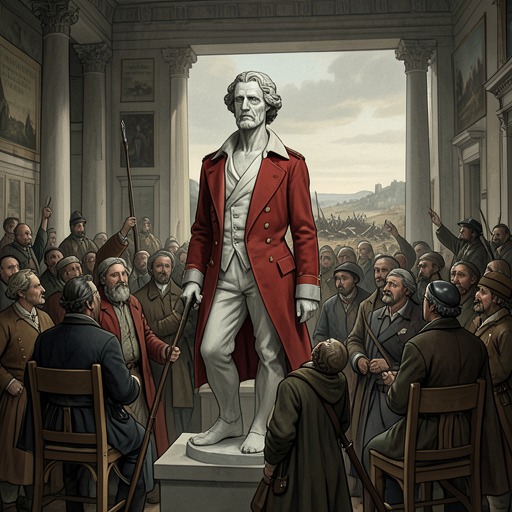
One day in early January, a vast crowd gathers at the quayside. Townspeople, merchants, governing officers, priests, and soldiers wait together; muskets are fired into the air and artillery salutes greet Byron as he steps off the boat. Despite an exhausting journey and feeling ill, he observes the formalities graciously, receiving speeches and applause. The event gives his political purpose a public stage: the money he has brought and the cause he represents are concentrated in the figure welcomed from the boat.
That figure is also carefully fashioned for attention. Byron is accustomed to being watched and welcomes the adulation, making an impression through elaborate dress, exotic headdresses, and extravagant helmets styled after ancient Greek warriors. Yet his appetite is not simply for the crowd’s general admiration. He likes to find an individual within it and direct his attention there, turning public celebrity into a more intimate encounter. The narrative presents this habit as part of his need to have an object for his love, without which he does not feel fully alive.
Despina and the Returned Look
Among the spectators is Despina, watching from the area reserved for women with her mother and sister. Their position in the crowd gives them little view, and they crane their necks to catch sight of the procession. Byron’s gaze eventually meets Despina’s. He looks at her with a curiosity the narrative describes as lascivious and does not conceal; she, in turn, meets his eyes rather than looking away. His eyes become the focus of her sudden fascination, and the moment’s intensity overwhelms her attention to the ceremony around them.
As Byron’s party moves on, he glances back at Despina. He expects her still to be looking, and her fixed, dark gaze strikes him like an electric shock, continuing to burn at the back of his neck as he walks away. The account treats this look as a possible turning point, though it leaves open whether it truly began Byron’s end. For Despina, the consequences are more immediate and clear: she cannot put him out of her mind, and for days she is unable to sleep or eat. She waits at her window for another sighting, once glimpsing him on horseback, while rumours that illness has confined him to bed keep her awake. Their encounter is therefore unequal in duration and consequence: a charged moment for Byron becomes an consuming, childish crush for Despina.
Illness, Death, and Retrospective Meaning
By April, Byron is gravely ill and delirious. The day before his death, Despina is already in a state of agitation as violent rain and a storm unsettle the city; the following day, the announcement of his death shocks Messolonghi. For Despina, who has never known such loss, the news brings an emptiness out of proportion to the briefness of their contact. She sees him for the third time lying in a coffin in the church of Agios Nikolaos. The crowds remain, but their purpose has reversed: they no longer gather to celebrate his arrival, and his closed eyes can no longer charm them.
The city’s grief takes civic form. Guns are fired from the fortress, Easter Week celebrations are cancelled, shops and public offices close, and three weeks of mourning are declared. Torrential rain postpones the funeral; when it proceeds the next day, thousands line the streets to say farewell. Byron’s death thus changes the meaning of the public welcome. The hoped-for saviour becomes a lost benefactor, and the mass attention once drawn to his arrival is redirected into mourning.
A later retrospective passage complicates this public image with an account of private sorrow. The narrator recalls that Byron’s deepest emotions were often directed toward men who did not return his love, and that his final months were marked by a desperate, unrequited passion for a teenage boy. In January 1824, Byron wrote a final poem about a heart no longer able to move others, while still insisting on its capacity to love; he died three months later. The narrator wonders whether heartbreak weakened him, but does not claim it caused his death. What the account does establish is the unhappiness of a man celebrated for his power to attract love yet unable to secure the love he most wanted. That contrast recasts his magnetism: the crowd’s devotion cannot answer the private longing concealed behind it.