Magda
Cartes Postales from GreeceMagda’s brief connection with the traveling violinist Antoni gives her a rare experience of being moved and met through music, without turning a transient encounter into a promise of permanent love. In Kalamata, she is both conspicuous and isolated: men admire her beauty, while the circumstances of her broken engagement have marked her as a spinster. Her response to Antoni’s playing, and the violin string she keeps afterward, make the encounter significant not because it changes her life’s setting but because she can treasure its happiness on its own terms.
Identity and Social Position
Magda is one of the few unmarried women her age in Kalamata. Both her parents have died, and she lives alone above the family shop, which sells knitting wool, ribbon, and thread. She was once engaged, but the wedding was called off when it became clear that she could not have children. The town calls her the yerontokori, or spinster, making her social identity hinge on an unrealized marriage and her inability to bear children.
That label sits beside a very different public reputation. The narrative describes Magda as the most beautiful woman in Kalamata and as the object of intense male desire, emphasizing her glossy hair, full lips, and ample breasts. Her beauty does not spare her from isolation: married women regard her with suspicion, and few invite her to join them. She is visible to the town, but not necessarily welcomed by its women.
A Familiar Walk, Taken Alone
Magda often walks from the family shop in the old part of town, through the main square, and onward to the sea. Men at the cafés greet her with wolf whistles and catcalls. These are presented as appreciative rather than hostile, and most of the men are people she knows. Still, their attention fixes on her body: her breasts press against her blouse, whose buttons seem unable to contain them, and she is resigned to being noticed in this way.
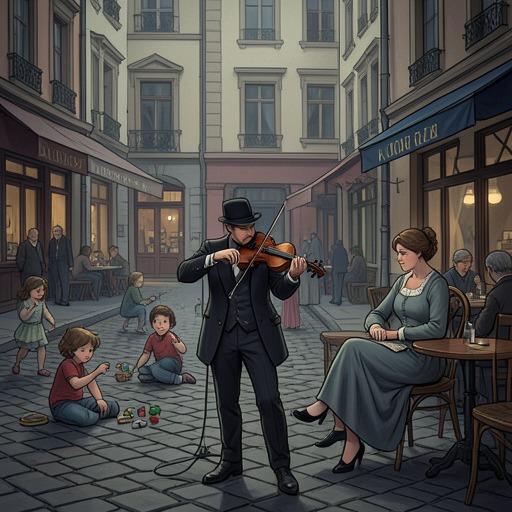
On the evening of her encounter with Antoni, the bitter-orange trees along the street are heavy with bright fruit. Magda reaches the port by the road beside the sea, where lively cafés face the water. She always goes to the café owned by her cousin Andreas, sits outside, and lights a cigarette. The port is otherwise quiet: the water is still, the concrete waterfront nearly deserted, and a few people wait in the distance to unload and reload a boat. Nearby warehouses hold crates of dried fruit for shipment and large drums of olive oil. Against this working harbor, Magda is sitting alone when a single sustained violin note breaks the silence.
The Music and the Meeting
The violin is unfamiliar to Magda, whose musical knowledge is rooted in the bouzouki, the baglama, and the dancing steps of the Kalamatianos. She is immediately captivated. Closing her eyes, she listens not only to each note but also to the spaces between them. The response registers first in her body: the hairs on her arms rise, her eyes prick, her throat tightens, and her neck flushes. She tries to dab away the tears with a paper napkin, but they keep falling.
The music also alters the public space around her. People toss coins into Antoni’s violin case, and the crowd grows until the cafés are full and no seats remain. The performance is unusual in a town where nothing is free; listeners are responding not only to the playing but to its effect on them. At times, the violin seems to carry more than one musical line, and its sound travels across the waterfront even when it seems to whisper. Near eleven thirty, the last note ends. Applause continues as Antoni puts the violin away and loosens his bow. The only spare chair on the seafront is at Magda’s table, so he sits opposite her while the clapping carries on.
When Magda tells him that the audience loved him, Antoni taps his case and answers that the listeners love what they have heard there. The exchange makes the instrument, rather than either person’s declaration, the center of their meeting. Yet the narrator notes that Magda is speaking for herself as well: the performance has reached her with unusual force.
Learning to Play and Exchanging Gifts
Antoni later takes the violin from its red velvet bed in the case and tunes it with small adjustments to the pegs. Magda watches the carving on the scroll. He moves her hair aside, sets the instrument beneath her chin, positions her left hand to support it, and guides the fingers of her right hand along the bow. He then helps her move her elbow so she can feel the bow glide across the steel string. People nearby watch as the note rings out.
The lesson turns her from listener into participant, however briefly. The instrument that had carried an unfamiliar sound across the port now rests against her body, and she produces a note with Antoni’s help. Later, Andreas notices a length of what looks like silver wire coiled around Magda’s wrist. She explains that she and Antoni exchanged gifts: the wire is the violin’s G string. When Andreas asks what she gave Antoni, she smiles enigmatically and resumes her tune; the narrative does not disclose her answer.
A Happiness Kept Without a Promise
The narrator presents the encounter as a connection between two people that made them happy for one night. He allows that Antoni may have been drawn to other listeners whose openness to music resembled Magda’s, while making clear that this is conjecture, not a confirmed account of Antoni’s relationships. What the narrator is certain of is that Magda was not the only person on Antoni’s route to be seduced by the sound of his Stradivarius. The passage therefore leaves the encounter intimate but not exclusive, and its significance does not depend on proving that it became a lasting romance.
The G string gives Magda something material to retain from the evening. The narrator imagines her wearing it around her wrist for the rest of her life because metal will endure, and understands her as joyful about the experience rather than regretful that it was brief. That reading distinguishes her response from the narrator’s own grief and regret: he recalls avoiding music because it stirred painful feelings, then downloading Bach sonatas, including Air on a G String, after hearing the story of Antoni and Magda. Her keepsake is thus both a token of a particular encounter and a counterpoint to sorrow. Magda does not need the night to last in order for its happiness to remain hers.