Manos and Stephanos Papazoglou
Cartes Postales from GreeceManos and Stephanos Papazoglou’s relationship is transformed from habitual sibling bickering into a contest for their father’s hotel empire, and their rival approaches to business end in shared ruin. The competition is meant to determine which son deserves to inherit; instead, it exposes how little either has learned about responsibility, while the consequences of their decisions fall on hotel guests, workers, families, and their father, Apostolos Papazoglou.
Brothers Raised for an Inheritance
By their twenties, Manos and Stephanos had spent a decade of summers at beach resorts belonging to their father’s luxury-hotel brand. Room service and Coca-Cola were part of their upbringing; neither had ever made a bed. Their childhood was far removed from the family’s earlier circumstances, when they had shared a divan in a one-bedroom apartment in Patras. Their mother, Melina Papazoglou, had praised them even when they did poorly at school, while Apostolos was absorbed in building his business. The brothers’ entitlement is presented as the product of that indulgence and neglect, not simply as an innate defect. In the present, they bicker constantly, and their father sees no reason to hand the business automatically to the elder son.
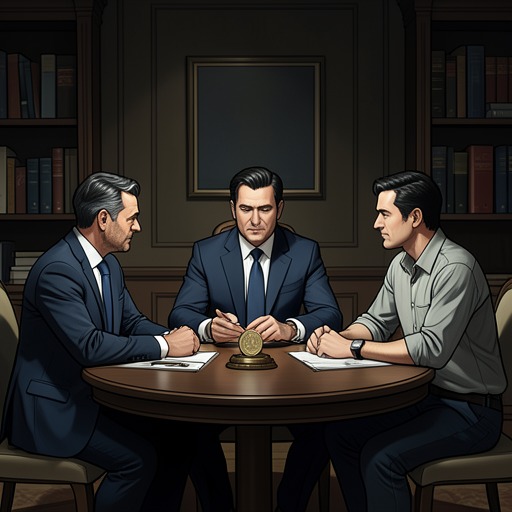
As Apostolos approached his seventy-fifth birthday, he wanted to retire without dividing the hotel group. He privately thought Stephanos more charming and better suited to lead it, but did not want to choose on that preference alone. Melina proposed a test of business ability, and Apostolos accepted. On 13 October, at a family birthday dinner, he announced that he would let a coin decide which undeveloped Patras site each son received. The more successful hotel, judged by the brothers’ balance sheets after two years, would earn its owner control of the entire empire. The result sent Manos to the plot near the busy port and Stephanos to the sandy beach site.
The decision overturned what both sons had assumed: each had expected eventually to receive half the business. They had left school at sixteen and pursued no further study, in part because they believed their wealthy father had already secured their futures. Now the promised inheritance had become an all-or-nothing contest between brothers. Their differences, already a source of jealousy and irritation, acquired a financial measure and a deadline.
Two Hotels, Two Strategies
Manos chose not to depend mainly on seasonal tourists. He aimed to attract businesspeople, commercial travellers, and dock workers, hoping to make money throughout the year. On his site stood a vast, empty office block; converting it was quicker and cheaper than demolishing it. He imagined the new hotel as a medieval castle, inspired by a childhood visit to the old castle at Nafplio, and named it Hotel Pyrgos. Its solid exterior, luxurious ground-floor rooms, gambling room, and deliberately suggestive reproductions of Botticelli paintings were part of a bid to offer a more sophisticated attraction in a workaday town.
Stephanos’s choice suited both his enthusiasm for swimming and his advantages as a sporting, physically confident young man. He began building the Thalassa from scratch, with only a little over six months to prepare for summer. Rather than imitate the castle-like ambition of his brother’s hotel, he used the plain, unadorned model that had first inspired Apostolos: simple rooms facing the sea. The speed and low cost of construction helped his accounts, but the foundations were shallow and the walls little more than a single sheet of plywood. The brothers’ businesses thus expressed opposing calculations: Manos invested in a year-round establishment with more elaborate facilities, while Stephanos kept construction costs low and relied on a seasonal beach trade.
Their rivalry was made public when Stephanos learned that Manos planned to open Hotel Pyrgos on 29 May and scheduled the Thalassa’s launch for the same day. The two opening parties became a direct comparison between their enterprises: Apostolos went first to Hotel Pyrgos, Melina to the Thalassa, and then the parents exchanged locations. That first summer seemed to vindicate both sons. Their profit margins impressed Apostolos, who, relieved by the figures, did not examine the businesses more deeply. The apparent success concealed how differently the competition was beginning to turn for each brother.
The Contest Turns Unequal
Manos’s strategy depended on a hotel that could remain profitable beyond the summer season, but its operations became vulnerable to pressure from Giorgos Kourtis, an owner of a rival hotel in the town centre with powerful connections. Kourtis had visited Hotel Pyrgos, including its private gambling room, and Manos understood that the rival was losing business to him. A few months after the opening, the hotel’s electricity was cut off despite there being no fault in its system. Reconnection required five million drachmas. The same happened to the water supply, with another demand for payment. Manos came to recognize these interruptions and charges as extortion, and believed Kourtis was directing the troubles.
Police searches compounded the pressure. Officers repeatedly searched for gambling, found evidence, and appeared to know where to look. Manos concluded that bribes were the only way to prevent further visits and keep the hotel operating. Meanwhile, the costs of extortion and bribery mounted alongside loans taken out to meet them. The balance sheet that would decide the inheritance was no longer a neutral measure of business skill: Manos’s accounts were being shaped by coercive demands, recurring payments, and a hotel whose underlying costs were increasingly difficult to cover.
The building itself made the year-round strategy precarious. In winter, power cuts left rooms unheated; when winds came across the Ionian Sea, indoor temperatures could fall below ten degrees. Condensation damaged the hotel’s Botticelli paintings, guest numbers dropped, and the castle-like Hotel Pyrgos began to deteriorate. Manos’s outgoings exceeded his income, and the approaching October reckoning made the pressure immediate. His debts grew so large that he could not sleep, and stress brought regular asthma attacks. He had gained so much weight that he struggled to reach the second floor, where his office was, and could not afford to repair the lift. His girlfriend, initially drawn to his status as the town’s grandest hotel owner, left after six months.
At the same time, Stephanos’s seasonal model appeared to be succeeding. The Thalassa needed to operate for only six months of the year; guests spent their days on the beach and paid inflated prices for drinks and water-skiing. Its profits depended on offering guests little in the way of construction or accommodation, while generating income from their holiday spending. That success intensified the contrast between the brothers: Manos was struggling to sustain a costly year-round hotel, while Stephanos was earning from a building whose structural weaknesses were invisible in the favorable balance sheet.
Collapse and Shared Consequences
An earthquake measuring 4.3 struck around four in the morning on a warm June night. The Thalassa’s floors shifted, and the hotel collapsed within minutes. Stephanos did not live there; woken by the quake, he ran toward the site but, seeing the building in ruins, fled in the opposite direction. More than two hundred guests had been staying at the hotel. Thirty were killed and about a hundred were wounded. Forensic investigators found that the building had been constructed without regard for guest safety. Families of the dead and injured guests took Stephanos to court for negligence. The contrast with Hotel Pyrgos was stark: it suffered only one cracked window.
The apparently more successful brother was thus confronted with the human cost concealed by cheap construction. Yet Manos’s relative escape from the earthquake’s physical damage did not amount to victory. By the time Stephanos was charged, Hotel Pyrgos had reached its own endpoint: its final guest had departed, its remaining employee had gone unpaid for six months, and Manos accepted that the debts were beyond repayment. A local police officer came to the reception door. Manos recognized the watch Apostolos had given him for his twenty-fifth birthday on the officer’s wrist; Orestes Sakaridis had accepted it instead of money during an earlier visit. The encounter connects the family’s succession contest to the continuing pressure Manos had faced from police and bribes. The two brothers’ crises had become legal as well as financial.
Apostolos’s seventy-seventh birthday, which he had imagined as the day of retirement and succession, instead forced him to choose which son’s trial to attend. Both proceedings were to begin in Athens on the same day, and Melina suggested settling the choice with another coin toss. Seven months later, on 29 May—the anniversary of the rival hotel openings—both brothers were found guilty of manslaughter. Compensation for the injured guests and bereaved families exceeded what the sale of the whole hotel empire could cover, and Apostolos had to declare bankruptcy. Neither son inherited the empire as imagined; the competition consumed it.
Dates, Memory, and the Meaning of Rivalry
The story frames the brothers’ contest through a series of reversals: a coin intended to make succession fair assigns the plots, a promising first summer masks diverging risks, and the date of the shared opening returns for the verdicts. The birthday coin toss took place on the thirteenth, a date the restaurant staff regarded as unlucky. They associated the number with 1453, whose digits add to thirteen. Later, people in Patras remembered both the choice of date and the brothers’ launch day. For years, the ruined hotels remained as reminders, and older residents treated the disaster as a lesson in the force of superstition and religious belief.
The brothers’ rivalry begins as an inheritance dispute between men who expect wealth without having earned responsibility. Their father’s test gives the contest a clear financial standard, but the outcomes expose what that standard cannot measure: the safety of guests, the durability of a building, or the costs of corruption and coercion. Manos’s more ambitious hotel is wrecked by extortion, bribery, debt, and seasonality; Stephanos’s profitable beach hotel collapses because its construction sacrifices safety. Their opposing business models do not produce a winner. The final result is a shared trial, the loss of the hotels, and the bankruptcy of the family enterprise they had competed to inherit.