Mihalis Nikopoulos
Cartes Postales from GreeceMihalis Nikopoulos is the veteran captain and former backbone of his town’s water-polo squad whose disappearance during the annual Theophany cross-diving ritual turns a sporting rivalry into a lasting public suspicion. For three days the community searches for his body, but finds nothing; years later, Giorgos Ziras recognizes him alive, a revelation that changes the meaning of the disappearance without resolving its circumstances.
Identity and Standing
For a decade, Mihalis had been central to the town’s water-polo team: its captain and highest-ever goal-scorer. His place in the squad carried unusual social prestige. The team’s selected swimmers were granted privileges, including the chance to dive for the cross at the Theophany ceremony, and their status in town could exceed that of council members or police officers. Mihalis was not simply an athlete in this setting; he was an established local figure whose sporting record and authority had become part of the town’s public life.
That standing did not make him secure in the team. The arrival of a new member generally meant that an existing player would soon leave, and the coach had decided Mihalis would not be needed for the coming season. The decision came after ten years as captain and after a decade of serving as the team’s backbone. The coach told him bluntly that he could make one final attempt to retrieve the cross, but that his captaincy would end in the summer. Mihalis showed no emotion at the dismissal. Beneath that composure, however, the narration presents anger accumulating like a bomb beginning to tick.
Rivalry with Giorgos Ziras
The player taking Mihalis’s place was Giorgos Ziras, younger and new to the team, though he had trained alongside its members for a long time. The coach valued Giorgos’s speed and agility in the water. Mihalis possessed formidable strength, compared in the narrative to a small speedboat, but his fouls were costing the team points and made him a liability. Their competition thus arose from both a personal displacement and a practical change in what the team valued: Giorgos’s quickness won him selection, while Mihalis’s force could no longer compensate for his penalties.
The rivalry had already become bitter. Once the coach began choosing Giorgos for important games, the other players’ resentment of him became evident. Mihalis had turned much of the squad against the younger man, and their hostility was visible both in and out of the water. Giorgos had also outperformed Mihalis in goal-scoring the previous season. By the time of the cross-diving ceremony, the conflict was therefore public knowledge, not a private disagreement between two athletes. That context makes the disappearance immediately dangerous for Giorgos: he is the rival who has replaced Mihalis, and the last person known to have seen him below the surface.
The Cross and the Disappearance
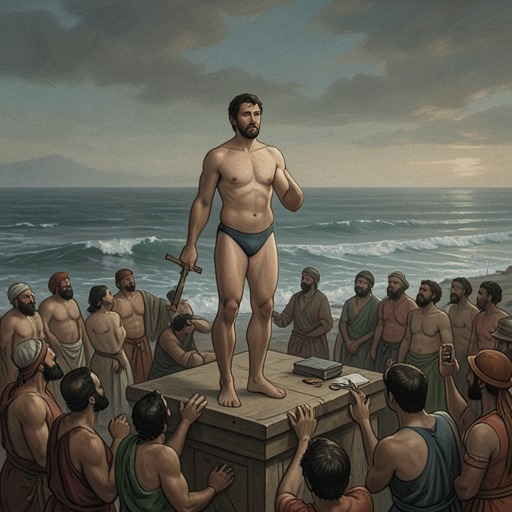
At the January ceremony, the swimmers wait beneath an arch of palm fronds before diving into the sea for the priest’s cross. Mihalis stands apart from the joking and mock-fighting of the other competitors, looking down into the water. When he lifts his eyes and fixes Giorgos with a penetrating stare, Giorgos experiences the force of his hatred and turns away. The exchange gives the impending dive an atmosphere of menace before either man enters the water.
Under the surface, Giorgos loses his goggles amid the crowded, opaque green water. He continues diving after the other swimmers begin to surface, spots a glint of the cross, and sees that one swimmer remains below: Mihalis, identifiable by the gold chain at his neck and the row of dolphin tattoos along his back and neck. Giorgos approaches; Mihalis swims away. Giorgos assumes he is going up for air and sees a brief chance to reach the cross. Finding it wedged beneath a rock, he shifts the rock, frees the cross, and rises with it held above his head. The account establishes Mihalis’s movement away from Giorgos, but does not explain why he swims off or what happens to him afterward.
When Giorgos reaches the platform, Mihalis is missing. Other swimmers dive back into the water, boats circle, and Mihalis’s mother and sisters wail as the search begins. Giorgos replays the last sight of him and remembers that Mihalis swam away rather than toward him. The townspeople nevertheless focus on the rivalry. They ask whether Mihalis had reached the cross first, and suspicion gathers around Giorgos, who had displaced the older, stronger player and was the last person to see him.
Search, Suspicion, and Return
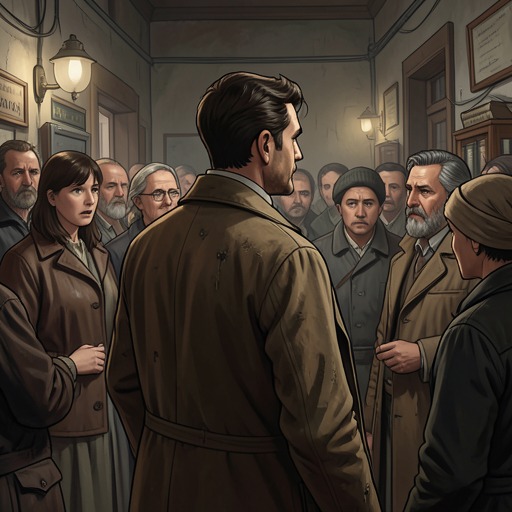
Residents search for three days, patrolling nearby beaches in case currents have carried Mihalis north. No body is found. Without a body, there is no funeral and no finality; the disappearance remains an open wound rather than a confirmed death. Mihalis’s father makes clear in the local kafenion whom he suspects. Although the police speak to everyone and question Giorgos last, and although there is gossip connecting Mihalis to local crimes, the community does not want to believe ill of its sporting hero. Instead, it casts Giorgos as a ruthless competitor capable of anything to win. With no body and no evidence, the police cannot arrest or formally charge him, but the town reaches its own judgment.
The suspicion also reshapes Giorgos’s life. He believes leaving town would look like flight and an admission of guilt; without family, friends, or a past elsewhere, he cannot imagine simply beginning again. The accusation becomes difficult even for him to hold at a distance: he starts to wonder whether he is guilty in some way. Mihalis’s absence thus continues to act on the living, while the lack of a confirmed death prevents the story from closing around an answer.
Years later, news of Mihalis’s father’s funeral gives Giorgos a way to understand a man he has seen keeping discreetly to the shadows. He knows beyond doubt that the man is Mihalis and that Mihalis is alive. Giorgos weeps, while Leonidas, his friend, cannot understand why he grieves at the death of the Nikopoulos father. The recognition reverses the apparent outcome of the search: Mihalis had not been found, but he had survived. His return is quiet and concealed, and the evidence does not reveal where he has been, why he disappeared, or whether he intends to rejoin the community. The unresolved gap between his vanishing and recognition keeps the disappearance from becoming a simple drowning story, while exposing how decisively a town’s certainty can precede proof.