Mihalis's Disappearance at the Theophania Ceremony
Cartes Postales from GreeceMihalis's Disappearance at the Theophania Ceremony is the unresolved disappearance of Mihalis Nikopoulos during a late-1970s cross-diving contest. Giorgos Ziras unexpectedly retrieves the cross, but the victory is immediately eclipsed by Mihalis’s absence. With no body and no clear account of what happened, the ceremony’s public contest becomes the source of an accusation that shadows Giorgos for nearly forty years.
The Ceremony and the Contest
The event is recalled against the annual Theophany ceremony, a public gathering shaped by both religious observance and local participation. In 2010, Giorgos stands near a crowded church as priests conduct the liturgy. Children are lifted to kiss an icon, candles burn in the sand, and adolescent boys in orange brocade wait to carry the cross to the sea. Young men gather by the water to compete. The ceremony’s repeated order makes the remembered disappearance feel like a rupture within a familiar communal event.
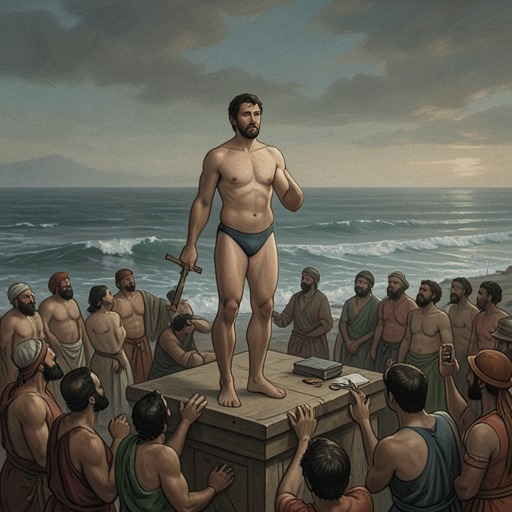
On the earlier occasion, the church was likewise full, and the procession followed the customary pace of the liturgy. Priests, municipal officials, and uniformed representatives moved from the church toward the water, where clergy boarded a small fishing boat. The swimmers waited on a platform. For ten years, Mihalis had won the contest, swimming to retrieve the cross and earning the status of a local hero. Giorgos, who had been displaced from his place in the town’s football team, entered the water with the other competitors, aware of the cold and the pressure to hold his position until the signal.
The priest immersed the cross three times, then released it on the third. That release began the race. Giorgos entered the water amid the crowd of swimmers and lost his goggles, leaving him unable to see clearly in the murky water. He continued below the surface, where he saw Mihalis near the cross. Mihalis swam away from him, and Giorgos took this movement as an opportunity to reach the object.
Giorgos Retrieves the Cross
The cross was caught beneath a rock. The other swimmers had pulled at it but had not tried to move the obstruction. Giorgos stood on the seabed, shifted the rock, freed the cross with his foot, and pulled it upward by its ribbon. He surfaced holding it above his head so that the crowd would see that he had retrieved it. The act made him the winner of a contest that, for a decade, Mihalis had dominated.
The response was not wholly celebratory. Some swimmers embraced Giorgos and kissed him on both cheeks, but he sensed that their congratulations were restrained: he had not been expected to win. He returned toward the boat so the priest could receive the cross, then made his way back to shore. His schoolfriend Leonidas helped him out of the water, and his mother offered him a towel. In the immediate aftermath, the customary recognition of the winner was overtaken by the discovery that someone was missing.
The Search and the Suspicion
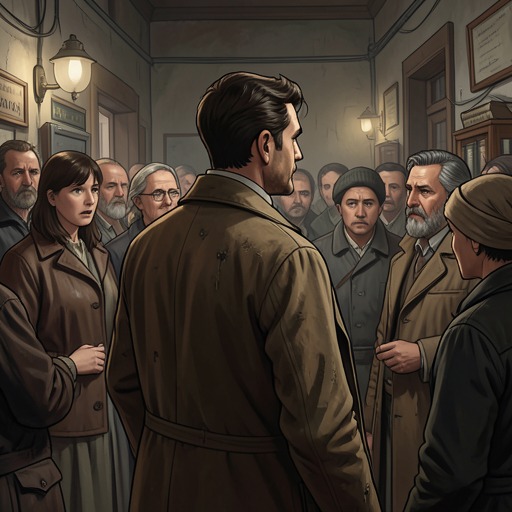
As Giorgos looked around the platform, people began asking where Mihalis was and whether anyone had seen him. Giorgos tried to say that he had seen him in the water, but nobody listened. Several swimmers went back in, while another alerted the priest; other boats circled as people searched the surface. Mihalis’s mother and sisters cried out, and a diver from a nearby town was contacted. Giorgos watched the waves, recalling that Mihalis had swum away from him rather than toward him.
The disappearance was quickly interpreted through the rivalry between the two men. Giorgos and Mihalis had been competitors on the team, and Giorgos had displaced the older, stronger player. Their antagonism had deepened after Giorgos outperformed Mihalis in football the previous season; Mihalis had also turned other team members against Giorgos. Because Giorgos was known to be the last person who had seen Mihalis, the victory that might have established his standing instead gave the community a reason to question him. Rumours that the cross’s winner was chosen in advance had circulated, but Giorgos had dismissed them and believed his swimming ability gave him a genuine chance.
Residents searched for three days, including along nearby beaches where currents might have carried Mihalis. They found nothing. Without a body, there was no funeral and no definitive account of his fate. Mihalis’s father made clear in the local coffeehouse whom he suspected. Police questioned the community and spoke to Giorgos last. Although there was gossip linking Mihalis to local crimes, the town was reluctant to doubt its sporting hero. The investigation also took place amid attention to a mid-December armed robbery in which two men had been killed; Mihalis’s brother and uncle had been caught in the act and were due to face trial, while witnesses had mentioned a third man. Despite this wider context, the community settled on its own judgment of Giorgos as a ruthless competitor capable of anything to win. With neither body nor evidence, he could not be arrested or formally charged, but the suspicion persisted.
The Long Aftermath
Giorgos could not leave town without believing that flight would look like an admission of guilt. He lost his place on the team when the coach dropped him, explaining that the team could not hold together without the full support of its members. His former teammates later achieved national success, and three went on to compete in the Olympic Games. Giorgos took a job packing and exporting feta cheese an hour’s drive away, continued to live with his mother, and avoided the town centre. From spring through autumn, he stopped to swim alone at an isolated beach; in winter, he went straight home.
Three years after Mihalis’s presumed death, a church service drew a congregation as large as the Theophany crowd. Nearly forty years after the disappearance, Giorgos still returned for the ceremony. The swimmers had become children and grandchildren of his generation, while many spectators remained the same. For Giorgos, attending was a way of asserting his innocence on the one day when that assertion seemed to matter. He could not seek forgiveness from the clergy, because he maintained that there was no sin to confess. Yet he continued to feel both guilty and innocent, living under a public judgment unsupported by proof. The missing body leaves the event without a final resolution: the town’s recurring ceremony renews the memory, while Giorgos remains a criminal in the eyes of some without ever having been charged with a crime.