Orestes
Cartes Postales from GreeceOrestes is Costas’s friend and a respected member of the village whose most consequential actions follow Costas’s sudden death beside the Aphrodite sculpture. Faced with the loss of his friend and the prospect that the discovery could disrupt village life, he protects both Costas’s wishes and the secret of the buried artefact. His care is practical rather than ceremonial: he moves the body, conceals the sculpture, arranges the return of a precious fragment, and helps carry Costas home.
Identity and Place in the Village
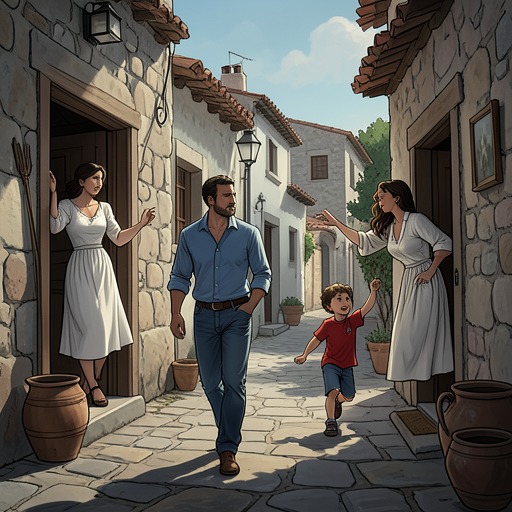
Orestes lives in the village with his wife, Eleni, and is closely connected to its communal life. He and the narrator have spent many hours talking about the power of sculpture, giving Orestes a particular interest in the art that has drawn Costas into an intense attachment. He is also part of the ordinary network of village assistance: after Costas dies, Orestes goes to Stella, consults the doctor, and enlists two other men at the kafenion to help retrieve the body.
The narrator’s account presents Orestes through acts of loyalty rather than a detailed personal history. His friendship with Costas is evident in the care with which he handles the death and in his confidence about what Costas would have wanted. That knowledge gives Orestes a role beyond that of a witness: he becomes the person who can make decisions for his friend when Costas can no longer make them himself.
Costas’s Death and the Hidden Sculpture
By the time Orestes reaches Costas’s kypos, Costas is dead. Orestes sees a smile on his friend’s face and carefully moves the body aside. As he does so, he feels a hard piece of stone in Costas’s top pocket and removes the fragment. He then wraps Costas in the blanket that had been used to protect the Aphrodite sculpture. The sequence binds the two objects of Orestes’s concern together: his friend’s body and the ancient figure that had occupied Costas’s final weeks.
Orestes understands that an archaeological discovery would not necessarily be welcomed by the people who lived around it. He reasons that a sculpture found in a field could bring archaeologists, restrictions on building or farming, and disruption to daily life. The example of the Thessaloniki metro, where suspected ancient remains could make construction take many times longer, gives his concern a concrete precedent. He fears that no one in the village would welcome the excavation, especially when nobody could know what else might lie beneath the ground.
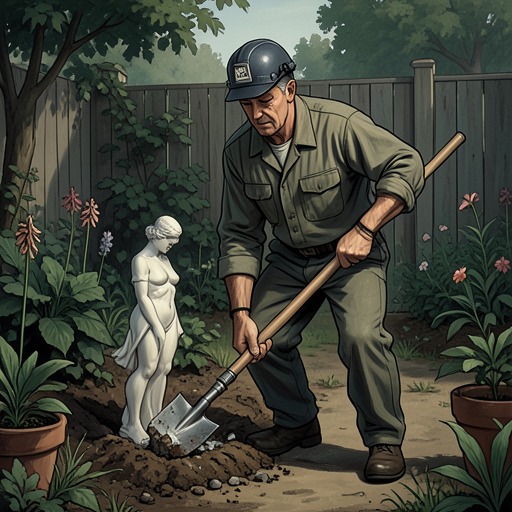
He therefore covers the sculpture again, replacing layers of soil for about an hour and smoothing the ground after building it up slightly higher than before. The concealment is deliberate: Orestes chooses to prevent the discovery from drawing outside attention, rather than risk the consequences he associates with archaeological investigation. His action preserves the village’s immediate quiet, but it also leaves open the possibility that the sculpture—or further remains—may be found by someone else in the future.
Funeral and Loyalty to Costas
After covering the sculpture, Orestes drives at full speed back to the village and visits Stella. She suggests that Costas must have had a heart attack, and the doctor agrees; the account thus gives a likely explanation for the death, not a witnessed diagnosis. Orestes then returns to the practical work of caring for his friend. At the kafenion, he asks two village men to help load a wheelbarrow onto a truck, and together they go to collect Costas’s body.
The funeral is to take place the following day. Before the burial, Orestes plans to visit Costas’s home, where the body will lie in an open casket, and discreetly put the precious Aphrodite fragment into the breast pocket of Costas’s only suit. Orestes is certain that this is what his friend would want. The gesture completes the care begun when he removed the stone from Costas’s pocket: he has kept the fragment safe and intends to return it to Costas in the place where it can accompany him into burial. His actions make friendship a form of stewardship, expressed through quiet decisions rather than public declarations.
Departure and Narrative Role
Orestes also helps shape the narrator’s departure from the village. After almost two months there, the narrator feels obliged to move on, despite the protests of Orestes and Eleni. Eleni tries to arrange an introduction to her unmarried niece, while the narrator explains that another relationship is not wanted and that more of Greece remains to be seen. When an old poster in the taverna prompts the suggestion of a monastery perched on natural rock, Orestes uncharacteristically agrees with Eleni that the journey is worthwhile.
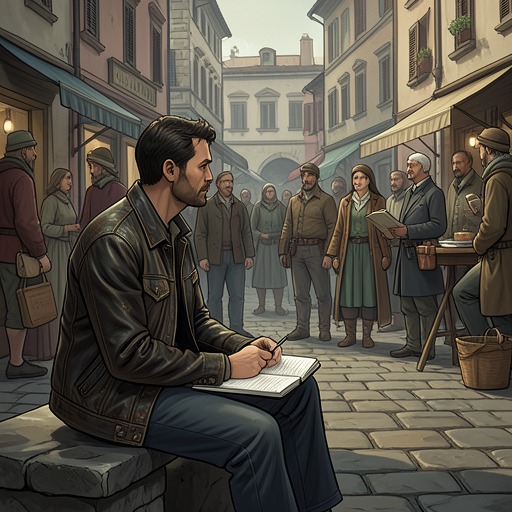
The narrator leaves with sadness, promising to return and bring Orestes a copy of the book in progress. The promise follows their many conversations about sculpture and gives their friendship a future-facing note, even as the narrator’s stay ends. Orestes’s care for Costas and his encouragement of the narrator’s onward journey reveal different forms of attachment: he remains to tend to the obligations of village life, while helping a visitor continue beyond it. Through him, the narrative sets the preservation of a private friendship against the uncertain public consequences of uncovering the past.