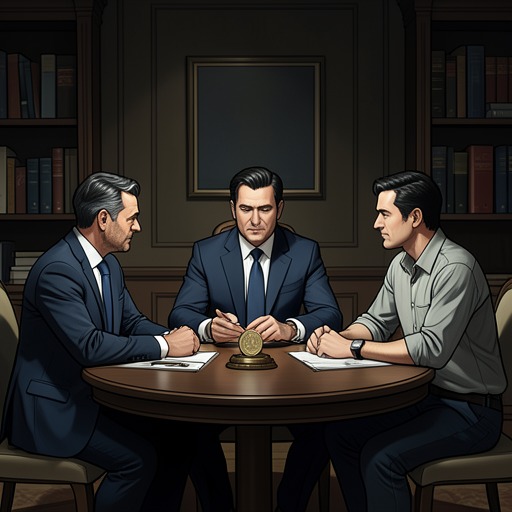
Orestes Sakaridis
Cartes Postales from GreeceOrestes Sakaridis is a local police officer whose repeated visits to the failing Hotel Pyrgos end in his death after Manos Papazoglou attacks him. The narrative gives him no private history or interior perspective: he emerges through a recurring transaction, a watch accepted in place of money, and the fatal confrontation that turns Manos’s financial desperation into a manslaughter case. His brief presence marks the point where the hotel’s collapse becomes bodily and irreversible.
Identity and Role
Orestes is identified as a local officer, and as the same policeman who had been coming to Hotel Pyrgos regularly over the preceding months. The story does not explain his official duties or describe any investigation into the hotel. Instead, his repeated arrival at the reception door, and his expectation of receiving “The usual,” frame the visits as an ongoing demand for payment. The scene strongly suggests a corrupt or coercive arrangement, although its precise terms are not spelled out.
That limited presentation matters. Orestes is not introduced through biography or a stated motive, but through the routine he shares with Manos: he comes to the hotel, waits at the door, and expects something from a proprietor who has run out of money. His role is defined by this repeated encounter and by the authority he carries as a police officer. The narrative leaves the reader to infer the nature of the exchange from the circumstances rather than supplying a full account of it.
The Watch and the Final Visit
During an earlier visit, when Manos was already out of funds, Orestes accepted a watch instead of money. The watch had been given to Manos by his father, Apostolos Papazoglou, for his twenty-fifth birthday. On the day of the fatal encounter, Manos spots it on Orestes’s wrist while watching him through a small office window. The object makes the history of their dealings visible: what had once been a birthday gift has become payment in kind, and Orestes arrives again after Manos has nothing left to give.
By then, the hotel is almost empty. Manos’s final guest has departed, and the last remaining staff member has left unpaid for six months. His debts have become unpayable, with interest compounding beyond what he could repay even if the hotel stayed full. In this setting, Orestes’s return is not an isolated visit but the last turn of a pressure that has been building through Manos’s financial collapse. Manos watches him check the time, recognizes the watch, and opens the door in anger.
Orestes can see the anger in Manos’s eyes. When Manos demands to know what he wants, Orestes replies that he thinks Manos knows, and calls it the usual. The exchange is brief, but it confirms the recurring character of their contact. The watch and the phrase together carry the backstory: no extended explanation is needed to show that Orestes expects a familiar payment and that Manos now has nothing left to offer.
Assault and Death
Manos lurches towards Orestes drunkenly, swinging a bottle at his face. Orestes avoids the blow and grabs Manos by the shoulders to restrain him. Manos wrenches one arm free and drives his elbow into Orestes’s stomach with his weight behind it. Orestes is badly winded and falls backwards; the side of his head hits the marble step. He lies very still.
The fall is the decisive change in Orestes’s role. Until that moment, he has arrived as the officer who appears to control the familiar terms of the encounter. After the blow, he is an inert body on the hotel steps. Manos takes several moments to recover his breath, then leaves without touching him. He drives away along the coast road, running red lights and nearly losing control, until a police car forces him to stop. The two officers who arrest Manos smell alcohol on his breath; during the drive they hear over the radio that their colleague’s body has been found at Hotel Pyrgos.
Consequences and Narrative Significance
Orestes’s death links the hotel’s financial ruin to the legal consequences that follow. Manos and his brother Stephanos both face trial, with proceedings beginning on the day Apostolos turns seventy-seven. Instead of the retirement and transfer of the hotel empire that Apostolos had expected, he must choose which son’s trial to attend. The verdicts of manslaughter are delivered in both cases seven months later, on 29 May. The compensation owed to injured guests and bereaved families exceeds what the entire hotel empire can cover, and Apostolos is forced to declare bankruptcy.
The episode gives Orestes a sharply bounded but consequential place in the story. His repeated visits establish a pattern of pressure; the watch fixes that pattern in a concrete object; and the final visit ends in a death that Manos cannot escape by driving away. Orestes is not developed beyond the evidence of those encounters, but their consequences extend far beyond the hotel steps: his death becomes part of the chain of trials, verdicts, and financial ruin that overturns Apostolos’s succession plans.