Panagiotis
Cartes Postales from GreecePanagiotis is a street musician in Thessaloniki whose hand-cranked barrel piano gives him both a livelihood and a durable sense of identity. A childhood encounter with a film shoot turns an ordinary street performance into a vocation; decades later, the coins he has gathered in its name reveal a vast, concealed fortune and bring a tax case that strips him of nearly everything. Even after that reversal, he insists that the instrument is enough to make him an artist.
A childhood encounter with the instrument
Panagiotis’s attachment to the hand-cranked barrel piano began when he was ten, in the early 1950s, as Greece was learning to live in peace again. He and his friends spent their days playing in the streets, disappearing into hide-and-seek and taking over alleys for football. In the summer of 1954, their routine was interrupted by the news that a film crew was shooting nearby. The boys stopped playing and waited on a wall, their legs swinging as they watched.
The crew brought the children into a scene built around the instrument. Panagiotis and a younger boy were filmed turning its handle before the boys were chased off like street children. During a break, Panagiotis lifted the lid and saw the mechanism inside: a complex coordination of parts that made music. That close look left him spellbound. The instrument’s appeal was not simply the sound it produced; he had seen how its intricate workings could turn a hand’s movement into music.
The film, Laterna, Ftohia kai Filotimo (Laterna, Poverty and Honour), was released the following year and became an enormous success. Its story concerned two itinerants who met a rich girl on the run. Though they could have gained a large ransom by handing her over, they chose to help her instead. In the summer of 1955, Panagiotis went with his parents to an open-air cinema to see the film. The screen transformed familiar Plaka, their neighbourhood, into a glamorised version of itself. When his face appeared, his parents applauded; he blushed with embarrassment and pride.
Asked what he wanted to do when he grew up, Panagiotis did not name acting. He chose the work he had seen at the centre of the scene: playing the barrel piano. His parents had not been hoping for an actor’s career, but he persisted in lobbying his father, telling him that he had settled on his future and that his father need not worry about it. The childhood ambition became the organising principle of his adult life.
The street musician and his public
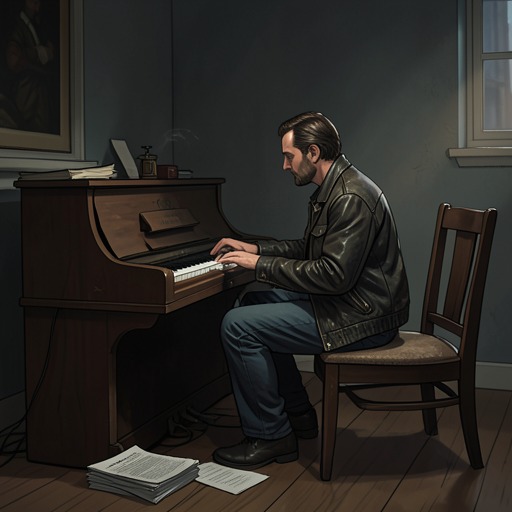
In later years, Panagiotis travelled between Thessaloniki’s old town and new town, its squares and esplanade, trundling his treasured instrument. Some people took his apparent happiness and ease for simplicity. He understood himself differently: as an artist. The coins left in the tambourine at his feet supported his solitary, modest life, while the performance offered passers-by a glimpse of an earlier, remembered world.
The book places him among street sellers whose livelihoods were changing as the city changed. Older people complained that traditions were disappearing and that they no longer recognised their country or the people in it. Panagiotis, by contrast, did not complain. In his view, the public’s wish to recapture the past had not disappeared. What he offered was less a practical commodity than an atmosphere—a memory evoked through music—and people were willing to pay for it.
His performances could briefly gather a crowd. At Aristotelous Square, a group might begin dancing around him, followed by additional rings of dancers until three or four circles formed. The gathering benefited nearby sellers as well as Panagiotis: people bought drinks, chestnuts, seeded bread, and paper tissues. The music thus worked both as an individual performance and as a small social event, drawing people together and stimulating the surrounding street trade.
As the years passed, however, the barrel piano came to be regarded more as an instrument of begging than as a form of culture. Panagiotis continued to think of himself as an artist, and people continued to give him money. To them, the sound recalled innocence; to him, the coins were his due, though he spent only what he needed. His reputation as the happiest man in Thessaloniki rested on this combination of artistic conviction, modest habits, and apparent freedom from the worries that afflicted other street sellers.
The hidden fortune and the tax case
That image changes when Panagiotis returns from a successful evening near the White Tower and finds his door open. An official-looking arrest warrant has been pinned to the frame. He leaves his instrument on the ground floor and climbs the stairs as usual. Inside, the floor is carpeted with coins. He adds that evening’s earnings to the hoard, lights a candle, and crosses the room to fetch water. The coin-covered floor glitters in the candlelight; even as some pieces slip through the floorboards, he makes a note to retrieve them the next morning.
The accumulated money is the result of decades of earnings, not a sudden windfall. A newspaper report describes coins piled almost a metre and a half deep in places, so that one of the taller police officers must stoop to avoid the ceiling. Three police sergeants take two weeks to count the money. Panagiotis has paid no tax for sixty years—not even ten cents. By more or less ignoring what he earned, he has preserved what he regards as a principled poverty, though the honour implied by that ideal has been compromised by the scale and concealment of his savings.
The case also interrupts the practice that defines him. During the long proceedings, Panagiotis cannot bring himself to play, even in the evenings. The euros are held in a bank while the case continues, then diminish as legal fees, tax, and fines are paid. His greatest fear is imprisonment, but the judge decides that a financial penalty is the appropriate punishment. In the end, Panagiotis is left with the hand-cranked barrel piano and little else.
Outside court, dressed in a suit and hat with a carnation in his buttonhole, he maintains that he remains an artist and that the instrument is all he needs. The declaration does not undo the loss of his savings or restore the years of performance suspended by the case. Instead, it defines what the money could not take from him: his sense of vocation. His identity has never depended solely on the wealth he accumulated, even though that wealth had become hidden beneath the image of a life lived on small change.
Bequest and afterlife
A few years later, Panagiotis dies in the bed where he has slept for nearly fifty years. His landlady finds a note directing that the instrument should go to his friend Tassos. She assumes the name belongs to one of the street sellers and finds the right man. The bequest passes on Panagiotis’s working instrument, but not the vocation that had made it his own.
For Tassos, the barrel piano is a step up from selling paper handkerchiefs, not a calling. He does not share Panagiotis’s visceral connection to it and cannot play with the same smile or take listeners back to a lost time. When Tassos later tells the story, a passing Ferrari’s music drowns out the square. His complaint about the old days concerns not only the ready availability of recorded music but also the government’s demand that street vendors pay what they owe. Tassos’s objection echoes Panagiotis’s refusal to regard himself as part of the tax system, while exposing a wider dispute about the obligations and benefits of public life.
Panagiotis’s legacy is therefore both material and unresolved. The instrument survives him and passes to another street seller, but its meaning does not transfer intact. His career had made the past audible to people who wanted to revisit it; Tassos inherits the object without being able to reproduce that effect. The hidden hoard, meanwhile, complicates the image of the contented musician who lived on little. Panagiotis’s story holds those truths together: he lived simply, treasured his art, accumulated a fortune without paying tax, and lost nearly all of it without surrendering his claim to be an artist.