Panagiotis's Tax Evasion Case
Cartes Postales from GreecePanagiotis’s Tax Evasion Case begins with a sharp contrast: the man regarded as one of Thessaloniki’s happiest street sellers has accumulated a fortune in coins while paying no tax for sixty years. The discovery turns his modest life into a public legal case. By its end, the authorities have taken almost everything he saved, and Panagiotis is left with the hand-cranked piano through which he had understood himself as an artist.
The Street Artist and His Private Principle
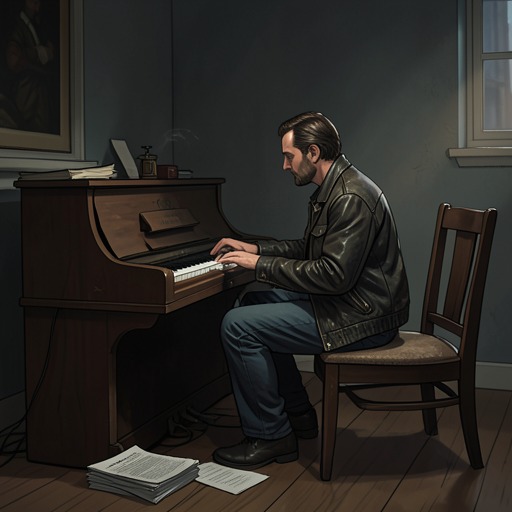
Before the case, Panagiotis played his hand-cranked barrel piano in the streets of Thessaloniki. People gathered around him to dance, sometimes forming several circles, while the crowds also benefited nearby sellers. Though the instrument came to be regarded by some as a form of begging rather than culture, Panagiotis continued to see himself as an artist. People rewarded his playing with coins and notes, and he spent only what he considered necessary for his modest life.
That apparent simplicity concealed an extraordinary accumulation. Panagiotis had kept decades of earnings rather than paying tax—not even ten cents, as the account puts it. He understood this refusal as a way of preserving a principle of noble poverty, although the story distinguishes that ideal from the compromised question of honour. His way of living depended on treating his earnings as if they did not add up to a taxable fortune. The eventual investigation makes the contradiction impossible to ignore: the small change he collected one performance at a time had become millions.
Discovery and Investigation
The change arrives after Panagiotis returns from a successful evening near the White Tower and finds his door open. An official-looking envelope attached to the doorframe is a warrant for his arrest. Inside, he adds that evening’s earnings to the coins covering the floor. In the dimness of his home, the accumulated coins form a glittering pattern overhead; some even slip through the floorboards. What he takes as the continuing storage of his modest daily takings is, in scale, a treasure hoard.
The authorities return the following day with a search warrant, but Panagiotis is already out playing. The scale of the money means that the police will need a truck to remove it, and the court will require it as evidence. A local newspaper reports that the coins are nearly a metre and a half deep in places. One tall officer has to stoop beneath the ceiling, and three police sergeants spend two weeks counting the different denominations. These measurements convert an apparently private habit into a public accounting: the case is not about a handful of missed payments but about a fortune built up over decades.
Court, Penalty, and Loss
The long court case interrupts Panagiotis’s work. While the proceedings continue, he cannot bring himself to play, even in the evenings. His accumulated money is held in a bank, but the sum steadily dwindles as lawyer’s fees, taxes, and fines are paid. The legal process therefore strips away the very reserve that his lifelong practice had created. By the time the case is settled, the hand-cranked piano is all he has left.
Panagiotis had feared imprisonment, but the judge imposes a financial penalty instead. The ruling takes almost all his property without sending him to prison. Its stated logic is that a financial punishment best fits the offence; its practical consequence is that the money which had been hidden in his home is consumed by the costs of the case. The outcome does not erase the distinction between his musical identity and his tax history, but it forces those two parts of his life into direct contact. His private definition of need and poverty could not exempt accumulated earnings from public law.
Aftermath and Significance
Outside court, Panagiotis presents himself as an artist who still has what matters: his instrument. That claim is both resilient and newly exposed. He has lost the hoard and must face the consequences of his long refusal to pay tax, yet the piano remains the object through which he understands his vocation. The episode gives no account of a return to the fortune he once possessed; its ending instead rests on the survival of the instrument after the money is gone.
A few years later, Panagiotis dies in the same bed in which he had slept for nearly fifty years. A note in his room directs that the hand-cranked piano go to his friend Tassos. The bequest carries the instrument beyond the case, but not the particular bond its former owner had with it: Tassos sells paper handkerchiefs and does not play with Panagiotis’s smile or his sense of vocation. Thus the legal case has a consequence beyond the financial penalty. It leaves the instrument intact, while the later transfer reveals that an object can pass to another person without passing on the artist’s way of life. The episode turns on this contrast between what can be counted and seized—coins, taxes, fines—and the personal meaning attached to music, which the judgment cannot itself measure.