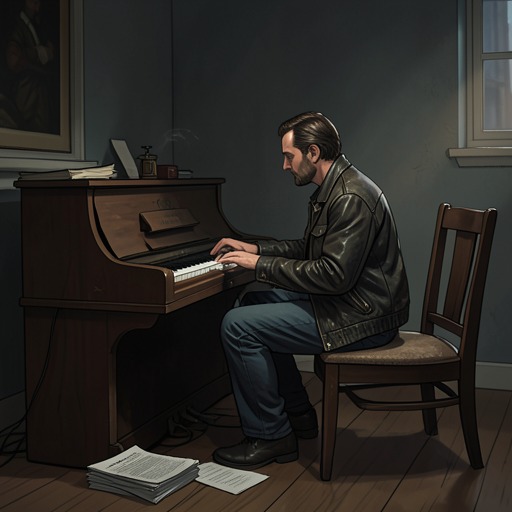
Panagiotis's hand-cranked barrel piano
Cartes Postales from GreecePanagiotis's hand-cranked barrel piano is the instrument through which Panagiotis makes a living, understands himself as an artist, and carries an image of an earlier world into the changing streets of Thessaloniki. Its elaborate mechanism produces music from a turning handle, but its importance exceeds its sound: it draws crowds and coins, preserves a connection to a film that made Panagiotis briefly famous, and remains his sole possession after a long tax case consumes his hoard. When he dies, the instrument passes to Tassos, who can play it but cannot reproduce the personal bond that made it Panagiotis's vocation.
Design and Sound
The laterna is a decorated wooden barrel piano whose music is made by a mechanical sequence hidden inside its case. Turning the handle rotates a wooden cylinder pierced with hundreds of steel pegs. Each peg catches one of a row of spring-loaded hammers, lifting it before it falls back onto a string and sounds a note. The careful coordination of cylinder, pegs, hammers, and strings gives the instrument its distinctive, chiming music. When the narrator hears it in the Ladadika, the sound seems to lie somewhere between piano and stringed instrument, with an occasional bell-like note; it brings on a powerful nostalgia for a time the narrator never experienced.
Tassos explains that laternas had once been ubiquitous, offering one of the earliest mechanical ways to produce music and remaining glamorous and popular for roughly a century. The first were made in Constantinople by an Italian; the name was associated with La Torno, or “the thing that turns.” Production largely ended after the 1950s, and in the present-day streets the instrument has become a rarer sight. Its hand-operated mechanism thus belongs to a musical world increasingly displaced by newer ways of hearing music, even as its sound continues to invite listeners back into the past.
Panagiotis's Discovery and the Film
Panagiotis's attachment to the instrument began when he was ten, in the early 1950s, while he and his friends spent their days playing in the streets of Athens. In the summer of 1954, a film crew arrived in their neighbourhood. After filming a scene, the crew left its equipment behind, including a lavishly painted laterna decorated with flowers and a black-and-white portrait of a glamorous couple. Panagiotis ran to it, touched its sun-warmed wooden case, and turned the handle. The music rang through the narrow street as the boys danced around the machine.
The crew returned and, rather than simply driving the boys away, filmed them gathered around the instrument. For the rest of the afternoon, the scene was shot and reshot, with Panagiotis and another boy turning the handle before the children were chased off like street urchins. During a break, Panagiotis lifted the lid and studied the intricate mechanism, spellbound by how its many small, coordinated actions made music. The film, Laterna, Ftohia kai Filotimo (Laterna, Poverty and Honour), was released the following year and became an enormous success. Its story concerned two itinerants who choose to help a runaway rich girl rather than hand her over for a ransom.
When Panagiotis attended an open-air screening with his parents in 1955, he saw his own neighbourhood of Plaka transformed on screen, its doors, steps, and windows glamorised by their appearance in the film. The portrait on the laterna belonged to the film's romantic stars, Jenny Karezi and Alekos Alexandrakis. The image and the instrument therefore carried a double association: the fictional romance remembered by audiences and Panagiotis's own appearance as one of the boys in the scene. People who stopped to listen came to know that he had been in the film; he became a local celebrity, dressed grandly, and made sure his connection to the screen was known.
A Street Performance and a Living Memory
After a decade on the road, Panagiotis settled in Thessaloniki, where newcomers, tourists, students, and travelling salesmen continually refreshed the potential audience for his music. He rented a small house in the old town, storing the laterna on the ground floor, and played in squares and streets around the city. In Aristotelous Square, his music could gather dancers into several concentric circles. The crowd brought business to other street sellers as well: salep, chestnuts, koulouria, and paper tissues all benefited when people stopped to listen and linger.
The instrument also gave Panagiotis a way to make a living without understanding his work as mere street vending. As older street sellers complained that traditions and familiar ways of life were disappearing, he alone seemed not to complain. Passers-by were drawn by the laterna's suggestion of the black-and-white past, and they dropped coins into the upturned tambourine at his feet. Many regarded Panagiotis as simple for being content to trundle from the old town to the new and from square to esplanade, but he thought of himself as an artist. That conviction sustained him through a solitary life, while the money from the crowds met his modest needs.
Over time, the laterna itself was increasingly treated as an instrument of begging rather than culture. Panagiotis nevertheless continued to regard himself as an artist, and listeners continued to reward the sound because it recalled a lost innocence. He accepted the coins as his due but spent only what he needed. In this arrangement, the piano was at once a working instrument and a meeting point between an individual performer and a public eager to recover the past: the crowds heard more than a tune, while Panagiotis's sense of vocation depended on continuing to play it.
The Tax Case and the Instrument's Inheritance
The laterna's role in Panagiotis's life becomes starkest when an official arrest warrant arrives at his home after a successful evening near the White Tower. Inside, his floor is covered with coins. He tips that day's earnings onto the accumulated money, lights a candle, and crosses the glittering floor to his bed and a cracked mug of water. The scene turns the small change collected in public into a private hoard: individually, many coins could not buy even a koulouri, but together they amount to millions. The instrument that had sustained his austere life had also, through the earnings it produced and the money he kept, brought him into conflict with the tax authorities.
For sixty years Panagiotis had paid no tax, not even ten cents. He considered the neglect of his earnings a way of preserving the principle of noble poverty, though the story makes clear that the claim to honour had become compromised. During the long court case he could not bring himself to play. The money held in a bank dwindled under the costs of legal fees, taxes, and fines. The judge imposed a financial penalty rather than a prison sentence, and the payments took everything from Panagiotis except the laterna. Outside court, still dressed in a hat and suit with a carnation in his buttonhole, he maintained that he was an artist and that the instrument was all he needed.
A few years later, Panagiotis died in the same bed in which he had slept for nearly fifty years. His landlady found a note directing that the laterna should go to his friend Tassos and tracked down the right man among the street sellers. For Tassos, the instrument was an improvement on selling paper handkerchiefs, but it was not a vocation. He lacked Panagiotis's visceral connection to it, did not play with a smile, and could not take listeners back to a lost time. When Tassos tells the story, the laterna is therefore both a working inheritance and the measure of what cannot be inherited: its mechanism and melodies survive, but the performer who joined them to a life, a film memory, and a public's longing is gone.