Peloponnese
Cartes Postales from GreeceThe Peloponnese is where the narrator’s travels in Greece truly begin, but its beauty offers no easy cure for grief. Across the novel, the region exists both as an imagined destination assembled from postcards and as a landscape encountered on the road: lush and historically resonant, yet unable to erase private sorrow or the marks of time. Its most idealised name, Arcadia, makes that tension explicit, bringing the idea of paradise face to face with death.
A place first imagined
Before the narrator travels through the Peloponnese, Ellie encounters its places through postcards signed only with an A. She pins the cards to a corkboard, where their blue-and-white images accumulate into a small map of Greece. Names including Methoni, Nafplio, Olympia, and Sparta give the distant country a growing presence in her life. The cards offer only snapshots, and Ellie knows they cannot convey the country’s sounds or scents; nevertheless, their images make her long to see the places for herself.
When the postcards stop arriving, that accumulated longing helps prompt Ellie to book a flight to Athens and choose a week near Nafplio, a place she recognises from the cards. Her decision is spontaneous, but it has been forming over months. The Peloponnese thus enters the narrative first as a geography of anticipation: a destination whose apparent brightness contrasts with the enclosed, unsatisfying routine of her life in London.
The narrator’s travels and grief
In October 2015, the first-person narrator describes the Peloponnese as the true beginning of his travels. Its fullness and vigorous natural life intensify rather than relieve his pain. The landscape stands in opposition to his mood, and the memories of a lost relationship persist wherever he goes. At a guesthouse in Methoni, his nightmares are severe enough that the owners rush to his room after hearing his cries. Travel gives him distance from home and the possibility of meeting people who do not know his former life, but it does not make grief disappear.
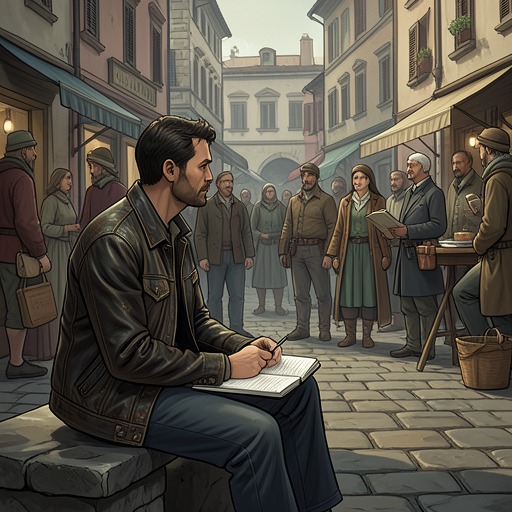
The hosts in Methoni urge him to visit Nafplio. He spends hours there, watching the world pass in its central square, and hears a local story about the Adamakos affair. The account of a man consumed for decades by a broken relationship sharpens the narrator’s reflections on his own loss. Nafplio is therefore more than a stop on his route: a conversation there turns the region’s social stories into a frame through which he considers abandonment, resentment, and the danger of being defined by the past.
Arcadia: ideal and lived landscape
Driving away from Nafplio, the narrator encounters a sign for Arcadia and realises that the name associated with an earthly utopia belongs to an actual region. He recalls the ancient poet Hesiod’s idealised account of Arcadian life as easeful and free from sorrow. The pastoral tradition seems briefly tangible when he sees a shepherd with his flock, whom he imagines in relation to Pan, the mountain god of myth. In this way, the road seems to cross a boundary between the ordinary world and the landscape of classical imagination.
The country he sees is deeply green, with flowering trees, mountains, waterfalls, and slate-roofed cottages on hillsides. Yet an image of Arcadia in a painting by Poussin, which the narrator has seen in the Louvre, brings shepherds gathered around a tomb into his thoughts. The painting’s presence complicates the pastoral ideal: even a landscape imagined as paradise cannot keep death outside it. The narrator recognises that heaven cannot exist on earth, and the region’s beauty prompts him to see how complacent he had been about his relationship and how mistaken his confidence in their shared future was.
He stops in Kosmas, where the square’s stillness unsettles him, and drives on to Tripoli. The movement between villages and towns keeps the region from becoming a single, unchanging idyll. Arcadia remains beautiful in the narrator’s account, but it is no longer simply a mythic refuge; his experience of it carries unease alongside admiration.
Ruins and the passage north
After spending about a week in Kalamata, the narrator travels north toward Patras, stopping at Olympia on the way. Standing on its running track, he imagines the crowd that once watched there. The ancient remains throughout Greece are only fragments of former buildings and monuments, but the narrator also notices a newer generation of ruins: empty, abandoned buildings in towns and villages. Some have been left divided among too many heirs for any one person to take responsibility; others have no explanation he can see. In Patras, an empty hotel becomes the immediate setting for another story told by local residents.
The contrast broadens the Peloponnese beyond the postcard image of blue skies and picturesque places. Ancient ruins register the distance between present and past; derelict modern buildings suggest that decline is not confined to antiquity. The narrator’s route through Methoni, Nafplio, Arcadia, Kosmas, Tripoli, Kalamata, Olympia, and onward to Patras makes the region a landscape of successive encounters, in which beauty remains real but never guarantees happiness, welcome, or permanence.