Preveza
Cartes Postales from GreecePreveza is the setting for a pivotal winter passage in Anthony Brown’s journey: the town’s Theophany celebration brings him into contact with local ritual and a decades-old story of accusation, while its brief warmth and hospitality help loosen the hold of his isolation. First encountered as one of the unfamiliar Greek place names traced on a map beside the postcards, Preveza becomes more than a destination. It is where the journey begins to feel capable of changing its traveller.
Arrival and winter setting
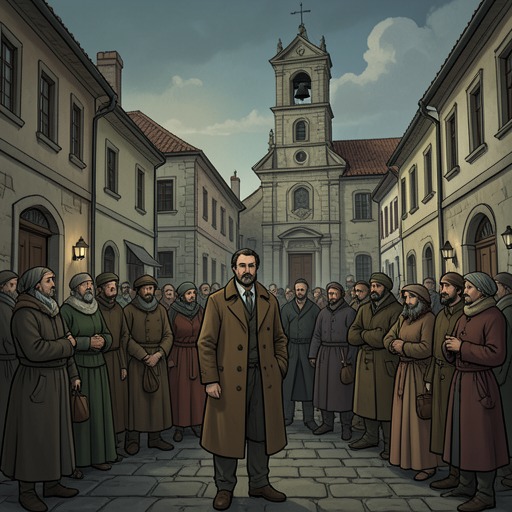
Anthony reaches Preveza late, after leaving Messolonghi and detouring through Arta. At first, the town seems quiet, in keeping with the off-season. The next morning, however, he wakes at dawn to the tolling of bells. When they stop, a priest’s voice carries the liturgy through loudspeakers fixed to the belltower opposite his hotel window. There is no going back to sleep; he dresses, goes downstairs, and walks out into the square.
The church is so full that hundreds of people stand outside, craning to see what is happening within. Looking for coffee, Anthony heads toward the sea and steps from a narrow, shadowed street into an unexpectedly warm west wind. The sea is sparkling in the sunshine. Snow has fallen in much of Greece in the preceding days, but the weather in this small harbor town has suddenly turned mild. Such brief January spells are known as halcyon days: a glimpse of spring that may vanish almost as quickly as it arrives.
The change in weather is matched by a change in the town’s public life. Crowds gather not only at the church but along the water, and people have dressed for the occasion. Some men wear suits, though many have taken off their jackets; the fishermen, by contrast, continue selling the previous night’s catch from their boats. Since 6 January is a public holiday across the country, every café along the seafront is full. The festive congregation and the working harbor occupy the same scene, one animated by ceremony and the other continuing its daily business.
The Theophany celebration
Unable to find a free table, Anthony asks a couple whether he can share theirs. They agree, and he learns that the crowd has gathered for the Theophany, the Greek Orthodox celebration of Christ’s baptism. The woman explains that the priest blesses the water by throwing a cross into the sea, after which boys dive in to retrieve it. She also describes the Kallikantzaroi, goblins said to cause trouble during the Christmas period, and the ceremony’s role in clearing the seas so sailing can begin again. Her husband speaks of the sea as central to Greek life, bound up with the country’s extensive coastline and islands.
The ritual is both religious observance and a public spectacle. As the priest’s words ring out over the water, young men prepare to plunge into the January sea. Anthony is struck by the scene’s scale and physicality: the divers, music, chanting, and congregation make the ceremony feel unusually vivid to a visitor accustomed to less colourful church traditions. His account dwells on the contrast between the cold season and the sight of people entering the sea, and on how strongly the event impresses itself on him.
Leonidas, Giorgos, and a buried accusation
The couple introduce themselves through the story of Leonidas, who once took part in the cross-diving ceremony when he was young. His wife, Dora, is a retired teacher; Leonidas is a local lawyer. Their easy teasing and affectionate familiarity make an immediate impression on Anthony. As the ceremony gathers around them, they point out Leonidas’s old school friend Giorgos Ziras, watching near the water in a black cap. Leonidas begins to explain their shared past, though Dora signals that the story carries painful weight.
The narrative then moves into a scene dated 6 January 2010. Giorgos stands near the church entrance, watching priests in brocade vestments and tall, jewelled hats recite the liturgy. He recognizes two of the older priests as boys he once knew, recalling how little time seems to separate the present from their childhood games. Inside, families kiss icons, lift small children to do the same, and light candles in a tray of sand; the church is crowded with worshippers.
The ceremony thus opens onto a second history: Giorgos’s long life in the shadow of a bad memory and an unspoken accusation, and the reappearance of Mihalis Nikopoulos. For Anthony, learning this story makes the ritual’s language of water and renewal resonate beyond its religious setting. The cross-diving offers a public moment of recovery, while Mihalis’s return gives Giorgos the possibility of renewal after decades of suspicion and silent suffering.
A pause that changes the journey
Anthony stays on in Preveza through the mild early-January days. He eats with Leonidas and Dora each night; Dora’s cooking and attentiveness help him recover weight lost in the weeks after his former partner failed to appear. By the time he leaves, he is beginning to look healthy again. This hospitality is not presented as a cure for grief, but it changes the conditions in which he is travelling: he is no longer simply enduring solitude, and the word alone has begun to lose some of its sting.
The town’s importance also lies in the way it corrects the distance between imagined Greece and lived experience. Postcards had made places such as Preveza alluring names and images, while their pictures could offer only a glimpse of a country’s sounds, scents, and daily life. Here, Anthony encounters a crowded holiday, working fishermen, a local couple’s companionship, and a story whose consequences reach across decades. When he leaves and drives east toward Karpenisi, a wrong turn takes him onto a remote mountain road. The detour continues the change begun in Preveza: he starts to consider that mistakes and apparent setbacks may lead somewhere better, and finds moments of freedom in being alone.