Theophany in the Greek Orthodox Church
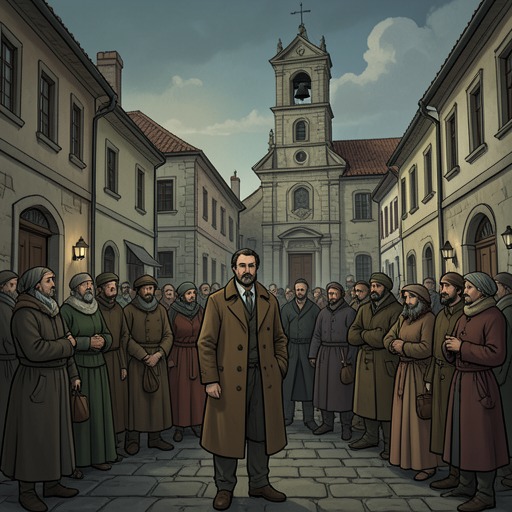
Cartes Postales from GreeceTheophany in the Greek Orthodox Church, celebrated on January 6, becomes in the novel both a public rite and a recurring measure of time. In Preveza, bells, liturgy and a cross cast into the sea draw the town to the waterfront; for Giorgos Ziras, returning to the ceremony decades after Mihalis Nikopoulos disappeared there is also a way to face a community that has long treated him as suspect. The feast’s yearly repetition brings collective celebration and private stigma into the same gathering.
The Feast and Its Meaning
The narrator encounters Theophany in Preveza after arriving late at night, when the town is quiet. At dawn, church bells wake the narrator, followed by a priest broadcasting the liturgy through loudspeakers fixed to the belltower opposite the hotel. The church is packed, with hundreds more outside. On January 6, a public holiday throughout Greece, the seafront cafés are full as residents gather for the ceremony.
A local woman explains that the Greek Orthodox celebration commemorates Christ’s baptism, understood as his first appearance as God. The priest blesses the water by throwing a cross into the sea. She also describes the kallikantzaroi, goblins said to cause trouble during the Christmas period; on Theophany, the seas are cleared of them so sailing can begin again. Her husband links the ceremony to the sea’s importance to Greece, with its coastline and islands.
The day’s weather heightens its sense of seasonal exception. After snow in much of Greece, a warm west wind brings a sudden rise in temperature to the harbour, and sunlight makes the water sparkle. These temporary January spells are known as halcyon days: a glimpse of spring that can vanish quickly. The crowd’s formal clothes, the full cafés and the fishermen continuing to sell their catch from their boats set ritual celebration alongside ordinary work.
The Ceremony at the Water
The rite moves from church to sea in a public procession. Clergy, attendants, the mayor and municipal dignitaries come down from the church with the town band; local army and navy representatives join them, and anyone with a uniform wears it proudly. The priests climb into a small fishing boat, whose precarious load prompts gasps from the crowd. The staging brings religious authority and local civic life together before the swimmers take their place.
The priest holds up the cross, attached to a long ribbon, and immerses it twice before releasing it on the third. That release signals the contenders to dive. The young men race through cold, opaque water to retrieve the cross. The winner receives a special blessing and, beyond that religious distinction, the standing of a local hero. The ritual therefore makes a contest out of participation: the gathered community watches while swimmers risk an uncomfortable, physical plunge for recognition as well as blessing.
In Giorgos’s earlier participation, the competition is disorderly as well as ceremonial. The swimmers jostle for position, and he is shoved from the platform after the cross is released. He enters clumsily, grazes his leg on splintering wood, loses his goggles, and is kicked in the stomach and face amid the crowded water. The familiar annual rite does not make the contest gentle: its sacred object is pursued through confusion, bodily contact and poor visibility.
Giorgos and the Recurring Date
The novel first introduces the 2010 ceremony through the narrator’s conversation with Leonidas, a local lawyer, and Dora, his retired-teacher wife. Leonidas once took part in the swim, as did his school friend Giorgos. Dora is wary of the story he is about to tell, while Leonidas insists that it has a happy ending. Across the crowd, Dora points out Giorgos in a black cap, watching the water as the young men prepare to dive. The contemporary gathering thus opens onto the earlier ceremony and its unresolved consequences.
In the late 1970s, Mihalis had won the cross-diving contest for ten years, swimming through the icy water with ease. Giorgos was among the competitors on the occasion recalled in the novel. The ceremony that once made Mihalis a celebrated figure became bound to his disappearance and to the suspicion that fell on Giorgos. The available account makes the consequences clear without making the ritual itself a verdict: the annual contest is public, but it cannot establish what happened to Mihalis.
The stigma lasts for decades. Giorgos works an hour’s drive away at a company packing and exporting feta cheese, continues living with his mother, and avoids the centre of town. In warmer months, from April to October, he stops on his way home to swim alone at a deserted, inaccessible beach; in winter he goes straight home. His mother also bears the strain of the family’s association with his unprovable innocence, although the two never discuss the event. A church service held three years after Mihalis’s “death” draws a congregation as large as the Theophania crowd, underscoring how the disappearance remains part of the community’s memory.
Repetition, Community and Reputation
For nearly forty years, Giorgos lives “like a shadow,” in the narrator’s account: present but without a public presence. The Theophany gathering offers a limited counterweight. It is the one day when he wants to hold his head high, and attending becomes his way of reaffirming his innocence. By 2010, the swimmers are the children and grandchildren of his generation, while many spectators are the same people who witnessed the earlier events. The crowd’s continuity makes the feast a marker of time as well as a setting for ritual.
The ceremony also shows how a shared religious occasion can distribute status and preserve memory. The winner is blessed and celebrated; Giorgos, by contrast, returns to a spectacle in which his old participation remains inseparable from suspicion. The ritual’s annual return does not resolve the disappearance, but it gives his claim to innocence a recurring public setting. Elsewhere in the novel, the image of a thousand candles passing flame along a waterfront during Easter similarly presents religious observance as a collective act; at Theophany, it is the cross and the divers, rather than the candles, that organize the crowd’s attention.