Aaron–Grace friendship
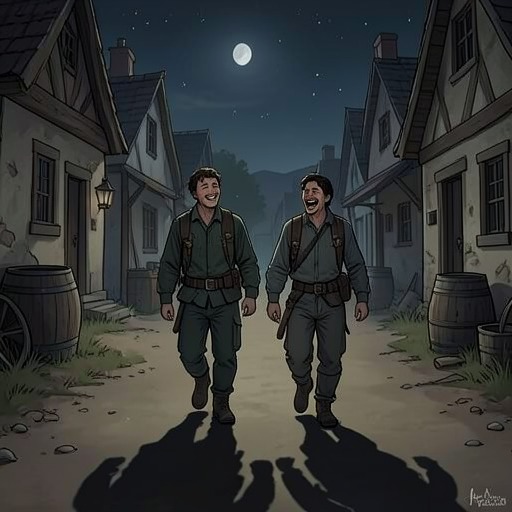
Cat PersonAaron and Grace’s friendship is the central source of companionship in Aaron’s Peace Corps years in the village, but it is never a simple refuge: it is built from teasing, misread signals, irritation, and Grace’s refusal to treat him as fragile. She makes his loneliness less solitary without promising to spare him embarrassment. Their bond reaches its clearest expression on the night before he leaves, when Grace appears in the darkness as the Night Runner she has described, and Aaron follows her into the night.
An Unceremonious Welcome
During Aaron’s first week in the village, Grace effectively adopts him. One evening she turns up at his door with a warm Coca-Cola and a burnt chapati, beginning a friendship with an offering that is both hospitable and deliberately unimpressed. Nineteen years old, she could be mistaken for one of the younger schoolgirls: she has a shiny outbreak of pimples, a partially toothless grin, and an air of distracted disdain. She asks which part of America he comes from. When he says Texas, she remarks that she had expected Texans to be large, like cowboys, and finds him merely normal-sized.
Grace had attended Butula a few years earlier, and she refuses to believe that Aaron can tell her anything about school she does not already know. Her familiarity lets her approach him as neither an exotic visitor nor an authority to be deferred to. She is curious about him, but curiosity comes wrapped in a joke; from the start, their closeness has the shape of a challenge as much as a welcome.
The challenge continues in Aaron’s cramped, rancid-looking house. After dark, Grace slips inside, says she has come unwillingly, and complains that spending time in such a hovel is beneath them both. She asks why he travelled all the way from Texas to live in a house smaller than the school cook’s. Aaron tells her the school provided it and there is nothing to be done, though he has in fact complained bitterly about the accommodation to his Peace Corps supervisors from the first day. Grace’s bluntness gives voice to the indignity of his living conditions, even as she keeps returning to them.
Teasing, Closeness, and Misread Signals
Despite her evident dislike of the house, Grace often stays until after midnight. She sucks on her knuckles and watches Aaron across the table under the lamp. He suspects that she may eventually make a move and spends time thinking about how he would respond. Yet she does not act on the suggestive closeness he perceives. At the end of an evening she gets up, yawns, and casually adjusts a bra strap that has slipped out of her dress sleeve. The scene leaves Aaron anticipating an intimacy that Grace has not offered; their friendship permits him to wonder, but does not confirm his interpretation.
After a pupil leads a teasing procession of girls who meow at Aaron, Grace explains that his eyes resemble a cat’s because of their colour. Aaron privately thinks Grace’s eyes look more feline than his: hers are brown, slightly prominent, and tilt upward at the corners. Later that evening, as he walks her to the boundary wall, he impulsively reaches toward her breast. Grace removes his hand, puts it back at his side, and laughs in his face. She wags a finger under his nose and makes clear that he has behaved badly. The refusal is direct, but the scene stays within their established register of mockery: Grace does not retreat from him, and Aaron’s embarrassment joins the other humiliations that keep him awake.
That combination of familiarity and correction defines their friendship more reliably than any prospect of romance. Grace can stay in his house for hours and make its discomfort a shared joke; she can also stop his unwanted touch without softening the rebuke. Aaron’s expectations do not govern the relationship. Grace’s ease with him includes the freedom to laugh at him, to refuse him, and to remain the person he turns to afterward.
The Night Runner and the Limits of Sympathy
When Aaron is worn down by a night of harassment, the headmaster visits and warns him about malaria, offering to send one of the girls with Panadol. Aaron declines and goes back to bed. Grace arrives at her usual hour, sees that something is wrong, and asks what happened. He gives her an account of the night’s ordeal but cannot bring himself to confess that someone defecated on his veranda. He says that the people responsible kept knocking until sunrise, and that he expects her not to believe him; even he finds the events hard to credit.
Grace does not simply dismiss the account. She identifies the intruder as a Night Runner, a figure familiar in Luhya tradition who runs about naked and causes trouble. Then she performs the story, lowering her voice, pounding the air, and using a gesture to describe the runner rubbing himself against a wall and leaving a filthy gift. Aaron has heard her tell other supernatural tales, including stories of a man cursed to crow whenever he urinates and adulterers magically stuck together until surgeons separate them. Those earlier stories seemed designed to tease his credulity. This time, Grace insists that Night Runners are real people, driven to run by a demonic mental disorder, and that their identities must remain secret. She recounts how a runner in a nearby village was nearly lynched before the community discovered that the person was a respected pastor’s wife.
Her account begins to unsettle Aaron’s scepticism, but her willingness to laugh also irritates him. She complicates her explanation with tales of runners who work in pairs and can change into cats, birds, or leopards to evade capture, then breaks off laughing. Aaron tells her she is not funny. Grace answers that he is too serious: being meowed at or having someone knock on the door at night, she argues, is not the worst thing in the world, and having troubles does not mean no one is allowed to laugh. Aaron says she could show a little more sympathy and sulks over the rest of his Coca-Cola. Their disagreement exposes a genuine limit in the friendship. Grace offers him company and a framework for what happened, but she does not respond to his distress in the consoling manner he wants.
Departure and a Shared Run
Aaron eventually tells his Peace Corps supervisor that he has been harassed, feels he has nothing left to offer the community, and wants to go home. He expects to be persuaded to stay; instead, the supervisor asks whether he feels in danger or is considering hurting himself. When he answers no, she tells him to come to the office the next day to complete his resignation papers. Aaron’s departure becomes definite, and he cleans the walls of his house with hot, soapy water, thinking of the harassment as a choice made by its perpetrators. The fact that he is leaving does not erase the friendship, but it places their remaining time under a deadline.
At sunset on his last day in the village, he walks into town and buys a chapati and a Coca-Cola. After a moment’s hesitation, he buys a second chapati and Coca-Cola for Grace. He wonders what she will say when she learns he is leaving and imagines her reproaching him for never having been taught about Night Runners in Peace Corps school. The purchase is a small, practical gesture of attachment: even while anticipating her teasing, he thinks of her and sets aside food for her. That evening Grace does not come. In the oppressive heat, Aaron sits on his mattress in his underwear, afraid to open the windows, holding a long, flat grass-cutting knife. He has told his supervisor truthfully that he does not feel in danger, but he is uneasy, humiliated, and powerless. Grace’s absence is felt against the familiar pattern of her nightly visits.
Later, girls in the courtyard first cry out in fear at Aaron’s appearance, then begin to jeer when one calls him a Night Runner. He sees himself through their eyes: a pale, ghostlike stranger with cat eyes, torn and dirt-covered boxer shorts, and leaves and twigs stuck to his legs. Then he hears Grace whisper his name from the shadows. He recognizes her by her long legs and toothless smile. She gestures to him and tells him in Swahili to run with her. Grace, who had laughed at him and frightened him with her stories, is herself unafraid; rather than crying or shouting, she runs.
Aaron is due to begin the long journey home the next day. That night Grace runs naked across the courtyard, unseen by everyone but him, and he runs after her, agile as a cat. The ending does not settle their earlier disagreements or turn their teasing into a declaration of romance. Instead, it gives their friendship a physical, shared climax: the man who had been humiliated by being treated as a cat and frightened by the Night Runner story now follows Grace through the very spectacle that had divided fear from laughter. For one last night, her company changes his position from isolated target to willing companion.