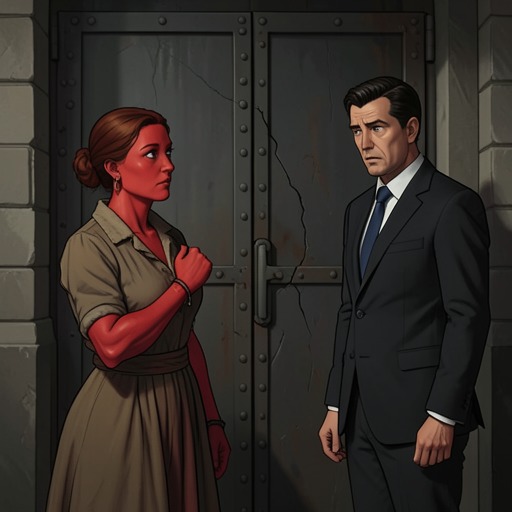
David
Cat PersonDavid is Laura’s partner and, eventually, her husband, whose care for her is tested by a condition that appears to resist both ordinary explanations and medical treatment. An engineer inclined to search for practical causes, he tries to help by investigating, organizing, and speaking up. Those efforts sometimes bring him closer to Laura and sometimes deepen the breach between them. The ending confirms that her suffering was not merely imagined, but turns his hard-won faith into a new danger of his own.
Identity and Introduction
David first watches Laura studying in a bar in Red Hook. Her library books are stacked beside her, and her lipstick stands out against an otherwise rumpled appearance. When she knocks over a beer, she lets herself get soaked rather than risk the books. David is drawn to the combination of disorder and confidence he sees in her. Laura later explains the lipstick as a way of looking intentional even when the rest of her appearance is not; David understands her appeal as something that makes the apparent contradiction disappear. This first impression establishes his attentive, admiring gaze, but also the difference between them: he observes and tries to make sense of Laura, while she moves through the world with a more instinctive certainty.
Six months into their relationship, David still has difficulty believing that Laura has chosen him. Although they say they love each other and share the minor routines and disagreements of a couple, he continues to imagine that she might suddenly expose their relationship as a joke. His insecurity matters because it precedes the illness: even before there is a crisis to solve, David is uncertain of his place beside her.
A Shared Future Under Strain
One evening Laura arrives late to dinner and tells David that she has left her doctoral program. She wants him to accept a job offer he has been considering so they can move across the country and try life in California. Her proposal is sudden and forceful enough that David is unsure whether he wants the change. He is caught between the future Laura has already imagined and his own uncertainty about leaving. As he later recalls the evening, Laura’s fascinated reaction to blood in the mirror becomes a disturbing sign of what is to come.
After the move to San Francisco, David makes a spreadsheet called David and Laura Live Together to track shared costs, including rent, the car, food, and travel. Because he earns more as an engineer while Laura is technically still on a temporary academic contract, their contributions are divided according to income: she pays 18 percent and he pays 82 percent. The arrangement gives their shared life a practical structure, but its appearance in a later argument makes money part of the pressure surrounding Laura’s illness and their unequal financial positions.
Trying to Help Laura
As Laura’s itching becomes the focus of her days, David searches the apartment for possible causes, looking for insects and other explanations. He also turns to WebMD, but the number of possible causes convinces him that online searching cannot settle the question. He urges Laura to consult someone more qualified. She tells him to stop trying to help, because she believes his interventions make things worse. The exchange captures the central difficulty of his caretaking: he is trying to respond to real distress, but Laura experiences his problem-solving as an intrusion rather than relief.
David’s concern grows as the illness interferes with sleep and everyday life. He sees Laura trying numerous ways to manage the itching and searching online for explanations. At one point, he wakes to find her away from their bed and discovers that she cannot sleep. Later, after she has injured her face while scratching in her sleep, the couple argue through the night. David calls in sick to work, Laura loses her voice from shouting, and he punches a wall. The episode shows the illness consuming the space between them: concern, exhaustion, anger, and fear are no longer easily separated.
Medical Doubt and Its Cost
At a medical appointment with Dr. Lansing, David speaks when Laura is silent. He recounts her work-related stress and the difficulties she has had since their move, presenting the history as though it were his own story and partly believing it in that moment. He intends to make the doctor understand the context, but Laura’s expression tells him that she feels betrayed. Only then does David grasp that he has exposed her private vulnerabilities without permission and used them to support the idea that her suffering is imagined.
When David challenges Dr. Lansing’s judgment, the doctor distinguishes between the reality of Laura’s distress and uncertainty about its cause. He explains that Delusional Parasitosis may be associated with depression or may signal psychosis, and that treatment can be difficult when patients refuse help. David’s impulse to advocate for Laura is therefore complicated: he has just undermined her confidence by speaking for her, yet he also fears that the doctor is dismissing her. The scene places him between two responsibilities—trying to protect Laura and respecting her account of herself—and shows that good intentions do not prevent harm.
Laura begins treatment with antidepressants and what her psychiatrist calls a very mild antipsychotic. She sleeps for longer stretches, and the visible effects of the illness lessen; she resists scratching and the marks fade. David tells himself she is getting better, but he also resents the slowed, tired person he sees on the sofa, as though treatment has taken away the woman he loves. His response is not a simple rejection of her care. Rather, it reveals how relief and grief coexist: the symptoms that frightened him are easing, while the change in Laura makes him feel that he has lost something too.
Marriage and the Ending
David and Laura find encouragement through an online network of people dealing with difficult-to-diagnose illnesses, whose members provide a twelve-page list of sympathetic doctors. They believe they will keep searching for answers. In that renewed moment of shared hope, David proposes to Laura in a clinic parking lot. They marry a week later in a courthouse ceremony kept secret from their parents and friends in San Francisco and New York. Laura buys a new dress and an old-fashioned hat with a veil; a couple they do not know serves as witnesses, and strangers take a few photographs. David sees that Laura is sad about how the pictures turn out, but understands their marriage as the beginning of a life in which they still have time to learn how to love each other.
The closing revelation overturns the assumption that Laura’s symptoms have been only psychological: Il parassita emerges, and David is infected when it transfers to him. His decision to believe Laura is vindicated, but not rewarded with safety. The same organism that has shaped her suffering now lodges beneath David’s eye, leaving him with a new source of itching and the threat of further infection. The reversal gives his earlier practical searching and his conflicted advocacy a sharper significance: he was right to take Laura’s pain seriously, yet neither love nor medical treatment had protected them from the real cause. Their marriage ends the account not as a resolution of the illness, but as a bond entered just before its danger becomes David’s as well.