Grace
Cat PersonGrace is a nineteen-year-old Luhya woman whose irreverent friendship gives Aaron both a local companion and a way to understand the village’s Night Runner lore. She first appears as a teasing, perceptive presence in his daily life; at the end of his stay, she emerges from the darkness and runs with him, making their bond the story’s final answer to his humiliation and isolation.
Identity and Introduction
Grace adopts Aaron during his first week in the village, arriving at his door one evening with a warm Coca-Cola and a burnt chapati. She is older than the girls at the school—nineteen, though her acne, partially missing teeth, and dismissive air could lead someone to mistake her for one of the younger pupils. Her manner is direct rather than deferential. When Aaron says he comes from Texas, she remarks that she had expected Texans to be large, like cowboys, and judges him instead to be of ordinary size.
She had attended Butula a few years earlier, and her familiarity with school life shapes her conversations with Aaron: she stubbornly refuses to believe that he can tell her anything about it that she does not already know. Her confidence is comic, but it also establishes her as someone with local knowledge and a strong sense of her own authority. Aaron, a volunteer from elsewhere, is the one who is new and uncertain; Grace does not treat that difference as a reason to defer to him.
Friendship with Aaron
After dark, Grace slips into Aaron’s cramped, stale-smelling house. She claims she has come unwillingly and that spending time in such a miserable place is beneath them both. She once asks why he came all the way from Texas to live in such a small house, pointing out that even the school cook has a better one. Aaron explains that the school provided his accommodation and that he has no choice, although he has in fact complained to his Peace Corps supervisors about it from the start. The contrast shows how easily he presents his circumstances as unavoidable even when he has already protested them elsewhere.
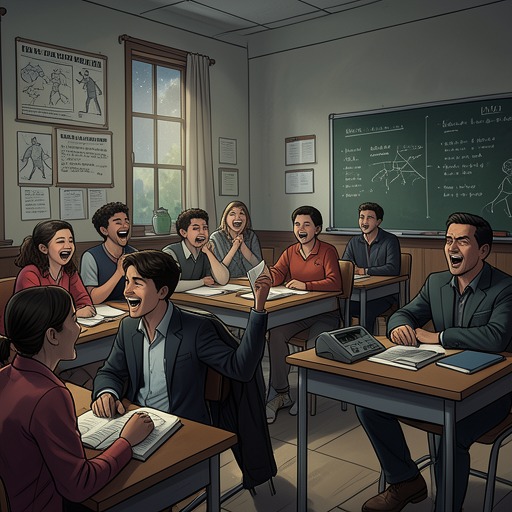
Grace’s familiarity with him includes mockery, but it is not simply dismissal. When Aaron tells her how Linnet Oduori followed him home meowing, joined by other girls along the way, Grace says that the girls are reacting to his eyes: their color makes them look like a cat’s. Aaron privately considers that Grace’s own eyes look more feline than his anonymous blue ones. Her brown eyes are slightly prominent, with upturned corners; in profile, he sees the pale crescent of the iris. The exchange turns the schoolgirls’ teasing into a shared subject between the friends, while Aaron’s attention to Grace’s face gives the teasing a more intimate dimension.
The Night Runner Lore
When the girls’ harassment escalates into an ordeal that lasts through the night, Aaron tells Grace what happened but cannot bring himself to mention that someone defecated on his veranda. He expects her to laugh at him. Instead, she listens and identifies the culprit as a Night Runner. She describes Night Runners as a familiar Luhya phenomenon: naked people who run around causing trouble, pound on houses, rub themselves against the walls, and sometimes leave a filthy offering behind.
Grace performs the explanation as much as she gives it. In a low, masculine voice, she furrows her brow, punches the air to imitate the pounding, and gestures toward her backside as she describes the obscene contact with the wall. Her theatrical account fits a pattern: she has previously told Aaron stories of a man cursed to sing like a rooster whenever he urinates and of adulterers magically stuck together until they had to be separated at a hospital. Those stories have sounded like jokes designed to challenge his credulity. The Night Runner account, by contrast, seems to convince her.
She insists that Night Runners are not spirits but human beings driven by a demonic mental disorder, whose identities must remain secret lest their communities punish them. As an example, she recounts the capture of a Night Runner in a nearby village: the person was almost lynched before the villagers discovered that the runner was a respected pastor’s wife. Grace also describes pairs, elaborate ways of avoiding capture, and the ability of a pursued runner to become an animal such as a cat, bird, or leopard. Aaron’s skepticism begins to give way as he asks how to stop one. Grace’s account offers no simple remedy; the runners’ capacity to change form makes them difficult to pursue.
Departure and Final Run
On the last day of his village stay, Aaron decides to leave the Peace Corps. He has been humiliated and made to feel that he has nothing left to offer the community. At sunset he walks into town for the last time and buys a chapati and a Coca-Cola; after a moment, he buys another of each for Grace. He wonders how she will react to his departure, remembering her challenge about whether the Peace Corps had taught him anything about Night Runners. His unspoken answer is that it taught him none of what he needed to know.
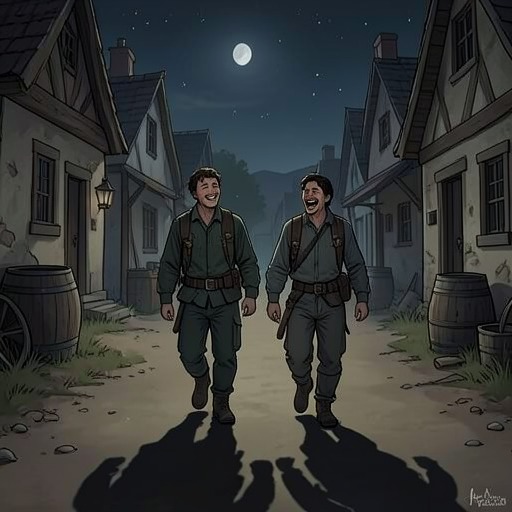
Grace does not arrive at her usual hour that evening. Aaron waits in oppressive heat, afraid to open the windows, sitting in his underwear with a long, flat tool from the yard beside him. Then, in the school courtyard, a voice whispers his name from the shadows. He recognizes Grace by her long legs and toothless smile. She signals to him and tells him to run with her. The younger girls first cry in fear at Aaron’s appearance, then mock him as a Night Runner; he sees himself through their eyes as a pale, cat-eyed stranger in torn, dirt-covered underwear, his legs caught with leaves and twigs.
Grace neither recoils nor joins the girls in jeering. She runs naked through the courtyard, invisible to everyone but Aaron, and he follows her, agile as a cat. The scene links the humiliating label attached to him, Grace’s earlier account of runners who change shape, and the cat imagery surrounding his eyes. It suggests that Grace herself may belong to the world she has described, but it does not explain her identity or the rules governing what Aaron sees. What it makes clear is the difference between being pursued and mocked alone and choosing, with Grace, to run. Aaron is due to leave for home the next day; their run is not a resolution of his larger problems but the last shared moment of his village life, and the story’s closing image of their friendship.