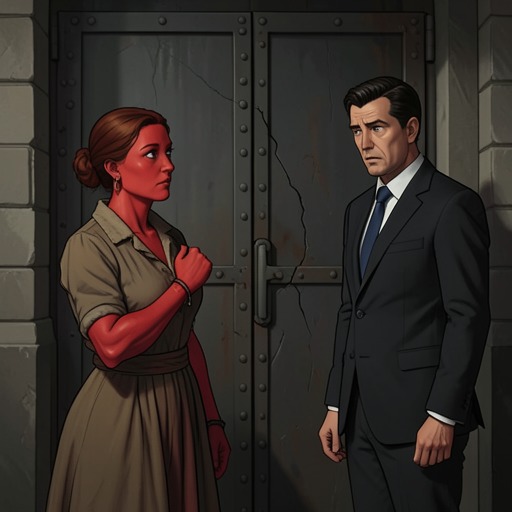
Laura
Cat PersonLaura’s story in “The Parasite” makes the boundary between illness and delusion painfully unstable. As her skin becomes covered in sores and she is treated for an imagined infestation, the evidence seems to confirm that her conviction is a symptom of mental illness. Then, on her wedding night, a living parasite emerges from her body—and transfers itself to David. The revelation vindicates what she has endured, but comes too late to make her recovery simple or secure.
Identity and a life redirected
Before the illness takes over their life together, Laura is pursuing a doctorate and has been with David for six months. He still half-expects her to realize that she has made a mistake in choosing him, even as they share ordinary couple’s routines and say they love each other. Her confidence in their future unsettles that expectation: she arrives an hour late to dinner, announces that she has left her doctoral program, and urges him to accept a job offer so that they can move across the country and try California together.
David hesitates over the change, but the scene’s more ominous turn is Laura brushing her teeth. She spits foam streaked with blood, then studies her reflection with fascinated attention. Later, David will remember her bloody, bared teeth as a warning. At the time, the moment marks a change in her body that neither of them understands. A year later, she confronts him as soon as he comes home, ordering him to look at the marks beneath her arm and asking what has bitten her. Rumors of bedbugs in their San Francisco neighborhood offer an easy explanation, though their glass-and-steel apartment seems an unlikely refuge for such insects.
The hunt beneath the skin
Over one weekend, David sees how completely Laura has organized her days around the lesions and their unbearable itch. The number of bites has tripled overnight. She takes a baking-soda bath, massages herself with basil and aloe, trims her nails, repeatedly washes the sheets, and carefully applies bandages only to remove them again. Online, she keeps rephrasing searches about swollen, itchy skin and punctures; she studies disturbing images and reads through endless forums filled with other people’s accounts of suffering.
David searches the apartment on hands and knees for flies, larvae, fleas, or mites, but finds nothing. His brief internet searches leave him with more possible causes than answers. When he suggests that Laura consult someone better qualified than WebMD, she tells him to stop trying to help because he is making things worse. Her frustration deepens the isolation of the illness: the harder she tries to establish what is happening, the less able David is to tell whether he is witnessing physical evidence or a conviction consuming her.
On a Tuesday, David returns from work to find Laura examining her arm with a magnifying glass and digging into a small wound with a cotton swab. She says she can see something, a white speck, then pushes the swab into the blister and raises its bloody tip as if she has found proof. At their appointment, she shows Doctor Lansing each blister and explains her theory about the torsalo, along with the evidence she has collected in a plastic bag. The doctor’s interest appears to vanish when she presents it: he glances at the bag and crumples it on the table. He asks instead how she feels apart from the itching.
Treatment, doubt, and commitment
Doctor Lansing explains to David that Laura’s suffering is real even if the parasites are imaginary, and that delusional parasitosis can accompany depression or mark the beginning of psychosis. He warns that treatment can be difficult, especially when patients refuse help, but says Laura is willing to accept care. She begins taking antidepressants alongside what her psychiatrist calls a very mild antipsychotic.
The treatment eases some symptoms, but also changes Laura’s presence in the relationship. She sleeps eight hours, then nine, then ten, and takes long afternoon naps. Her weight increases, her once-beautiful black hair thins, and David often finds her on a sofa marked with cream. The wound on her face begins to heal; she no longer scratches as relentlessly, and the welts she resists picking at subside after a day or two. Yet David continues to believe that some of them are insect bites. He tells himself she is getting better, while resenting the slow, fogged version of the woman he loves. Their life settles into a stagnant routine, and at night he wonders whether a physical parasite might be draining something essential from her after all.
They marry secretly at a courthouse, telling neither their parents nor their friends in San Francisco or New York. Laura buys a new dress because her old ones no longer fit, and finishes the look with a small vintage hat and veil. Strangers serve as witnesses and take a handful of photographs. Laura looks pale in them, her conspicuous cheek scar visible through the veil; David understands that they will not become family keepsakes. He nevertheless imagines that they can do it better next time, and that they have a lifetime to learn how to love each other.
The parasite and the reversal
On their wedding night, moonlight falls across Laura’s arm. The first lesion has healed into a raised, shiny scar, but another blister has formed just above it. When David touches it, the lump feels warm despite Laura’s cool skin, and he feels it pulse beneath his fingertip. The sensation is so slight that he wants to dismiss it, but the swollen skin trembles as if something inside is struggling to get out.
Laura is too deeply asleep to wake. David watches the blister swell, open at its center, and release a clear bubble of blood before the parasite pushes through her skin. He pulls it free and drops it onto the sheets. It is a ten-centimeter length of knotted white flesh ringed with thousands of quivering legs: too large for a matchbox and too strong for the plastic bag Laura had brought to the doctor. David recognizes, at last, that Laura was right and that his earlier belief in her had nearly given way. He imagines returning to the doctor with the creature sealed in a glass jar and getting Laura the medical help she needs.
That apparent rescue is overturned almost at once. The parasite lashes out, catches David near the eye, and burrows into the soft tissue there, sending pain through him. The story therefore gives Laura vindication without a clean cure: the infection has been real, but its emergence leaves David infected and Laura’s future uncertain. Her body, which had been treated as unreliable evidence, proves the truth only in a form that makes the danger newly intimate.