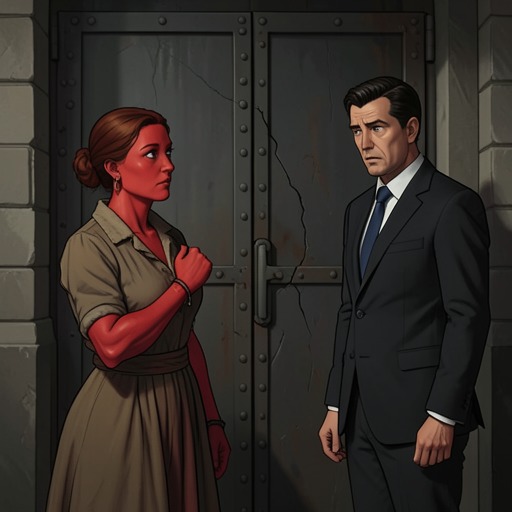
Laura's Parasitosis and the Parasite's Transfer
Cat PersonLaura's Parasitosis and the Parasite's Transfer is a medical crisis that becomes a reversal of both diagnosis and fortune: what Laura is told she only imagines is eventually revealed as a living parasite, but the proof arrives too late to keep David safe. The episode binds intimate care to uncertainty, as David moves between doubting Laura, defending her, and discovering that belief alone cannot protect either of them.
Symptoms and the Search for an Explanation
A year before the crisis comes to a head, Laura arrives home with marks she believes are bites. The possibility of bedbugs seems plausible in their San Francisco neighborhood, where rumors of an infestation are circulating, but hard to reconcile with their sleek glass-and-steel apartment. The symptoms rapidly become harder to dismiss as minor: after three days she has three bites, one on her cheek, and scratches so intensely that her eye swells shut. She is irritable and increasingly distressed. When David urges her to see a doctor, she says she cannot afford the insurance deductible; she has arranged an appointment at a free clinic on Longford Street instead.
David initially treats her search for an explanation as wasted effort, but soon finds himself repeating the same Google searches he had dismissed. At home, he finds Laura examining her arm with a magnifying glass and probing a small wound with a cotton swab. She insists she sees a tiny pale speck and celebrates when she lifts it from the wound. To David it looks no more than a minute, glinting grain. Laura identifies it as a torsalo parasite, and proposes that an insect laid eggs in a cut or burn, with larvae then burrowing beneath the skin. She argues that its presence inside her explains why David has no symptoms and why nothing has been found in their apartment. Her certainty brings relief: at last, she has an account of what is happening to her. David, who can see only a speck, does not share it.
Medical Authority and the Matchbox Evidence
David arranges an appointment with his own doctor, Dr. Lansing, and asks to accompany Laura into the examination. Dr. Lansing looks over her many blisters and asks gentle questions; Laura answers as best she can, then presents the plastic bag containing what she believes she extracted. The doctor's manner changes. He gives the bag only a cursory look, sets it down, and asks how Laura feels apart from the itching. When she falls silent, David recounts the history for her, including her vulnerabilities, in the hope of making the doctor understand. He realizes too late that he has exposed her private struggles without permission in order to persuade a stranger that her pain is imaginary.
Dr. Lansing offers medication for the underlying cause he believes is implied by her condition, connecting her skin symptoms to the pressure she has been under and suggesting that improving her mood may reduce the dermatological problems. When David asks what can be done for the itching and presses for a dermatologist, the exhausted Laura agrees to try what the doctor recommends. Dr. Lansing then explains the reasoning behind his skepticism: Laura sees something in the bag that he cannot see, and she is certain where he is not. He calls the bag an example of Prova nel portafiammiferi, a form of supposed proof once presented in empty matchboxes and now collected in plastic bags or containers, or captured in phone photographs. The contents, he explains, may be dead skin, dust, or lint: particles that take on the appearance of evidence when someone is intensely focused on the body and searching it for proof.
David objects that the explanation turns Laura's painstaking effort to gather evidence against her, as if trying to document her suffering were itself a sign that she was losing touch with reality. Dr. Lansing insists that he has not dismissed her distress: the parasites may be imaginary, but her suffering is real. He warns that Delusional Parasitosis can be associated with depression or be an early sign of psychosis, and can be difficult to treat, particularly when patients refuse help. Laura is willing to accept treatment, and he urges David not to obstruct it if he loves her.
Treatment, Doubt, and a Second Opinion
Laura begins a course of care involving antidepressants and what her psychiatrist calls a very light antipsychotic. The treatment appears to calm the scratching and allows the wound on her face to heal. She sleeps for longer and longer stretches, takes long afternoon naps, gains weight, and loses some of her beautiful black hair. New raised marks continue to appear, and David still privately thinks they may be insect bites, but Laura resists scratching them; after a day or two, they subside. David tells himself that she is getting better, even as he sometimes looks at the slowed, foggy person on the sofa and resents what he fears the medication has taken from her. Their life settles into a stasis that he cannot accept as a certain cure. At night he wonders whether a physical infection has been misread as mental illness and whether his own account to Dr. Lansing helped silence Laura's pain.
David proposes seeking a second opinion from a dermatologist, not another psychiatrist. He brings Laura a carefully arranged stack of scientific articles he printed at work, pointing to evidence that physical skin diseases can be misdiagnosed as psychiatric problems, especially in women. Laura worries about the cost, but David says he does not care; when she suggests putting the expense on their spreadsheet, he rejects the calculation and reassures her that he loves her and will take care of her. They travel to the new dermatologist with the windows down, having agreed to leave the plastic bag at home and not volunteer information about the medication unless asked. They want Laura to be assessed afresh, beginning with the simple account that she is generally well but has an itch.
The dermatologist sees Laura alone. When she returns, she tells David that the doctor asked about her blisters and stress, then asked whether she was taking medication. Laura disclosed Depakote and believes that admission changed the doctor's view at once; the proposed treatment is a chemical peel for her scar. David is disappointed, but Laura comforts him: they knew it would be difficult, and this is only a first step. The couple have also connected online with a network of people who have hard-to-diagnose illnesses and supporters who provide a twelve-page list of sympathetic doctors. Their search remains open, sustained by their shared conviction that they will keep looking.
Marriage and the Parasite's Emergence
In the drab parking lot outside the clinic, David asks Laura to marry him. They marry a week later at a courthouse, keeping the news from their parents and friends in San Francisco and New York. Laura buys a new dress because her old ones no longer fit and finds a vintage hat, which she decorates with a veil. Another discreet couple serve as witnesses, and strangers take a handful of photographs. Laura looks pale, and the prominent scar on her cheek shows through the veil; the pictures will not become the family keepsakes they imagine, but David thinks they have their lives ahead of them to learn how to love each other.
On their wedding night, David notices that the first bite has healed into a raised, glossy scar. A new blister has appeared about a centimeter above it. When he touches it, the skin feels warm, and he senses a pulse beneath his fingertip. The blister swells and trembles as if something inside is trying to escape. Laura is sunk in a drugged sleep and cannot be woken. As the skin ripples, a dark pinprick opens at its center; a clear, blood-filled bubble rises and bursts, and the parasite that has fed on Laura for months comes out.
David catches it and pulls it from her skin, stretching it like a living thread before dropping it onto the sheets. It is a knotted white tube of flesh, ten centimeters long, ringed with a thousand quivering legs. Its size and movement turn the earlier speck in the bag into something unmistakably alive. David believes that Laura was right and that he was right to believe her; he imagines bringing the creature to a doctor in a thick glass jar and finally putting medical science on her side. He also imagines that Laura may still carry newly hatched larvae, but that the mother parasite is dying and that she can be treated.
That hope lasts only moments. The parasite straightens, touches David's face with a leg, and hooks into the soft place between his eye and the bone. It disappears into him in a burst of pain. The sensation of legs inside his cheek and against his skull fades, leaving an itch and a small bump beneath his eye. Laura turns in her sleep and scratches herself, while David collapses beside her with the creature now inside his own body.
Reversal and Significance
The late emergence resolves the conflict between Laura's perception and the doctors' interpretation in the most literal possible way: the evidence once dismissed as dust or lint has a living source. Yet proof does not produce immediate safety. David's support, their marriage, and the prospect of finally being believed all arrive at the threshold of a new infection. The transfer makes the couple's closeness physically consequential: the parasite passes from Laura to the person who tried to protect her, leaving the diagnosis vindicated but the danger unresolved.