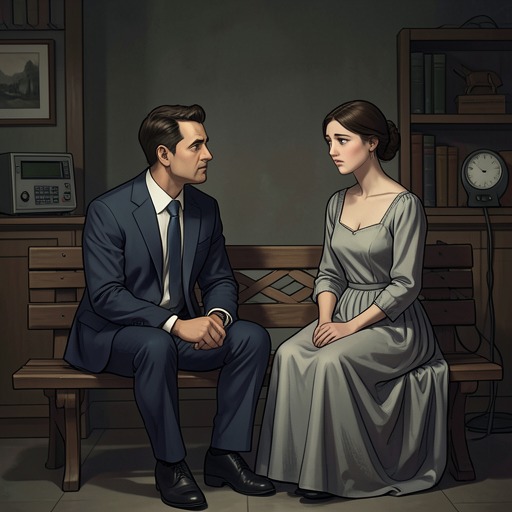
Ted Leaves Rachel and the Party with Anna on New Year's Eve 1998
Cat PersonTed’s departure with Anna Travis from a New Year’s Eve party in Trenton, New Jersey, turns an evening of jealousy and strained sociability into a decisive choice: he abandons Rachel Derwin-Finkel and leaves with Anna. The scene presents that choice as the triumphant high point of Ted’s life, but a twenty-years-later reflection from a hospital stretcher casts it as the start of a long decline.
Background and Arrival
On the last day of 1998, Ted and Rachel arrive at Cynthia Krazewski’s house. Rachel has dressed as if preparing for battle: a very tight black dress, glittering high heels, heavily sprayed hair arranged in a French twist. Ted rings the bell; after a pause that seems deliberately prolonged, Cynthia opens the door. Rachel presses between Ted and their host and explains that Anna invited them. Her entrance gives the evening an immediate tension: the couple has come together, but Anna is already the person around whom Ted’s attention will turn.
Inside, Ted finds Anna at once, talking in a corner with Ryan Creighton. Her loose pinafore dress, leggings, and newly dyed red hair strike him as a sharp contrast with Rachel’s polished appearance. He momentarily wonders whether Rachel is more attractive than Anna, or whether they are equally attractive, a comparison that shakes the assumptions he has held about Anna’s singularity. Then Anna lays a hand on Ryan’s bicep and laughs flirtatiously. Ted’s heart sinks again. Rachel notices the direction of his gaze and tightens her grip on his hand until it hurts.
Jealousy and the Party
Once Anna realizes that Ted and Rachel are watching, she takes Ryan’s arm and approaches them. The ensuing greetings are superficial, punctuated by familiar exclamations about how long it has been. Anna and Rachel share a laugh at Ted’s awkward habits, while Ryan appears genuinely bored. The exchange makes Ted the subject of their shared amusement even as his attention remains fixed on Anna and Ryan; he privately feels so detached from the party that he would not care if everyone there, himself included, died that night. He gets very drunk.
A disturbance at the door later draws attention away from the party. Anna disappears, and Ted tries to follow, but Rachel stops him with a brutal grip on his wrist. The guests hear that Marco Hernandez has briefly come by and left after seeing Anna there. Conversation turns to the restraining order: people wonder whether it is real or invented, and how such an order works in practice. The account does not resolve those questions. Instead, the episode adds an uneasy, unresolved complication to the party before Ted’s personal crisis comes back to the foreground.
At midnight, Ted kisses Rachel with his tongue and squeezes her bottom. The physical gesture does not signify a renewed commitment. He discovers that he can enjoy an experience while feeling entirely detached from caring about it, and even finds the detachment itself pleasurable. He wonders whether he has somehow become Buddhist or undergone a psychotic break. The moment makes his outward intimacy with Rachel and his inward indifference coexist, so that the public New Year’s kiss becomes a prelude to separation rather than reconciliation.
The Private Conversation and Departure
Ted asks Anna to speak privately, and she takes him out onto the porch. It is cold, with light sleet falling, though his alcohol-warmed state keeps him from caring much about the weather. Anna lights a cigarette, exhales smoke, and scratches her thighs. Ted had not known that she smoked. The move outside separates their conversation from the party and its public performance, while leaving Ted still intoxicated and Rachel inside.
Anna tells him that she cannot believe what he has done: making out with his girlfriend and fondling her in front of Anna. Her accusation names the action Ted had just treated as pleasurable but emotionally inconsequential, and makes clear that Anna has been watching it as something that affects her. She cries as she says she is tired of pursuing bad men and wants someone dependable and good. Ted’s narration idealizes her in response, dwelling on her dimples, smooth skin, freckles, hair, and the perfume that enchants him; he describes her as the woman who has made him useless to anyone else. Anna kisses him. Ted embraces her and resolves to be good to her for the rest of his life, while privately reserving a minute to break up with Rachel first.
Anna waits on the porch while Ted goes back inside. He tells Rachel that he is leaving with Anna, beginning an explanation that he does not finish. Rachel’s look reaches, in the narration’s image, into the ragged tangle of his soul; words are no longer needed to convey what his choice means to her. The breakup brings shouting and crying, followed by beer thrown at Ted—only the liquid, not the glass. At last, he leaves the party with Anna, having arrived with Rachel Derwin-Finkel. The physical departure makes the choice final for the evening, but the scene supplies no account of Rachel’s subsequent actions or of what happens between Ted and Anna that night.
Triumph and Retrospective Reversal
At the moment of leaving, Ted experiences the departure as the greatest and most triumphant moment of his life. The narration renders his happiness as if it were a sensation he could be granted for eternity in paradise. That exalted feeling is sharply at odds with the preceding drunkenness, emotional detachment, and painful breakup: Ted experiences his chosen future with Anna as a personal victory, even as the scene has shown the harm and instability bound up in the choice.
The narrative then jumps twenty years ahead. From the perspective of a hospital stretcher, Ted has to admit that, from that night onward, things went more or less wrong. This retrospective turn does not spell out every consequence of leaving Rachel, but it overturns the scene’s ecstatic ending. The departure remains a decisive romantic turning point—Anna reciprocates, and Ted chooses her over Rachel—while the older Ted’s perspective makes the triumph look less like a secure beginning than a moment whose promise the later course of his life fails to fulfill.