
Intuition Against Manufactured Certainty
CaughtThis flow traces Wendy Tynes’s uneasy movement from confidence in evidence to doubt, discovery, and a more complicated understanding of what she can know.
increasing Bearing strength in each event
 decreasing
Bearing strength in each eventdecreasingThe Door of Certainty
The Door of Certainty
A foreboding arrival
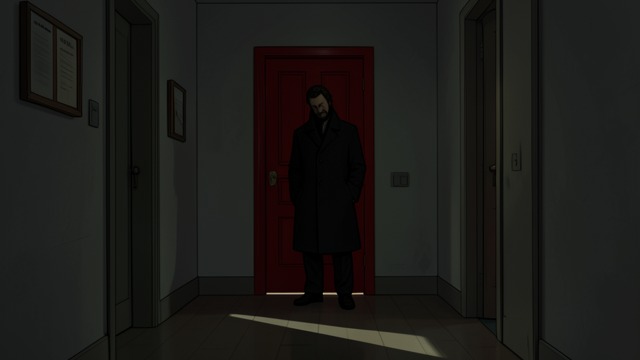
Wendy Tynes’s sting begins as a carefully arranged encounter: Dan Mercer believes he is answering a troubled teenager’s appeal for help, while the cameras are ready to expose him. The red door and the staged darkness turn the operation into a scene that feels ominous before its facts are established.
Instinct and proof
The opening image makes the reader feel danger without yet knowing where it lies. The tension between appearance and reality begins here: a frightening setting does not prove a crime, just as a convincing performance cannot by itself establish innocence.
Wendy’s later certainty rests on the encounter, the messages, and material found at Dan Mercer’s home. The scene’s dramatic force therefore anticipates the novel’s central question: whether facts gathered through a performance can be trusted as a complete account of what happened.
The Case Looks Settled

The Case Looks Settled
Evidence under pressure
At the hearing, defense attorney Flair Hickory challenges how the sting was conducted and emphasizes that Wendy entered Dan Mercer’s home before the police search. Wendy maintains that she feared Mercer might harm himself, while the defense suggests she was protecting the evidence that made her story work.
The courtroom separates what Wendy believes from what she can establish. The judge’s ruling excludes the material recovered from Mercer’s home and dismisses the charges, turning the prosecution’s apparent certainty into legal failure.
A verdict without resolution
Wendy still believes the evidence points to guilt, but the ruling leaves her unable to treat conviction as settled truth. The case exposes a distinction between suspicion, proof, and lawful proof: each may tell a different story, and none can simply substitute for the others.
Doubt Returns
Doubt Returns
A clue changes the question
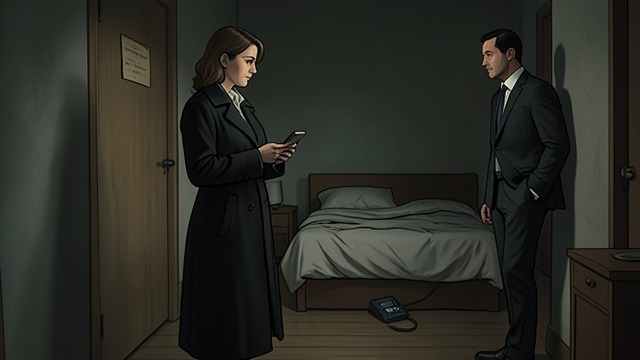
When investigators find Haley McWaid’s phone beneath the bed in Dan Mercer’s motel room, the discovery appears to confirm Wendy’s original judgment. Yet she cannot dismiss what she has learned about Mercer’s past relationships, the Princeton roommates, and the pattern of scandals attached to them.
She begins to ask whether Haley might have left home voluntarily to meet someone, rather than been seized by a stranger. The phone could be evidence of a crime, but it could also have been left behind during a hurried departure. Its meaning depends on a story the investigators have not yet established.
Revising, not excusing
Wendy’s doubt does not make her certain that Mercer was innocent. Instead, it forces her to recognize how quickly a plausible interpretation can harden into a verdict, especially when a suspect already carries a powerful stigma.
Her growing willingness to question her own reporting becomes a form of responsibility. She does not discard evidence; she asks whether she has mistaken evidence for a complete explanation.
A Theory of Escape
A Theory of Escape
Reconsidering the disappearance
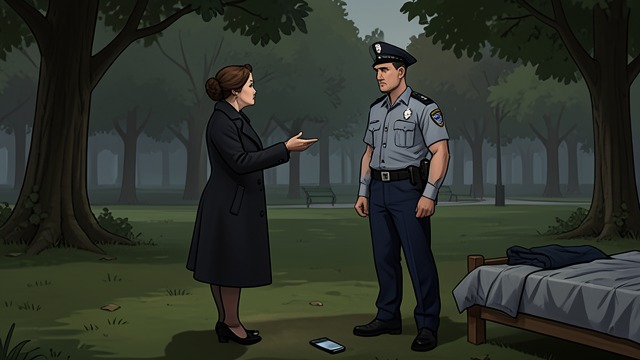
At Ringwood State Park, Wendy tells investigator Frank Tremont that Haley McWaid may have had a secret relationship with Dan Mercer and left home to meet him. The absence of a forced entry, the hidden boyfriend, and Haley’s search for the park form a possible explanation, though each detail remains open to other readings.
Tremont resists the theory because it risks burdening the grieving McWaids with an unverified claim about their daughter. He also points out the unanswered question of why Haley’s phone would remain beneath Mercer’s motel bed if she had fled with him.
The limits of a good theory
The exchange shows that a theory can make scattered facts feel coherent without making it true. Wendy’s account is worth investigating, but she and Tremont cannot yet fill its gaps.
The search therefore becomes more than a hunt for a body. It is also a test of how investigators handle uncertainty: whether they will protect a compelling explanation from inconvenient facts, or keep revising it as the evidence changes.
The Final Reversal

The Final Reversal
A staged death reconsidered
After learning that Jenna Wheeler helped conceal Haley’s accidental death, Wendy returns to the supposed murder of Dan Mercer. She notices that only one bullet was recovered at the trailer and realizes that Ed Grayson’s apparent execution may have been staged to let Mercer escape.
The clues that once seemed to incriminate Grayson—the blood, the gun residue, the witness, and the missing body—can now be read as parts of a deliberate deception. Wendy confronts him, but she admits that she cannot prove her reconstruction and is not seeking to prosecute him in that moment.
Knowing what remains unknowable
Ed Grayson secretly connects Wendy to the living Dan Mercer. The final revelation confirms that her instinct that something was wrong had not been baseless, but it does not make her earlier certainty harmless: her public exposure helped destroy Mercer’s former life.
The novel ends not with perfect knowledge but with a partial truth and an act of forgiveness. Wendy’s investigation arrives at an answer through correction, not infallibility; what she can do with that answer matters as much as what she can establish.
At the opening sting in the red-door house
Three months after the sting, during the suppression hearing
After the motel search reveals Haley McWaid’s phone
During the search at Ringwood State Park
At the lacrosse memorial, after the cover-up is exposed
