“There's no earthly way of knowing”
Charlie and the Chocolate Factory“There's no earthly way of knowing” is the tunnel song performed during the Chocolate River boat ride in Wonka's Chocolate Factory. Sung as the boat plunges into darkness, it transforms a practical loss of visibility into a theatrical display of uncertainty: the passengers cannot see the route, cannot predict the destination, and cannot tell whether the journey is slowing or accelerating. Its decisive effect is to make uncertainty itself the scene’s entertainment, while the frightened reactions of the adults and children expose how completely Willy Wonka controls the tour’s atmosphere.
Setting and Performance
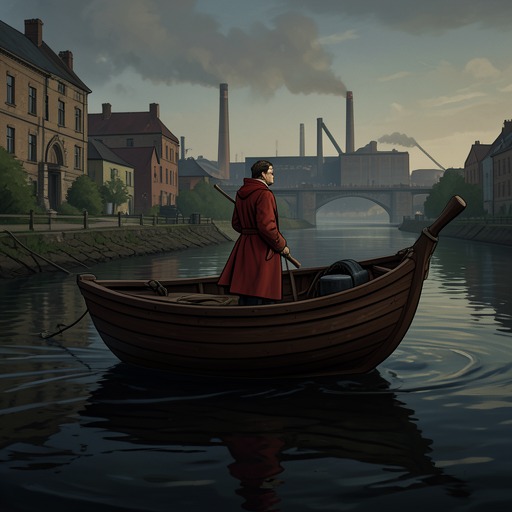
The song begins when the Chocolate River narrows and runs toward a great round tunnel resembling an enormous pipe. Rather than stopping or reassuring the passengers, Willy Wonka jumps up, waves his stick, and orders the boat to go at full speed. The Oompa-Loompas row faster, and the boat shoots into the pitch-dark passage while everyone screams with excitement. The song therefore arises from a concrete change in the environment: the brightly navigable river gives way to a space in which ordinary sight and orientation no longer function.
The Oompa-Loompas provide the movement and rhythm of the performance as they continue rowing through the darkness. The opening lines state that there is no earthly way of knowing which direction the boat is taking, followed by the repeated uncertainty about where the rowers are going. The song is not an ornamental interruption detached from the action; its words describe the passengers’ actual predicament while the boat continues deeper into the tunnel.
Uncertainty as Comic Threat
Violet Beauregarde voices the immediate practical fear by asking how the rowers can see where they are going. Willy Wonka answers not with an explanation but by echoing and intensifying the uncertainty, laughing at the fact that there is no way to know where the boat is heading. The song’s humor depends on the gap between the passengers’ need for safety and Wonka’s willingness to treat danger as spectacle.
The lyrics continue by emphasizing that the rowers keep rowing and show no signs of slowing. This detail gives the song its mounting pressure. Darkness alone creates suspense, but continued speed removes the comfort of pause or control. The boat is carried forward by unseen motion, and the performance makes that loss of control audible before the passengers know what the tunnel contains.
Reactions and Narrative Function
The song produces a sharp change in the emotional temperature of the boat ride. What began as excitement becomes alarm when the parents conclude that Willy Wonka has lost his reason. They call him crazy and describe him with a rapid series of increasingly emphatic terms: he is “balmy,” “nutty,” “screwy,” and “batty.” Their reaction shows that the song has crossed the boundary between an unusual guide’s joke and behavior they regard as genuinely dangerous.
At the same time, the adults’ horror confirms Wonka’s authority over the scene. He controls the boat’s speed, the passengers’ access to information, and the emotional interpretation of the journey. The title phrase promises that no ordinary earthly knowledge can reveal the route, and the performance fulfills that promise by withholding both visual confirmation and verbal reassurance. The passengers are made dependent on a guide who appears to enjoy their dependence.
Connections to Wonka's World
The song belongs to a factory whose secrets are deliberately exposed through spectacle. Willy Wonka’s Golden Ticket notice promises that five children will be shown the secrets and magic of his factory, but the tour repeatedly makes knowledge unstable: visitors are shown extraordinary spaces without being granted predictable rules for moving through them. In the tunnel, the promised revelation becomes temporary blindness. The factory can be entered, yet it cannot be mastered by ordinary expectations.
The performance also reflects the Oompa-Loompas’ established role in Wonka's Chocolate Factory. Willy Wonka introduces them as workers imported directly from Loompaland and says that they love dancing, music, and inventing songs. The tunnel song is thus part of a recurring musical presence within the factory, but it is unusually bound to immediate physical risk. Their rowing sustains the boat’s motion while their singing gives that motion a playful, almost ceremonial form.
Significance of the Expression
As an expression, “There's no earthly way of knowing” names more than the passengers’ inability to see. It crystallizes the larger logic of the Chocolate River sequence: wonder and fear occupy the same current, and the same theatrical energy that delights the visitors can also strip them of confidence. The line is funny because it states the obvious in song, yet unsettling because the boat continues forward without correcting the uncertainty.
The song’s lasting force comes from its collision of cheerful performance and genuine helplessness. The Oompa-Loompas keep rowing, Willy Wonka keeps laughing and urging speed, and the passengers can only shout in the dark. The expression consequently becomes a compact emblem of the factory’s method: familiar forms such as a boat ride, a guide’s instructions, and a children’s song are made strange by impossible surroundings and by the refusal of the person in control to explain what comes next.