“They all come out in the wash”
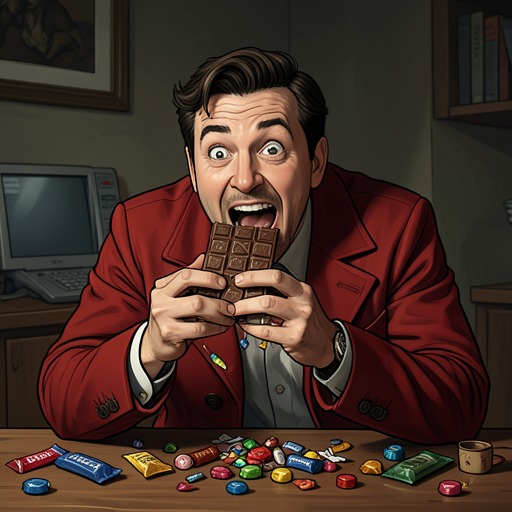
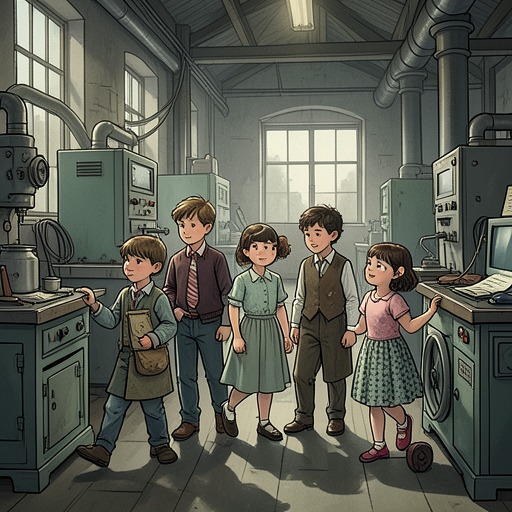
Charlie and the Chocolate Factory“They all come out in the wash” is Willy Wonka’s recurring formula for dismissing apparent disaster at the factory. It promises that children who have been swallowed, discolored, dropped, or shrunk will eventually be recovered or corrected, but its ordinary domestic image sits uneasily beside extraordinary bodily danger. The phrase therefore works simultaneously as reassurance, comic understatement, and a sign of Willy Wonka’s unnerving confidence in the factory’s processes.
Meaning and First Use
Willy Wonka first uses the expression after Augustus Gloop falls into the Chocolate River and disappears beneath its brown surface. Rather than treating the incident as an unresolved emergency, he tells the remaining visitors not to worry about Augustus Gloop because he is “bound to come out in the wash.” He immediately extends the assurance into a general rule: “They always do.” The phrase converts a child’s disappearance into something resembling a stain that can be removed during washing, reducing the danger while implying that the factory has a reliable method of restoration.
The contrast is deliberately sharp. Augustus Gloop has fallen into the river after leaning too far over it, and his mother cries that he cannot swim. Willy Wonka, however, moves directly to the next stage of the tour and announces that the group must travel by boat. His confidence keeps the narrative moving, but it also makes the expression morally and emotionally ambiguous: the promise may be accurate, yet it does not require him to pause over the child’s fear or the parents’ alarm.
Reassurance Amid Transformation
The wording becomes more significant as the tour produces further bodily reversals. Augustus Gloop is not the only child whose physical condition changes in an alarming way. Violet Beauregarde’s entire skin, together with her hair, turns a brilliant purplish-blue, like blueberry juice, after the factory’s experimental confectionery goes wrong. Willy Wonka admits that the dessert stage still causes trouble and says he will correct it one day, but the event remains a grotesque public spectacle before any remedy is described.
The same pattern surrounds Mike Teavee. After the television experiment, Mike Teavee is restored in one piece but is no more than an inch tall. His parents regard this as a calamity, while Willy Wonka treats the result as an expected technical consequence. His confidence that the victims will eventually “come out in the wash” allows the phrase to cover not only literal contamination but also swelling, shrinking, disappearance, and other violations of ordinary bodily limits.
Recurrence and Narrative Function
After two children have already vanished from the tour, Willy Wonka again counts the survivors and urges everyone to leave the room before anyone else is lost. The repetition of his composure establishes a verbal pattern: each new crisis is acknowledged only briefly, then absorbed into the factory’s onward movement. “They all come out in the wash” becomes a refrain that links separate punishments and accidents, promising that the apparent endings are not final.
The expression also creates tension between expectation and result. In ordinary use, washing removes dirt gradually and predictably; at the factory, recovery follows spectacular and often frightening transformations. Veruca Salt’s mother falls head first into the Nut Room’s rubbish chute after the squirrels nudge her from the edge of the hole, while Mr Salt reacts with a joke about the amount of rubbish. Such scenes place parental panic, physical danger, and comic language side by side. The refrain belongs to that same unstable register, making catastrophe sound routine without making it harmless.
Willy Wonka’s Confidence and the Factory’s Logic
The phrase characterizes Willy Wonka as someone who treats the impossible as manageable. He does not explain the mechanism by which a child will be recovered, nor does he offer the anxious adults a conventional safety procedure. Instead, he relies on a compact household expression whose familiarity disguises the strangeness of what it is being asked to describe. His language makes the factory seem governed by hidden systems that he understands completely and others do not.
That confidence is reinforced by his treatment of Mike Teavee. When Mike’s parents object to his tiny size, Willy Wonka refuses further argument, summons an Oompa-Loompa, gives written instructions, and sends the helper to find the boy in his father’s pocket. He again tells the parents not to look worried because “They all come out in the wash, you know; every one of them …” The unfinished cadence carries the refrain into the Oompa-Loompas’ song, turning personal reassurance into part of the factory’s continuing performance.
Comic Understatement and Moral Unease
As an expression, “They all come out in the wash” depends on understatement. The children’s experiences involve danger and radical bodily alteration, yet the phrase invokes an everyday chore. That mismatch produces comedy, but it also prevents the reader from accepting the factory’s wonders as entirely benevolent. The assurance may be true, but it is delivered by a proprietor who permits the tour to proceed through repeated crises and treats their consequences as recoverable technical outcomes.
Its final force lies in this double movement. The phrase keeps hope alive by insisting that disappearance and transformation are temporary, while its repetition normalizes the suffering that makes the reassurance necessary. In Willy Wonka’s vocabulary, the factory can turn a child into a blueberry, reduce another to an inch, or send another through a chocolate river without surrendering control. The expression is thus both a promise of eventual restoration and a compact emblem of the factory’s unsettling ability to make the grotesque appear ordinary.