Augustus Gloop
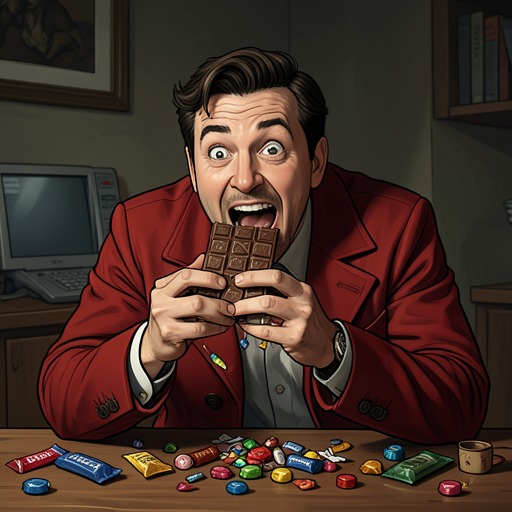
Charlie and the Chocolate FactoryAugustus Gloop is a greedy, nine-year-old boy whose defining passion is eating, especially chocolate. He is the first child to find a Golden Ticket for Willy Wonka's factory tour, but the prize does not transform his appetite into self-control. Instead, his hunger carries him from the public excitement of the worldwide ticket hunt into the factory's first major accident, where he falls into the Chocolate River and disappears up a pipe.
Identity and Introduction
Augustus is introduced in the children's roll call as a greedy boy, a description that establishes him through a single dominant trait rather than a complex private history. The newspaper portrait emphasizes his enormous size, making appetite visible in his body as well as in his behavior. His mother presents his eating as a hobby and claims that he would not eat so much unless he needed nourishment, while also treating his success as a source of family pride. The family's defense of him makes his gluttony seem normalized at home rather than corrected.
His identity is therefore tied to excess at several levels: he is physically enormous, consumes chocolate habitually, and is publicly celebrated because that consumption makes finding a Golden Ticket almost inevitable. The contrast with Charlie Bucket's scarcity is especially sharp. Charlie receives a chocolate bar only as a rare birthday gift, whereas Augustus's daily appetite gives him repeated access to the commodity that the rest of the world is frantically pursuing.
The Golden Ticket and Public Fame
Willy Wonka's announcement limits the factory visit to five children and hides five Golden Tickets beneath the wrappers of ordinary Wonka bars anywhere in the world. The announcement turns chocolate buying into a global competition. Adults tear open multiple bars in sweet shops, children smash their piggy banks, and even a bank robber spends a thousand pounds on chocolate while searching for a ticket. Augustus's victory consequently appears as the first proof that the contest can be won.
The next day, the newspaper announces that Augustus has found the first ticket and prints his picture on the front page. His mother explains that he eats so many bars of chocolate each day that it was almost impossible for him not to discover one. This detail makes his success both accidental and causally appropriate: he does not overcome scarcity through patience or ingenuity, but encounters the prize through relentless consumption. The ticket also converts a private habit into public spectacle, making Augustus one of the five famous children before he has entered the factory.
When the children gather outside the factory gates, Augustus stands with his parents among the carefully protected ticket holders. The crowd and the policemen turn the children into a media event, while their parents restrain them from climbing over the gates. When Willy Wonka welcomes the group, Augustus is the first child to step forward, give his name, and enter with his parents. Wonka greets him with elaborate enthusiasm, a response that briefly presents the greedy boy as an honored guest before the factory begins testing the children's conduct.
Appetite in the Chocolate Room
Augustus's decisive action occurs beside the Chocolate River. While Willy Wonka is explaining the Oompa-Loompas and describing the cacao bean as the substance from which all chocolate is made, Augustus quietly sneaks down to the riverbank. He kneels beside the water and scoops hot melted chocolate into his mouth as fast as possible.
The setting intensifies the temptation. The river is not merely a supply of confectionery; it is a vast, visible stream of chocolate inside the factory, where the material usually enclosed in wrappers has become part of the landscape. Augustus responds to this abundance as though restraint were impossible. He ignores the tour, the adults, and the danger of the river in order to consume the product directly from its source.
His mother warns him that he may give his cold to a million people, and his father tells him to be careful because he is leaning too far out. The warnings reveal that Augustus's parents recognize the immediate danger but do not establish an effective boundary before the accident. His appetite has already carried him beyond ordinary participation in the tour: he is no longer looking at the factory's marvels but trying to ingest them.
The Fall and Its Consequences
Mr Gloop is correct about the danger. Augustus suddenly shrieks, splashes into the Chocolate River, and disappears beneath its brown surface in a single instant. His mother turns white and cries for help, explaining that he cannot swim even a yard. His father refuses to dive in because he is wearing his best suit, an exchange that combines genuine panic with the parents' comic inability to manage the crisis.
The river does not simply wash Augustus away. It draws him into the factory's system, and he is soon associated with the pipe that carries chocolate onward. His fall makes his body part of the machinery of production: the boy who could not stop consuming chocolate is physically absorbed into the route through which chocolate travels. The scene converts gluttony into a grotesque form of industrial consequence, while the adults and the watching children are left to witness the result.
Augustus's accident also establishes the factory tour as more than a reward or spectacle. The Golden Ticket promises access to Wonka's secrets and magic, but each child's behavior determines how that access becomes dangerous. For Augustus, the first test is not a hidden puzzle but the ability to stand beside unlimited food without taking it. He fails immediately, and the factory's abundance exposes rather than satisfies his desire.
Narrative Role and Thematic Significance
Augustus is a deliberately flat character in the sense that nearly every supplied detail returns to one idea: appetite without control. His size, his mother's explanation, the chocolate bars that lead him to the ticket, his first movement into the factory, and his plunge into the river all repeat the same pattern. This repetition gives him instant recognizability and makes his accident feel like a consequence prepared by his introduction rather than an unrelated surprise.
At the same time, Augustus's story connects personal behavior to the wider economics of the Golden Ticket contest. Wonka manufactures scarcity by hiding only five tickets, while the announcement creates a worldwide buying frenzy. Augustus succeeds because his excessive consumption already matches the contest's commercial logic. The same habit that makes him a successful consumer makes him unable to treat the factory's products as anything other than objects for immediate consumption.
The Oompa-Loompas' background sharpens that contradiction. Willy Wonka explains that they came from Loompaland, where cacao beans were extraordinarily scarce: an Oompa-Loompa might find only three or four a year, and the tribe longed for them above all other food. Wonka brings the entire tribe to his factory, where they work, speak English, make music, and have access to cacao beans and chocolate. Against that account of scarcity, Augustus's uncontrolled access appears morally and narratively excessive. The factory joins hunger, labor, production, and pleasure in one enclosed world, and Augustus becomes the child who mistakes abundance for an invitation to consume without limit.
His role also supports Wonka's larger system of spectacle. The ticket contest generates headlines, crowds, reporters, and worldwide attention; Augustus's public fame then turns into the first dramatic incident inside the factory. The children are not merely visitors but visible examples whose conduct gives the factory's wonders and warnings an audience. Even Wonka's later vision of television chocolate, in which viewers would be told to take a Wonka bar directly from the screen, extends the same logic of immediate access that Augustus embodies. Augustus is the cautionary extreme of a world where desire is continually stimulated, packaged, and placed within reach.