Augustus Gloop song
Charlie and the Chocolate FactoryThe Augustus Gloop song is the Oompa-Loompas’ musical response to Augustus Gloop’s plunge into the Chocolate River at Wonka’s factory. It is both a comic interlude and a formal act of judgment: the song turns the consequences of Augustus’s uncontrolled appetite into a public lesson about greed, bodily excess, and the limits of indulgence.
Occasion and Performance
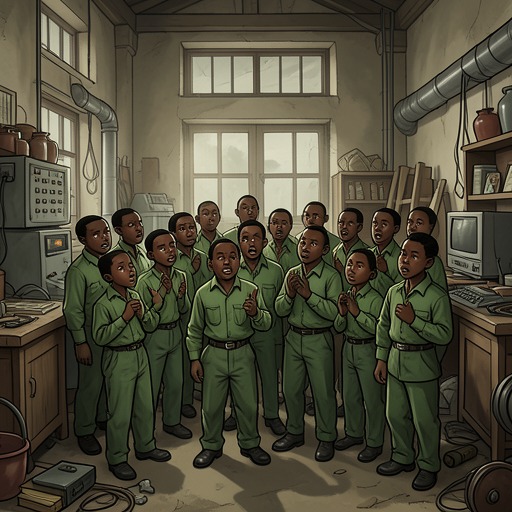
The song begins after Augustus Gloop has leaned too far over the Chocolate River, fallen into its brown surface, and disappeared beneath it. As Mr and Mrs Gloop hurry away with their small escort, five Oompa-Loompas on the far side of the river hop and dance while beating small drums. Their repeated chant of “Augustus Gloop!” announces the subject before the song develops into a spectacle of rhythm and ridicule.
Charlie Bucket recognizes that a song is about to begin and asks Grandpa Joe what the Oompa-Loompas are doing. The performance therefore becomes part of the factory tour itself: the children and adults do not merely hear an explanation of Augustus’s fate but watch the factory’s workers interpret it. The Oompa-Loompas’ dancing and drumming give the episode a ceremonial shape, making Augustus’s removal from the tour feel like one installment in a recurring system of consequences.
Greed Made Bodily
The song identifies Augustus as “The great big greedy nincompoop!” Its central image is not simply that of a child who likes chocolate, but of a body visibly enlarged by appetite. Augustus has already been presented as enormously fat, with flabby folds of flesh and a face compared to a huge ball of dough; the song converts that grotesque appearance into a moral sign. His body appears to display what his character cannot restrain.
The performance also links greed with the destruction of ordinary pleasure. The Oompa-Loompas sing of a child who cannot tolerate even the smallest amount of fun or happiness for anyone else, and they describe their response as using “the gentle touch” before carefully taking the offending child away. The apparently mild language is comic because it surrounds a frightening transformation of scale: Augustus’s appetite has led him into the river, while the workers’ measured intervention removes him from the scene.
A Comic Moral Mechanism
The song’s method is deliberately double-edged. It is a punishment, but it is delivered through music, choreography, repetition, and grotesque humor rather than solemn preaching. The Oompa-Loompas do not merely report that Augustus has been taken from the river; they arrange his fate into a memorable pattern that the other children can recognize when later misbehavior produces its own consequences.
Mr Wonka intensifies this ambiguity after the performance by praising the Oompa-Loompas’ singing and insisting that the audience must not believe their words because it is all nonsense. The disclaimer makes the song more, rather than less, revealing. Its rhymes are presented as playful nonsense, yet they clearly organize the factory’s moral logic: excessive appetite is exposed, bodily danger follows, and the group converts the incident into entertainment and instruction.
Relation to the Factory’s Wider Pattern
The Augustus Gloop song establishes the form later associated with the other children’s punishments. At the factory, bodily change repeatedly makes conduct visible: Augustus disappears into the Chocolate River, Violet Beauregarde becomes the brilliant purplish-blue color of blueberry juice, Veruca Salt is pushed head first into the rubbish chute by squirrels, and Mike Teavee is reduced to a boy no more than an inch tall. The Augustus song is the first fully developed musical interpretation of this pattern.
Its imagery also belongs to the factory’s larger grotesque world, where eating, chocolate production, machines, and human bodies continually cross their boundaries. Augustus’s appetite draws him physically into the chocolate-making process, and the song gives that invasion a social meaning. The danger is not abstract: it is enacted through a body that reaches, falls, disappears, and must be removed.
Narrative and Thematic Significance
As a recurring type of factory performance, the Augustus Gloop song helps make the tour episodic and judgmental. Each child’s behavior is followed by a spectacular consequence, and the Oompa-Loompas’ songs provide a chorus that interprets what has happened. Their collective voice contrasts with the adults’ frantic reactions and with the children’s selfish demands, supplying a communal perspective on conduct that the families themselves often refuse to acknowledge.
The song’s decisive significance lies in its conversion of appetite into narrative form. Augustus’s greed is first displayed through his size, then enacted through his dangerous reach toward the Chocolate River, and finally preserved in the Oompa-Loompas’ chant. Music turns a moment of physical peril into a lasting moral emblem: the child who treats consumption as his defining activity becomes the subject of a song in which the whole factory can recognize, repeat, and mock the consequences of excess.