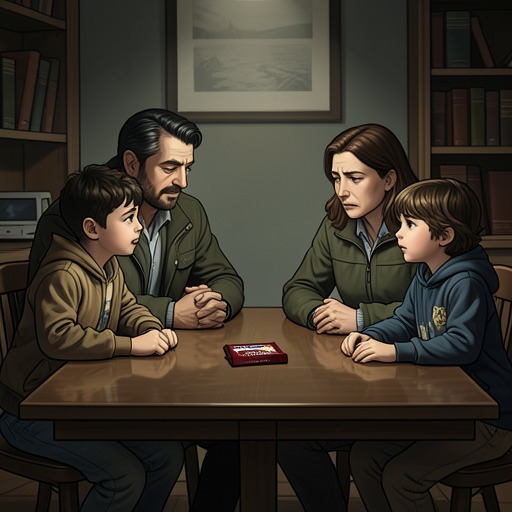
Augustus Gloop–Mr and Mrs Gloop
Charlie and the Chocolate FactoryAugustus Gloop–Mr and Mrs Gloop is one of the clearest family relationships in the factory tour: Augustus is presented as an enormous nine-year-old whose appetite governs his behavior, while Mr and Mrs Gloop alternately defend, restrain, and fail to control him. Their relationship turns food into both family identity and narrative danger. Mrs Gloop treats Augustus’s compulsive eating as evidence of health and nourishment; Augustus treats chocolate as an object to be consumed immediately; and Mr Gloop, although more cautious, cannot prevent the consequences when his son ignores every warning at the Chocolate River.
Family Identity and Public Image
Augustus Gloop first enters the story through the publicity surrounding his discovery of a Golden Ticket. The newspaper image emphasizes his extraordinary size, describing a nine-year-old so enormously fat that he appears to have been inflated by a powerful pump, with flabby folds bulging from every part of his body and a face resembling a monstrous ball of dough. His physical appearance makes his appetite publicly visible before the family ever reaches Wonka's factory. Augustus is not introduced as an independent personality so much as the embodiment of eating taken to a grotesque extreme.
Mrs Gloop openly confirms that appetite is the organizing principle of her son's life. She tells newspapermen that he eats so many bars of chocolate each day that finding a Golden Ticket was almost inevitable, adding that eating is his hobby and that it is the only thing in which he is interested. Her defense turns excess into a form of parental pride. She argues that Augustus would not eat so much unless he needed nourishment and insists that the food is all vitamins. In doing so, she refuses to recognize appetite as a problem and presents his consumption as reasonable, even admirable.
The family's public celebration also reveals how closely the parents identify themselves with Augustus's success. His discovery produces newspaper attention, holiday excitement, and a parade in his honor. Mrs Gloop speaks as a proud mother whose son's appetite has brought him distinction, while Augustus's size becomes part of the spectacle. The family therefore arrives at the factory carrying a public image already shaped by consumption: Augustus is famous because he eats, and his parents have helped make that behavior appear harmless.
Appetite, Indulgence, and Parental Authority
At the Chocolate River, the relationship's central conflict becomes physical. Augustus quietly sneaks down to the riverbank and kneels beside the hot melted chocolate, scooping it into his mouth as quickly as possible. Mrs Gloop immediately protests, but her warning is framed less as a moral condemnation than as anxious pleading. She begs Augustus not to touch the river and repeats that he should come away, while Augustus ignores both her and Willy Wonka because the chocolate seems fabulous to him.
Augustus's reply shows the narrowness of his desire. He does not marvel at the river as an invention or wait for permission to taste it; he wants a bucket so that he can drink it properly. The scale of the Chocolate River, which contains thousands of gallons of chocolate each hour and is circulated through enormous glass pipes, only magnifies his appetite. For Augustus, abundance does not create wonder or restraint. It creates an irresistible opportunity to consume more.
Mrs Gloop's warnings remain ineffective because the family has already taught Augustus that eating is central to his identity and need not be questioned. Her earlier claim that he eats for nourishment is contradicted by the scene at the river, where he continues despite explicit instructions and despite the danger of leaning over the bank. She can protest, but she has no authority capable of interrupting the appetite she has celebrated. The relationship thus exposes a contradiction between parental affection and parental discipline: Mrs Gloop wants to protect Augustus, yet her habitual defense of him has helped normalize the behavior that endangers him.
Mr Gloop responds differently but is no more successful. He warns Augustus that he is leaning too far out, a practical observation that proves correct almost immediately. When Augustus falls into the chocolate, Mr Gloop first refuses to dive in because he is wearing his best suit, then begins removing his jacket and preparing to enter the river. His response is slower and more self-conscious than Mrs Gloop's frantic appeals, but it still reflects parental concern. The difference between the parents is not that one cares and the other does not; it is that Mrs Gloop reacts through emotional pleading while Mr Gloop moves from hesitation toward physical intervention.
The Chocolate River Crisis
The fall transforms the family's ordinary pattern of indulgence into an emergency. Augustus disappears beneath the brown surface, and Mrs Gloop goes white, waving her umbrella and screaming that he will drown because he cannot swim even a yard. When Augustus's chocolate-covered face rises again, he cries for help and asks to be fished out. The scene briefly reverses the family's earlier public image: the celebrated eater is no longer a comic figure of abundance but a child trapped inside the substance he could not resist.
Mr Gloop's attempt to prepare for a rescue is overtaken by the factory's machinery. Augustus is drawn closer and closer to the mouth of one of the great glass pipes. Powerful suction takes hold of him, pulls him beneath the surface, and carries him into the pipe. The parents are forced to watch the consequence of his appetite through the transparent machinery. Augustus shoots upward head first, like a torpedo, while chocolate swishes around him and gathers behind his body as a solid mass.
The pipe makes the family’s helplessness especially stark. The parents can see Augustus, hear the commotion, and understand that pressure is building, yet they cannot reach him. Mrs Gloop demands that the pipe be smashed and shouts for Augustus to come out, while Mr Gloop has no effective answer. When Augustus disappears from view, she calls for the fire brigade. Her earlier indulgent certainty has become panic, but panic cannot undo the permission and habit that brought him to the river.
Parents Against Wonka's Detachment
Willy Wonka repeatedly insists that there is no danger and describes Augustus's passage as an interesting journey from which he will emerge safely. Mrs Gloop rejects this reassurance. She imagines that her son will be turned into marshmallows and, when Wonka explains that the pipe leads to the room where he makes strawberry-flavored, chocolate-coated fudge, she insists that Augustus will instead be made into that confection and sold by the pound throughout the country. Mr Gloop agrees that this is possible, making the parents' fear more concrete even as Wonka treats the situation as absurd.
The confrontation exposes incompatible understandings of what has happened. For the parents, Augustus is a vulnerable child who must be rescued from an industrial process. For Wonka, the factory's processes remain ordinary and controlled, and Augustus's movement through them is an amusing consequence rather than a catastrophe. Mrs Gloop is therefore outraged when Wonka laughs. She accuses him of treating the boy's suction into the Fudge Room as a colossal joke and points her umbrella at him as though it were a weapon. Her anger is the strongest assertion of parental protection in the episode, but it arrives only after the danger has become unavoidable.
Wonka finally orders an Oompa-Loompa to take Mr and Mrs Gloop to the Fudge Room and help them find Augustus. The instruction acknowledges the parents' need to pursue their son while preserving Wonka's authority over the factory and its machinery. The Oompa-Loompa's immediate laughter intensifies the parents' humiliation and distress, and Wonka has to tell him to control himself because Mrs Gloop does not find the incident funny. The family leaves the riverbank not through its own success, but through the factory owner's intervention.
Narrative Significance of the Relationship
The relationship between Augustus and his parents links private family behavior to the factory's wider moral pattern. Augustus's hunger is not the same as Charlie Bucket's poverty-driven longing for food and chocolate. Charlie Bucket may receive only one small chocolate bar each year and carefully make it last for more than a month, whereas Augustus has access to so much chocolate that his daily eating becomes the source of his fame. The contrast separates need from excess: Charlie's desire is shaped by scarcity, while Augustus's appetite has been enlarged and publicly rewarded by abundance.
The family also mirrors the factory's movement of food through bodies, pipes, and production rooms. Willy Wonka's Chocolate River is designed to be mixed by a waterfall and pumped through glass pipes to other parts of the factory. Augustus enters that circulation as though he were another substance being transported. His parents' horror comes partly from seeing the boundary between person and product collapse: the boy who consumes chocolate risks becoming part of the chocolate-making process himself.
The relationship's decisive pattern is therefore not simple parental love versus childish disobedience. Mrs Gloop's proud rationalization, Augustus's refusal to stop, Mr Gloop's delayed rescue attempt, and the parents' shared powerlessness form a chain of cause and consequence. They have accompanied Augustus into a world where appetite is rewarded, but the factory converts that appetite into peril. Their bond remains emotionally intense throughout the crisis, yet it cannot protect Augustus from the behavior that the family has treated as his defining virtue.