Charlie Bucket finds the fifth Golden Ticket
Charlie and the Chocolate FactoryCharlie Bucket finds the fifth Golden Ticket at the precise moment when hunger, chance, and disciplined generosity converge. The discovery ends the worldwide search for Willy Wonka's last ticket, gives Charlie access to Wonka's factory, and turns a starving boy's small purchase into a public event with consequences for his entire family.
Causes and Background
The event is rooted in Charlie's severe poverty and persistent hunger. Mr Bucket is the only member of the household with a job, and his work at a toothpaste factory does not provide enough money for proper food. The family survives on bread and margarine, boiled potatoes and cabbage, and cabbage soup; Charlie feels the deprivation most sharply because his parents often surrender their own portions to him, yet the food remains insufficient for a growing boy. His strongest desire is chocolate, a food he sees through shop windows but almost never tastes.
Chocolate has therefore become both an object of hunger and a ritual of restraint. Once a year, on Charlie Bucket's birthday, the family saves enough money to give him one small bar. Charlie places it in a wooden box and treats it as if it were solid gold, taking tiny nibbles over more than a month. The contrast between this carefully rationed sixpenny bar and the lavish promise attached to the Golden Tickets makes the later discovery more than a lucky prize: it is a reversal of the material conditions that have governed his daily life.
The immediate background is Willy Wonka's announcement that five children, and only five, will be admitted to Wonka's factory. The selected finders are promised a personal tour, access to the factory's secrets and magic, and enough chocolates and sweets to last for the rest of their lives. Five tickets are hidden beneath the ordinary wrappers of five Wonka bars, potentially anywhere in the world. The announcement converts chocolate from a scarce treat into a global search mechanism, using concealment, limited supply, and the authority of Wonka's name to generate an extraordinary buying frenzy.
That frenzy exposes the unequal resources available to the contestants. Adults buy ten bars at a time, children smash their piggy banks, and a gangster spends a thousand pounds stolen from a bank on Wonka bars. A supposed second ticket in Russia proves to be a fake, while Professor Foulbody's machine for detecting tickets without opening wrappers is destroyed after its mechanical arm seizes the gold filling in a duchess's tooth. By the day before Charlie Bucket's birthday, four tickets have effectively been claimed, including one by Veruca Salt, leaving the final ticket as the object of worldwide speculation and commercial obsession.
What Happens
Charlie has been growing thinner and weaker, with a frighteningly pale, pinched face and skin drawn tightly over his cheekbones. He adapts to his failing strength with remarkable practicality: he leaves home earlier so that he can walk slowly to school, rests during break instead of playing in the snow, and performs every task carefully to avoid exhaustion. The discovery begins during the journey home, when he is hungrier than ever and notices something silvery lying partly buried in the snow in a gutter.
Charlie steps off the kerb and finds a fifty-pence piece. He carefully pulls the damp, dirty coin free and holds it between his shivering fingers. At that instant, the money has one immediate meaning: food. The coin is not first experienced as an abstract financial resource or as the possible instrument of a miraculous change; it is the material answer to an empty stomach.
He turns automatically toward the nearest newspaper and stationery shop, which also sells sweets. Charlie decides that he will buy one luscious bar of chocolate and eat it at once, while taking the remaining money home to his mother. This plan preserves the family relationship that poverty has made central: even at the edge of starvation, Charlie does not imagine spending everything on himself. His desire for chocolate is intense, but it is bounded by the intention to return most of the money to his household.
Inside the shop, Charlie lays the coin on the counter and asks for a Wonka's Whipple-Scrumptious Fudgemallow Delight, remembering how much he enjoyed the one received on his birthday. He tears off the wrapper and eats rapidly, taking enormous bites and then continuing until the entire bar has disappeared in less than half a minute. The shopkeeper warns him to take it slowly, but Charlie cannot stop. Afterward he is out of breath and extraordinarily happy, having briefly escaped the bodily misery that has defined his recent days.
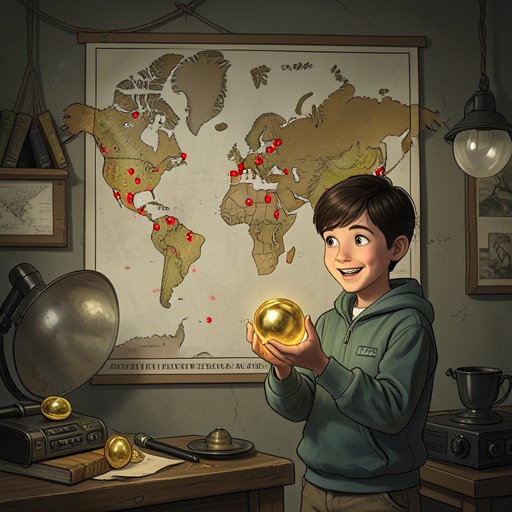
The shopkeeper places Charlie's change on the counter: nine five-pence pieces. Charlie pauses before taking it. The sight of the coins turns his single purchase into a temptation. He quietly asks for one more bar of the same kind, and the shopkeeper agrees. Charlie picks it up and tears open the wrapper; beneath it comes a brilliant flash of gold. His heart appears to stop, while the ordinary chocolate wrapper suddenly reveals itself as the covering for the last and most valuable object in the contest.
The shopkeeper identifies it as a Golden Ticket and announces that Charlie has found Wonka's last one. He leaps into the air, calls for other people to look, urges Charlie not to tear the precious ticket, and celebrates the fact that the discovery has happened in his own shop. Within seconds, about twenty people crowd around Charlie, with more pressing in from the street. The ticket has changed the social meaning of the shop: a private purchase has become a spectacle, and Charlie himself has become the center of public attention.
Immediate Consequences
Charlie remains motionless amid the shouting crowd, holding the ticket tightly in both hands without even fully unwrapping it from the chocolate. He feels dizzy and weightless, as though he were floating like a balloon, while his heartbeat thumps in his throat. The physical reaction records the gap between the event's humble cause and its enormous significance: a starving child has found the one object capable of opening Wonka's sealed world.
The crowd immediately translates the ticket into monetary value. A man offers Charlie fifty pounds and a new bicycle, while a nearby woman offers two hundred pounds. Charlie refuses to sell it. His decision preserves the event's narrative direction: the ticket is not exchanged for a short-term improvement but retained as access to the factory, its promised wonders, and the supplies that may sustain his family.
The fat shopkeeper responds with personal warmth rather than calculation. He says that he has a feeling Charlie needed a break like this and expresses gladness that Charlie received it. Charlie thanks him and runs through the snow toward home. As he passes Wonka's factory, he waves at it and announces that he will be seeing it soon. The gesture joins the found ticket to the destination it unlocks, turning the factory from a distant source of longing into an imminent place in Charlie's future.
The discovery also makes Charlie the subject of immediate media pursuit. After he reaches home, Mr Bucket reads Wonka's instructions aloud to the family: the visit is scheduled for the first day of February at ten o'clock in the morning, Charlie may bring one or two family members, and the ticket must be present for admission. The promise extends beyond the visit itself, offering trucks loaded with food for Charlie and his household, continued refills if supplies run out, and further surprises inside the factory.
The family's private celebration is quickly overwhelmed by publicity. A loud knock brings swarms of newspapermen and photographers, who have tracked down the finder of the fifth ticket and demand his story for the morning papers. The small house remains in pandemonium for hours, and Mr Bucket cannot dismiss the reporters until nearly midnight. Charlie's luck therefore produces two kinds of abundance at once: the promised abundance of food and sweets, and the intrusive abundance of public attention.
Narrative Significance
Charlie Bucket's discovery is a sharp value reversal from starvation to possibility. Before the event, fifty pence means a meal and perhaps a small act of sharing; after it, the same purchase yields entry into Wonka's world and the prospect of a lifetime of supplies. The reversal is not created by Charlie's deliberate pursuit of wealth. It occurs while he is following the most immediate logic of hunger, and its force comes from the collision between an ordinary chocolate bar and the extraordinary secret beneath its wrapper.
The scene also makes consumption into a form of narrative selection. Across the world, the Golden Ticket contest encourages frantic purchasing, speculation, machines, theft, and media circulation. Charlie, by contrast, enters the contest with one coin found in the snow. His access to the prize is inseparable from his poverty, because the reader understands exactly what the chocolate means to him as food before it becomes a route to fame. The ticket thus exposes the inequality surrounding the contest while temporarily overturning its expected hierarchy.
The object itself carries the event's central tension. The ticket is hidden under an ordinary wrapper, so its extraordinary value is invisible until the wrapper is torn. Chocolate functions first as a scarce birthday treasure, then as immediate nourishment, and finally as the medium through which Wonka's invitation reaches its chosen recipient. The later promise that televised viewers may reach out and take Wonka chocolate from their screens extends the same logic: the brand seeks to make desire instantaneous, turning attention, appetite, and wonder into a continuous channel of circulation.
Most importantly, the discovery establishes Charlie's entrance into the factory tour while preserving the family as the event's true horizon. Wonka's invitation allows one or two relatives to accompany each child, and the promised trucks are said to carry enough food for the entire household for many years. Charlie's victory is therefore not presented merely as individual enrichment. It carries the possibility of restoring the household that has fed him from its own already inadequate portions, making the final Golden Ticket both a personal miracle and a family deliverance.