Charlie Bucket's birthday
Charlie and the Chocolate FactoryCharlie Bucket's birthday is both a sharply limited celebration and a turning point in the story. In a family too poor to buy a better house or even another bed, the birthday chocolate bar represents rare nourishment, carefully preserved pleasure, and the possibility that an ordinary day might open into something extraordinary. The birthday immediately preceding the discovery of Charlie's Golden Ticket brings those meanings together: it is the occasion of his only annual chocolate bar, the moment when he dares to imagine finding a Golden Ticket, and the threshold between the family's habitual scarcity and the astonishing promises of Willy Wonka.
Poverty and the Annual Ritual
Charlie Bucket's birthday is defined by scarcity rather than abundance. The Bucket family sleeps on mattresses on the floor, and winter draughts blow across the room, while the family cannot afford either a better house or even one more bed. Mr Bucket is the only family member with a job, working in a toothpaste factory as a cap-screwer, yet his wages cannot provide enough food for the household. Their meals consist of bread and margarine for breakfast, boiled potatoes and cabbage for lunch, and cabbage soup for supper; Sunday offers the small luxury of a second helping.
Charlie feels the resulting hunger most severely. His parents often surrender their own portions of lunch or supper to give him more, but even their sacrifice cannot satisfy a growing boy. Chocolate therefore signifies more than confectionery. It is the food he longs for above all else, the bright opposite of cabbage and cabbage soup, and an object made almost unbearably desirable by its absence. On the way to school, he sees slabs of chocolate stacked in shop windows and watches other children eat bars in front of him. The ordinary act of buying and consuming chocolate becomes, for Charlie, a daily spectacle of deprivation.
Once a year, the family saves its money so that Charlie can receive one small chocolate bar on his birthday. The gift is not treated as an incidental sweet but as a precious household event. Charlie places the bar in a small wooden box and guards it as though it were solid gold. He delays eating it, first allowing himself only to look at it, then exposing a tiny corner and taking a tiny nibble. By repeating this ritual day after day, he makes a sixpenny bar last for more than a month. The birthday thus extends beyond a single morning: it creates a carefully rationed afterlife of pleasure, in which restraint is the condition that allows the gift to endure.
The Birthday Before the Golden Ticket
The birthday becomes especially charged when Charlie's mother reminds him that the next day is his birthday and promises that his present will be a Wonka chocolate bar. Charlie immediately recognizes the brand and asks whether it is truly a Wonka bar. His excitement is inseparable from the contest surrounding Willy Wonka's factory, because five Golden Tickets have been hidden beneath the wrappers of ordinary Wonka chocolate bars and the finders alone will be admitted to the factory.
Charlie knows how unlikely his hope is. Grandpa George states that the children who find the tickets will be those who can afford to buy chocolate every day, whereas Charlie receives only one bar a year. The contrast exposes the contest's unequal starting conditions: its public language presents the tickets as a matter of luck, but repeated purchasing depends on money. Charlie's birthday bar is therefore both a gift and a single chance within a worldwide buying frenzy that includes adults purchasing ten bars at a time, children smashing piggy banks, and a gangster spending a thousand pounds stolen from a bank on Wonka bars.
Even after the second ticket is found by Veruca Salt, Charlie allows himself to imagine that his own bar might contain the third. His thought is expressed as a wish rather than a plan, and the family treats the unwrapping as something to witness together. Grandpa Joe asks Charlie to bring the bar in so that everyone can watch him remove the wrapper. The birthday gift consequently becomes a collective ritual: the chocolate belongs to Charlie, but the suspense belongs to the whole household.
The Unwrapping and Its Immediate Meaning
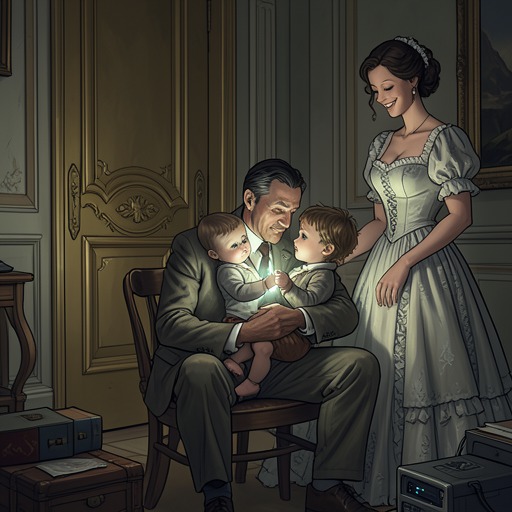
On the morning of his birthday, Charlie enters the room where the four old grandparents are waiting to wish him a happy birthday. He sits nervously on the edge of the bed, holding his only present with great care. The wrapper identifies it as Wonka's Whipple-Scrumptious Fudgemallow Delight, while the grandparents, propped on their pillows at either end of the bed, stare anxiously at the bar. Mr and Mrs Bucket stand at the foot of the bed and watch as well.
The scene gives the birthday a precise emotional structure. Charlie is surrounded by family, but the household's attention converges on a single inexpensive object because the object carries an immense value for them. The bar contains nourishment, pleasure, the memory of annual sacrifice, and the remote possibility of transformation. Its wrapper is therefore not merely packaging: within the contest's logic, it may conceal access to Willy Wonka's factory, and the act of opening it becomes a test of hope against probability.
The birthday does not erase poverty before the ticket is found. Instead, it makes poverty visible through the family's anxious concentration on one bar and through the care with which Charlie handles it. The family's affection also appears through deprivation: his parents have gone without food for him, and the four grandparents share the suspense of his gift. The celebration is modest in material terms but expansive in emotional importance.
From Private Gift to Public Event
The Golden Ticket changes the birthday's scale. Willy Wonka's notice promises the five finders a personal tour of the factory, access to its secrets and magic, and enough chocolate and sweets to last for the rest of their lives. The invitation specifies that the visit will take place on the first day of February at ten o'clock in the morning, that each child may bring one or two family members, and that the ticket must be present at the factory gates for admission. It also promises that trucks will escort the children home with food for their households, and that the factory will refill their cupboards if their supplies later run out.
For Charlie's family, these promises directly answer the conditions embodied by the birthday bar. A small, slowly consumed sixpenny treat is set against the prospect of continual supplies and trucks loaded with food for the entire household. Chocolate moves from rare gift to imagined economic security. At the same time, the contest's language turns consumption into spectacle and brand loyalty into access: ordinary wrappers conceal extraordinary privileges, while the factory's secrets and promised surprises make the product a gateway to a larger world.
The birthday also becomes the point at which the family is pulled into the machinery of publicity. After Charlie is identified as the fifth finder, swarms of newspapermen and photographers track him down and pour into the little house. Several hours of interviews and disorder follow, and Mr Bucket cannot remove them until nearly midnight, delaying Charlie's sleep after the birthday's intimate morning ritual. The day that began with four grandparents watching one carefully held bar ends with the family under the gaze of the press.
Narrative and Cultural Significance
Charlie Bucket's birthday links three systems that otherwise seem separate: household survival, consumer desire, and mass communication. The family's hunger makes chocolate materially significant; the annual gift turns it into a sacred object; the Golden Ticket contest converts that object into a lottery mechanism; and the newspapers transform the finder into public news. The birthday is the hinge through which private longing becomes a global event.
Its power also lies in contrast. Other children can search by buying repeatedly, while Charlie receives one bar and must make it last more than a month. The worldwide hunt celebrates abundance and frantic purchasing, but Charlie's birthday presents chocolate as something to be preserved, inspected, and shared emotionally even before it is eaten. That difference establishes Charlie not as the strongest consumer but as the child most conscious of an object's value.
The birthday's final significance is prospective. The bar is initially only a modest present, yet it carries Charlie from the floor mattresses and cabbage meals toward the factory gates, where Willy Wonka's promises of spectacle and lifelong food supplies await. In this way, Charlie Bucket's birthday is not simply a date in the family calendar. It is the narrative's concentrated image of deprivation, tenderness, suspense, and the sudden conversion of a small domestic ritual into a life-changing public adventure.