Charlie Finds the Fifth Golden Ticket
Charlie and the Chocolate FactoryCharlie Finds the Fifth Golden Ticket is the decisive reversal in Charlie Bucket's fortunes: a starving child who can normally taste chocolate only once a year becomes the final winner of Willy Wonka's Golden Ticket contest and gains entry to Wonka's Chocolate Factory. The discovery transforms chocolate from an object of distant desire into the means of rescue, public recognition, and a promised encounter with the factory's secrets.
Causes and Background
Charlie’s discovery takes place against the poverty that has defined his daily life. Mr Bucket is the only member of the household with a job, working in a toothpaste factory as a cap-screwer, yet his wages cannot provide enough food for the large family. Their meals consist largely of bread and margarine, boiled potatoes and cabbage, and cabbage soup; Sundays are better only because everyone may have a second helping. Charlie feels the hunger most sharply, even though Mr Bucket and Mrs Bucket often surrender their own portions to him.
Chocolate therefore has a double meaning for Charlie. It is both an intensely desired food and a symbol of abundance that remains almost entirely beyond his reach. He sees slabs of it in shop windows and watches other children eat it, while his own family can afford only one small bar for him on his birthday. Charlie preserves that birthday bar in a small wooden box, taking tiny nibbles so that a sixpenny bar lasts for more than a month. His careful handling of the chocolate reveals not greed but the discipline imposed by scarcity: pleasure must be rationed because food itself is uncertain.
The Golden Ticket contest creates a global market of expectation around this private longing. A newspaper headline announces that the Wonka factory will open to five children, and Willy Wonka’s notice promises each finder a personal tour, access to the factory’s secrets, and enough chocolate and sweets to last for life. The tickets are hidden beneath the ordinary wrappers of five Wonka bars and may be anywhere in the world. The ordinary chocolate bar thus becomes a lottery device, while the wrapper conceals a sudden passage from common consumption to exceptional privilege.
The contest also produces a worldwide buying frenzy. Adults purchase ten bars at a time, children smash their piggy banks, and a gangster spends a thousand pounds stolen from a bank on Wonka bars before being found among mountains of chocolate. A supposed ticket in Russia is exposed as a fake, and Professor Foulbody’s machine, designed to detect gold without opening a wrapper, is destroyed after its mechanical arm attacks the gold filling in a duchess’s tooth. By the time the second ticket is found by Veruca Salt, the search has become a spectacle of appetite, money, technology, and media attention. Charlie enters that spectacle with almost none of the resources possessed by the other searchers.
The Discovery
On the afternoon in question, Charlie is weaker than ever. He has grown thinner, and his face has become so white and pinched that he appears close to serious illness. Instead of allowing exhaustion to overcome him, he changes his routine: he leaves home earlier so that he can walk slowly to school, rests during breaks while other children play in the snow, and performs every task carefully to conserve his strength. The discovery begins not with triumph but with a bodily condition produced by hunger and a practical attempt to survive it.
Walking home through the snow and icy wind, Charlie notices something silvery in the gutter. Part of the object is buried beneath the snow, but he recognizes it as a fifty-pence piece. He carefully pulls the damp, dirty coin free and looks around to see whether someone has just dropped it. The coin is small in physical size but immense in consequence: held between his shivering fingers, it means one thing to him at that moment—food.
Charlie immediately heads toward the nearest newspaper and stationery shop, which also sells sweets. His first plan is both urgent and generous. He will buy one luscious bar of chocolate and eat it at once, then take the remaining money home to Mrs Bucket. The coin gives him a momentary choice between immediate relief and family responsibility, and he imagines doing both rather than treating the money as his private possession.
He eats the first bar almost uncontrollably. In less than half a minute, the chocolate has disappeared, leaving him breathless but extraordinarily happy. When he reaches for his change, he sees nine five-penny pieces on the counter. The sight of the remaining coins creates the event’s crucial temptation. Charlie quietly decides to buy one more bar of the same kind, the Whipple-Scrumptious Fudgemallow Delight, even though the money was meant to return home.
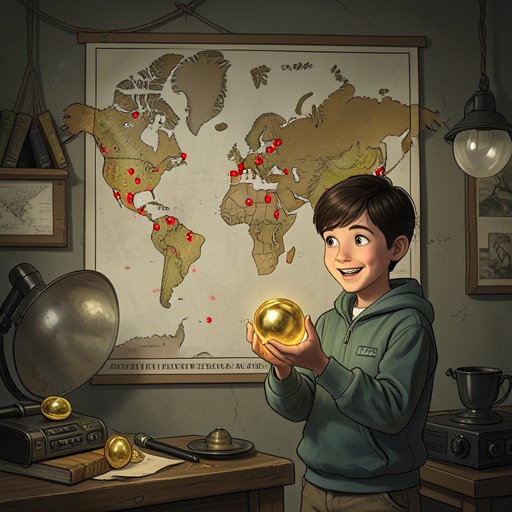
When Charlie tears away the second wrapper, a brilliant flash of gold appears underneath it. His heart seems to stop. The shopkeeper immediately recognizes the object as the last Golden Ticket and cries out that Charlie has found it in his own shop. The announcement draws a crowd of about twenty people, with more pushing in from the street, converting Charlie’s private moment of astonishment into a public spectacle.
Stakes and Immediate Choice
Charlie does not move or even finish unwrapping the ticket. He holds it tightly in both hands while people push and shout around him. He feels dizzy and strangely weightless, as though he were floating like a balloon, and hears his heart beating loudly in his throat. The physical details register the scale of the reversal: the child who has been made almost invisible by poverty suddenly becomes the center of every gaze.
The crowd quickly interprets the ticket as a commodity with a cash value. A tall man offers Charlie fifty pounds and a new bicycle, while a nearby woman offers two hundred pounds. These offers attempt to translate the promise of the Golden Ticket into immediate money, but Charlie’s response is not recorded as a negotiation or calculation. He does not sell it. His refusal preserves the future promised by the ticket: the factory visit, the experience of seeing what is inside, and the possibility of lasting supplies for his household.
The shopkeeper responds differently from the crowd. Rather than exploiting Charlie’s vulnerability, he says that he has a feeling Charlie needed a break like this and wishes him good luck. That response recognizes the discovery as relief for a child in need, not merely as an opportunity for speculation. Charlie thanks him and runs home through the snow, turning as he passes Wonka’s Chocolate Factory to wave at it and announce that he will soon be seeing it.
Consequences and Aftermath
The ticket’s significance becomes clearer when Mr Bucket reads its instructions to the family. Willy Wonka invites the finder to spend one whole day at the factory as his guest, promising to conduct the tour personally. The visitor may bring one or two family members, must arrive at the factory gates at ten o’clock on the first day of February, and will not be admitted without the ticket.
The promised reward extends beyond the tour itself. Large trucks are to escort the visitors home carrying enough delicious food to supply the finder and the entire household for many years. If those supplies ever run out, the ticket holder may return to the factory and have the cupboard refilled with whatever is wanted. For Charlie’s family, this promise directly answers the material deprivation that has shaped his life; the Golden Ticket offers not just sweets but an end to the household’s recurring shortage.
The announcement also changes Charlie’s position within his family. The choice of companion becomes a serious question because only one or two relatives may accompany him. Mrs Bucket cannot leave the other three old people alone for a whole day, while Grandpa Joe celebrates when the possibility arises that he might go with Charlie. The ticket therefore produces a new form of family participation: Charlie’s private discovery becomes a shared household event, and his good fortune reaches beyond his own appetite.
Its public consequences are immediate and overwhelming. Newspapermen and photographers track down the finder of the fifth ticket and pour into the Bucket home, demanding the full story for the morning papers. The little house is thrown into complete pandemonium for several hours, and the visitors do not leave until nearly midnight. Charlie’s poverty has not disappeared in that moment, but the media attention reverses his social visibility: the child who once stood outside shop windows now becomes newsworthy because he possesses the final golden object.
Narrative Significance
The discovery joins hunger, chance, restraint, and spectacle in one tightly arranged sequence. Charlie’s longing for chocolate has been established through empty meals, the yearly birthday bar, and the tiny nibbles that make a sixpenny treat last more than a month. When the fifty-pence piece appears, the story allows him to satisfy that longing before offering the greater prize. The first bar is consumed in seconds; the second, bought under temptation, contains the ticket. Appetite thus becomes the immediate route to revelation, while the golden wrapper turns an ordinary purchase into a life-changing threshold.
The event also contrasts Charlie with the economics of the worldwide contest. Others search through purchasing power, smashed savings, public claims, machines, and frantic accumulation. Charlie has only a coin found in the snow, and even then he plans to take the remainder home to Mrs Bucket. His poverty limits his participation, but it also makes every choice materially intelligible: chocolate is food, the change belongs to the household, and the ticket cannot be reduced to an offer of cash.
The Golden Ticket functions simultaneously as prize, advertisement, invitation, and promise of abundance. Its discovery intensifies Willy Wonka’s brand mythology, drives reporters to Charlie’s home, and prepares the factory visit as a spectacle already surrounded by secrecy and expectation. Later, Wonka imagines an even more direct form of television advertising in which a chocolate bar could be taken from the screen into the viewer’s hands. Against that fantasy of limitless commercial reach, Charlie’s discovery remains tactile and local: a hungry child, a dirty coin, a shop counter, a torn wrapper, and one unmistakable flash of gold. The event is powerful because the immense machinery of the contest finally turns on the smallest possible purchase.