Charlie Wins Wonka’s Factory
Charlie and the Chocolate FactoryCharlie Wins Wonka’s Factory is the climactic reward of Willy Wonka’s Golden Ticket contest: after the other children have disappeared from the tour, Charlie Bucket is the only child left, and Willy Wonka declares that he has won. The prize is not merely a lifetime supply of sweets but the entire Wonka’s Chocolate Factory, which Charlie will inherit when he is old enough to run it. The decision transforms Charlie’s material situation, secures the factory’s future, and turns a day of spectacle into a carefully designed succession test.
Causes and Background
The event grows out of the extraordinary announcement that Willy Wonka, the confectionery genius unseen for ten years, will admit exactly five children to his factory. Five Golden Tickets are hidden beneath the ordinary wrappers of five ordinary Wonka chocolate bars, anywhere in the world where Wonka’s Sweets are sold. The selected children will see the factory’s secrets and magic personally with Willy Wonka, and each will receive enough chocolate and sweets to last for the rest of life.
The contest immediately becomes a worldwide chocolate-buying frenzy. Adults tear open ten bars at a time, children smash their piggy banks, and a gangster spends a thousand pounds on Wonka bars before being found amid mountains of chocolate, opening wrappers with a long dagger. The search therefore operates as both a public game and a vast advertising campaign: scarcity creates urgency, newspapers multiply the excitement, and every purchaser becomes a potential distributor of the Wonka name. Grandpa Joe recognizes the commercial force of the announcement, exclaiming that the whole world will buy Wonka’s chocolate bars and that Willy Wonka will sell more than ever before.
For Charlie, however, participation begins from the opposite economic position. The Bucket family is too poor to buy a better house or even one additional bed, and Charlie receives only one bar of chocolate a year. Grandpa George therefore insists that there is no realistic hope of Charlie finding a ticket, because the children most likely to find one are those who can afford to buy bars every day. Charlie’s eventual victory reverses the assumption that purchasing power determines access to the prize: the child with the fewest opportunities becomes the one selected to inherit the enterprise.
The Hidden Selection Process
The public rules promise five visitors, but the final reward depends on something the announcement does not disclose. The children are not simply being shown the factory as lucky consumers. Willy Wonka later explains that he invited five children and intended the one he liked best at the end of the day to be the winner. The factory tour is thus a concealed evaluation, with its rooms, inventions, warnings, and disappearances functioning as tests of how the children respond to temptation and authority.
The contest’s publicity also makes Charlie’s discovery a media event before the tour begins. When the fifth Golden Ticket is found, newspapermen and photographers track down the family and flood the Bucket home for several hours, creating complete pandemonium before Charlie can go to bed. At the factory gates, enormous crowds gather to watch the five ticket holders enter, while policemen hold the public back. The event is therefore watched from its beginning: the winning child is not only a participant in Wonka’s private experiment but also the focus of a worldwide spectacle.
What Happens in the Great Glass Lift
Near the end of the tour, Willy Wonka turns toward the lift and asks how many children remain. Grandpa Joe answers that there is only Charlie left. Wonka swings around and stares at him, while Charlie stands holding tightly to Grandpa Joe’s hand. The silence marks the instant when the apparent tour becomes a final reckoning. Charlie does not claim the result for himself; the fact is spoken aloud by Grandpa Joe, and Charlie remains quiet as Wonka confirms it.
Willy Wonka then erupts with excitement and tells Charlie that he has won. He shakes Charlie’s hand so vigorously that it nearly comes off, congratulates him repeatedly, and announces that the real fun is now beginning. He urges Charlie and Grandpa Joe into the Great Glass Lift, saying that there are arrangements to make and people to fetch before the day is over. Charlie is intensely excited rather than frightened or nervous, and Grandpa Joe shares that excitement as Wonka reaches for a button high on the lift’s glass ceiling.
The lift carries Willy Wonka, Grandpa Joe, and Charlie high above the town. Looking down at the factory, Wonka expresses his love for it and asks Charlie whether he loves it too. Charlie answers that he thinks it is the most wonderful place in the whole world. Wonka’s serious questioning gives the exchange the weight of a pledge: Charlie’s affection for the factory is not treated as a passing response to its wonders but as evidence relevant to his suitability as its future keeper.
The Inheritance and Its Conditions
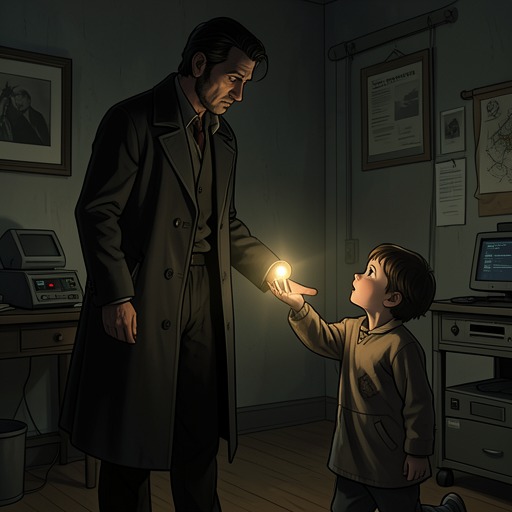
Willy Wonka tells Charlie that he has decided to give him the whole place. As soon as Charlie is old enough to run it, the entire factory will become his. Charlie stares in astonishment, and Grandpa Joe is so shocked that he opens his mouth without finding words. When Grandpa Joe asks whether Wonka is joking, Wonka insists that he is deadly serious. The reward is therefore an actual transfer of ownership, not a ceremonial title or a temporary privilege.
Wonka’s explanation reveals the practical and personal reasons behind the contest. He describes himself as an old man, much older than Charlie might think, and says that he has no children and no family. He cannot continue forever, yet someone must keep the factory operating, if only for the sake of the Oompa-Loompas. Although thousands of clever adults would gladly take over, Wonka rejects them because an adult would not listen, would not learn, and would try to run the factory according to personal methods rather than his own.
The successor must therefore be a child, but not merely any child. Wonka wants a good, sensible, loving child to whom he can disclose his most precious sweet-making secrets while he is still alive. Charlie’s inheritance joins moral judgment to industrial succession: the factory’s future depends on preserving Wonka’s way of making sweets, and Wonka believes that a child capable of listening and learning is more suitable than an ambitious adult. Charlie’s question immediately identifies the purpose of the Golden Tickets, and Wonka confirms that the contest was designed to find the child he liked best.
Consequences and Significance
The victory changes the meaning of the Golden Ticket from a lucky invitation into a succession mechanism. The initial notice promises access to secrets, magic, and lifelong supplies of sweets; the ending discloses that these were the visible rewards attached to a deeper search for an heir. The factory tour has tested the children under conditions of temptation and danger, while the final conversation in the Great Glass Lift makes the hidden objective explicit.
Charlie’s success also creates a sharp contrast with the family’s poverty. The Bucket household cannot afford proper food for everyone and usually eats bread and margarine for breakfast, boiled potatoes and cabbage for lunch, and cabbage soup for supper. Charlie’s inheritance offers not only wealth but a new home and a continuing place within the factory’s work. Wonka immediately orders that Charlie’s father, mother, and anyone else around them be fetched so that they can all live in the factory and help run it until Charlie is old enough to take over.
The outcome is also an institutional continuation rather than a private windfall. Wonka does not simply hand Charlie a fortune and withdraw; he intends to teach him the factory’s secrets while he is alive, and he connects the succession to the Oompa-Loompas who depend on the factory’s continued operation. Charlie becomes the bridge between Wonka’s eccentric present and the factory’s future. The event’s decisive value shift is from uncertainty to recognition, and from poverty without prospects to an inherited responsibility whose scale reaches beyond Charlie himself.