Everlasting Gobstopper
Charlie and the Chocolate FactoryThe Everlasting Gobstopper is one of Willy Wonka’s new inventions in the factory’s Inventing Room: a candy that can be sucked continuously without shrinking or disappearing. Presented as a treat for children who have very little pocket money, it combines extraordinary durability with an implicit promise that pleasure need not end when money runs out.
Appearance and Introduction
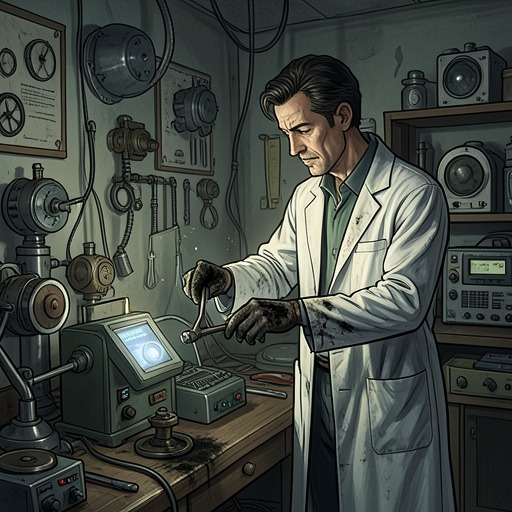
The candy appears in a gigantic room crowded with boiling pots, hissing kettles, sizzling pans, clanking machines, pipes, smoke, steam, and rich smells. Willy Wonka is especially animated there, moving among the equipment with delighted concentration: he tastes substances, adjusts knobs, inspects an oven, and watches a small machine produce large green objects that initially look like marbles. The setting makes the Everlasting Gobstopper part of an active process of invention rather than an ordinary finished product taken from a shop shelf.
Design and Operation
Willy Wonka announces the Everlasting Gobstoppers as completely new. Their defining property is that a child can place one in the mouth and suck it repeatedly without making it any smaller. The claim is deliberately emphatic: the candy never gets smaller and never disappears. Its operation is therefore the opposite of an ordinary sweet, whose value is consumed through eating. The Gobstopper preserves its physical size and its usefulness while the consumer continues to enjoy it.
Violet Beauregarde immediately compares the candy with gum, but Willy Wonka rejects the comparison. Gum is meant for chewing, whereas chewing an Everlasting Gobstopper would be dangerous because it could break the consumer’s teeth. The distinction establishes a precise rule for using the object: its remarkable endurance depends on sucking, not biting. The candy’s novelty lies not merely in lasting a long time, but in requiring a different relationship between the consumer and the confection.
Testing and Reliability
The Everlasting Gobstopper is not offered as a purely theoretical invention. Willy Wonka explains that one is being tested in the adjoining Testing Room by an Oompa-Loompa who has been sucking it for very nearly a year without stopping. Even after this prolonged test, the Gobstopper remains just as good as ever. The experiment gives the candy a visible history of endurance, although Willy Wonka’s qualification that he does not think it will ever become smaller leaves a small comic uncertainty beneath his absolute-sounding claims.
This test also connects the candy to the factory’s hidden labor system. The Oompa-Loompa’s extended act of sucking turns a fantastic promise into a demonstration, but the demonstration depends on a worker’s body and time. The object appears effortless to the visiting children because the work of proving its durability has been absorbed into the factory’s spectacle.
Economic and Narrative Significance
Willy Wonka says that he is inventing the Everlasting Gobstopper for children who are given very little pocket money. That purpose distinguishes it from the chocolate abundance that surrounds the factory and from the intense scarcity shaping Charlie Bucket’s life. Charlie longs for chocolate while his family survives on bread and margarine, potatoes and cabbage, and cabbage soup; on his birthday, the family can afford only one small chocolate bar, which he carefully stores in a wooden box and consumes by tiny nibbles over more than a month. Against that background, a candy that does not diminish answers a material anxiety as directly as it satisfies a sweet tooth.
The invention also reverses the usual logic of confectionery consumption. A chocolate bar is valuable to Charlie partly because it is scarce and must be rationed, while the Everlasting Gobstopper promises an almost permanent supply contained in a single object. Its fantasy is therefore economic as well as magical: one purchase could outlast the child’s available spending money. Yet the object remains embedded in a world where Willy Wonka’s products generate frantic buying, worldwide competition, newspaper attention, and brand devotion. Its promise of endless pleasure strengthens the factory’s image as a place where ordinary limits have been abolished.
Relation to Willy Wonka’s Brand and Inventions
The Everlasting Gobstopper exemplifies Willy Wonka’s habit of turning familiar foods into puzzles about time, use, and bodily experience. In the same Inventing Room, he introduces Hair Toffee, which produces a new crop of hair, a moustache, and a beard after half an hour. The Gobstopper similarly makes eating unpredictable by replacing disappearance with persistence. Both inventions transform a commonplace confection into a spectacle whose effects continue beyond the moment of purchase.
Its durability also suits the larger mythology of Wonka’s Chocolate Factory. The factory is presented as a secretive place of wonders, opened to only five children who find Golden Tickets hidden beneath ordinary chocolate wrappers. The ticket promises a personal tour, access to secrets and magic, and enough chocolates and sweets to last the winners and their households for years. Within that system of scarcity, revelation, and reward, the Everlasting Gobstopper functions as a miniature version of Wonka’s larger promise: the ordinary object is only a wrapper around an impossible experience.