Gluttony
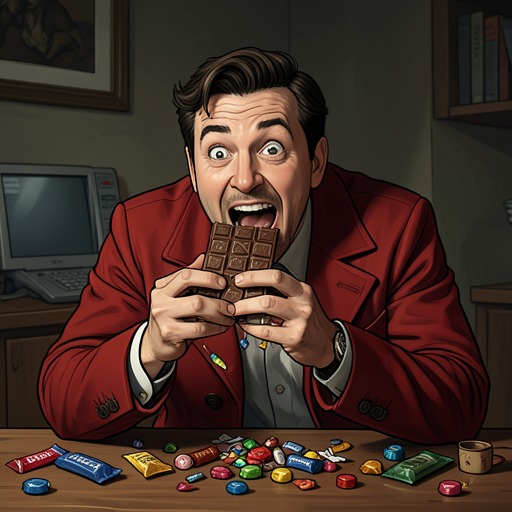
Charlie and the Chocolate FactoryGluttony is a recurring state of excessive appetite in Charlie and the Chocolate Factory, defined not simply by liking sweets but by allowing consumption to override restraint, instruction, and even physical safety. The condition is embodied by Augustus Gloop, whose appetite makes him both a public spectacle and the first child endangered inside Wonka’s factory. Set against Charlie Bucket’s poverty and hunger, gluttony becomes one of the book’s clearest moral and bodily contrasts: where Charlie preserves a scarce chocolate bar through patient, almost reverent nibbling, Augustus treats abundance as something to seize and swallow at once.
Definition and First Appearance
Gluttony is identified at the outset through Augustus Gloop, described as a greedy boy. His appetite is not presented as an occasional lapse but as the central fact of his identity. A newspaper portrait shows him as a nine-year-old so enormously fat that he appears to have been inflated with a powerful pump, with flabby folds of fat bulging from every part of his body. His body therefore makes his appetite visible before he performs it: excess has become his public appearance.
Augustus’s mother openly confirms that eating is his hobby and that it is all he is interested in. She explains his Golden Ticket discovery by saying that he eats so many bars of chocolate each day that finding one was almost unavoidable, while attempting to defend the behavior as nourishment and vitamins. Her defense reveals that gluttony is sustained not only by the eater but also by indulgent adults who transform compulsion into a sign of health, pride, or parental success. The family’s approval leaves Augustus with no reason to question the appetite that governs him.
Hunger as a Contrasting Condition
The force of gluttony becomes clearer through the deprivation endured by Charlie Bucket. Charlie’s family can afford only bread and margarine for breakfast, boiled potatoes and cabbage for lunch, and cabbage soup for supper. Although the family does not starve, everyone lives with a persistent empty feeling, and Charlie feels it most severely because his parents often surrender their own portions to him without being able to provide enough food for a growing boy.
Chocolate is consequently not an ordinary snack for Charlie. It is the food he longs for more than anything else, glimpsed in shop windows and carried by other children who eat it in front of him. Once a year, on his birthday, the family saves enough money to give him one small bar. Charlie places the bar in a small wooden box as if it were solid gold and delays eating it, taking tiny nibbles over many days so that the sixpenny bar lasts for more than a month. His restraint arises from scarcity, but it also expresses care, gratitude, and an ability to make pleasure endure. Augustus, by contrast, consumes chocolate as though desire itself were a command.
The contrast is intensified when Charlie grows thinner and frighteningly pale during the cruel winter. He changes his routine to conserve strength, leaving home earlier so that he can walk slowly to school and resting during breaks instead of playing in the snow. The same story thus places starvation and gluttony beside one another: Charlie’s body is diminished by the absence of food, while Augustus’s body advertises an appetite that has been allowed to become excessive. Neither condition is merely decorative; each prepares the reader to understand how food organizes their behavior and their place in the plot.
Gluttony Inside the Chocolate Factory
Augustus’s Golden Ticket grants him entry to Willy Wonka’s factory, where the promised abundance of chocolate turns his appetite into immediate action. During the visit, he quietly sneaks to the edge of the Chocolate River, kneels on its bank, and scoops hot melted chocolate into his mouth as fast as he can. The factory’s product is meant to be observed as a marvel, but Augustus cannot remain a spectator. He converts the spectacle into an opportunity for direct consumption.
When his mother and Willy Wonka call him away, Augustus ignores them. He declares that the chocolate is fabulous and says he needs a bucket to drink it properly. Willy Wonka warns that Augustus is dirtying the chocolate, identifying a further consequence of gluttony: private appetite becomes public contamination when the consumer refuses the boundaries imposed by the setting. Augustus then lies full length on the ground with his head extended over the river, lapping up the chocolate like a dog. His body has crossed from ordinary eating into an animalized act of ingestion, and the image makes visible the collapse of civilized restraint.
The appetite produces its own physical danger. Leaning too far over the river, Augustus suddenly falls in and disappears beneath the brown surface. His parents panic, but his father refuses to dive into the chocolate because he is wearing his best suit. The scene turns a comic display of greed into the first major accident of the tour. Augustus is not removed by an abstract rule or by a deliberate attack; the immediate mechanism of his punishment is the momentum of his own appetite, which carries him beyond the safe edge.
Public Ridicule and Bodily Consequence
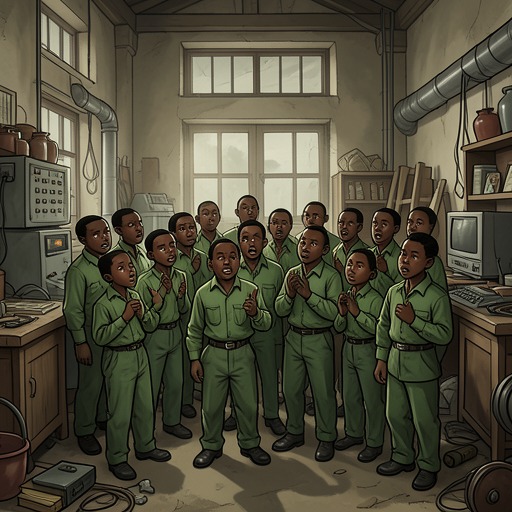
After Augustus falls into the Chocolate River, the Oompa-Loompas sing about him. Their song calls him a great, big, greedy nincompoop and describes him as revolting, vile, greedy, foul, and infantile. The language transforms his individual act into a public moral example. His behavior is not treated as harmless indulgence because it has endangered him, threatened the chocolate supply, and disregarded every warning given by the adults around him.
The Oompa-Loompas’ performance also makes gluttony a recurring social lesson within the factory. The child’s body is watched, named, mocked, and converted into entertainment for the other visitors. Consumption therefore leads not only to physical peril but also to exposure: the appetite that Augustus’s mother proudly displays to reporters becomes the appetite that the factory publicly condemns. The reversal is central to the book’s treatment of excess. Outside the factory, his size and eating are celebrated as evidence of celebrity and supposed nourishment; inside it, the same traits become the visible cause of his downfall.
Social Meaning and Narrative Function
Gluttony links food with class, publicity, and power. Willy Wonka’s Golden Ticket announcement promises each successful child enough chocolate and sweets to last for the rest of life, with further supplies available from the factory whenever the household runs out. That promise turns confectionery into security, status, and an imagined escape from want. Around the world, the remaining tickets provoke a frantic buying spree: adults purchase ten Wonka bars at once, children smash their piggy banks, and even a gangster spends a thousand pounds on chocolate while tearing wrappers open with a dagger. The contest makes desire collective, but Augustus embodies its most concentrated and least controlled form.
The state of gluttony also exposes the unequal meanings of the same commodity. For Charlie, chocolate is rare enough to be treasured like gold and consumed in measured fragments. For Augustus, it is available in such quantities that the act of eating becomes his identity. The factory magnifies this difference by presenting chocolate as a river, a substance produced on a scale that invites wonder but also tempts possession. The abundance promised by Willy Wonka does not abolish appetite; for Augustus, it removes the last practical limit that might have restrained it.
Finally, gluttony belongs to the book’s broader pattern of bodies pushed beyond ordinary boundaries. Augustus disappears beneath the chocolate’s surface, while other children later undergo spectacular bodily transformations: Violet Beauregarde turns brilliant purplish-blue and swells, Veruca Salt is pushed into a chute by squirrels after her mother falls into the Nut Room, and Mike Teavee emerges no more than an inch tall. Against these changes, Augustus’s episode establishes a governing principle: the children’s dominant habits are not merely criticized in words but made physically legible through the factory’s fantastic machinery and substances. Gluttony is therefore both a character state and a narrative device, converting uncontrolled desire into visible consequence while sharpening the moral and emotional significance of Charlie Bucket’s hunger, patience, and capacity to value what he receives.