Grandma Georgina
Charlie and the Chocolate FactoryGrandma Georgina is Charlie Bucket’s maternal grandmother, the mother of Mrs Bucket and the wife of Grandpa George. Her decisive narrative significance lies not in independent action but in the emotional structure she helps create around Charlie: within a family burdened by poverty, overcrowding, cold, and hunger, she is one of the elders whose love makes the household a place of stories, anticipation, and shared wonder.
Identity and Family Background
Grandma Georgina belongs to the older generation of the Bucket family. She and Grandpa George are the parents of Mrs Bucket, while Grandpa Joe and Grandma Josephine are the parents of Mr Bucket. The six adults and Charlie Bucket live together in a small wooden house on the edge of a great town. The arrangement is severely cramped: the house contains only two rooms and one bed, which is reserved for the four very old grandparents. Charlie’s parents sleep with him on mattresses on the floor.
The family’s poverty shapes Grandma Georgina’s physical and social position. The Buckets cannot afford a better house or even another bed, and the winter cold sends freezing draughts across the floor at night. Mr Bucket is the only family member with a job, earning little as a toothpaste-factory cap-screwer; the household survives on plain meals of bread and margarine, boiled potatoes and cabbage, and cabbage soup. Grandma Georgina therefore exists within a domestic world where material scarcity is constant, but where kinship is the principal available form of security.
Life in the Grandparents’ Room
All four grandparents are over ninety. They are described as extremely shrivelled and bony, and they spend the day huddled in their shared bed, wearing nightcaps to keep warm, dozing because there is little else to do. Grandma Georgina shares one end of this arrangement with Grandpa George, while Grandpa Joe and Grandma Josephine occupy the other end. Her confinement makes the grandparents’ room a place of physical limitation, yet Charlie’s visits repeatedly change its atmosphere.
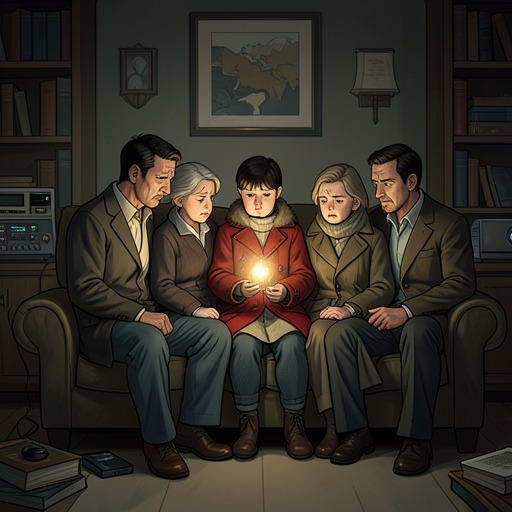
When Charlie opens the door in the evening and greets Grandpa Joe, Grandma Josephine, Grandpa George, and Grandma Georgina, the four elders sit up and their wrinkled faces brighten. They love Charlie, and his visits are the event they anticipate throughout the day. Charlie’s mother and father sometimes stand by the door listening as well. For roughly half an hour, the room becomes happy enough for the whole family to forget that it is hungry and poor. Grandma Georgina’s importance is thus inseparable from this recurring ritual: she is part of the circle of elders whose emotional response to Charlie turns an inadequate room into a temporary refuge.
Reactions to the Golden Ticket Contest
Grandma Georgina participates in the family’s early discussion of Willy Wonka’s announcement that five children will be allowed to visit Wonka’s Chocolate Factory. Willy Wonka promises that the five Golden Ticket finders will tour the factory personally, see its secrets and magic, and receive enough chocolate and sweets to last for the rest of their lives. Grandpa Joe responds with excitement, imagining the worldwide search and the surge in chocolate sales, while Grandma Georgina adds to the comic image of limitless abundance by observing that the sweets would have to be delivered in a truck.
Her response also helps establish the family’s distance from the contest’s economy. Charlie Bucket receives only one bar of chocolate a year, so he believes he has no real chance of finding a ticket. Grandpa George explains that the likely winners are children who can afford to buy chocolate every day, a direct contrast between Charlie’s scarcity and the purchasing power of wealthy families. Grandma Georgina nevertheless encourages hope, reminding Charlie that his birthday is the following week and that he has as much chance as anyone else. Her optimism does not erase the material facts, but it keeps Charlie from being reduced entirely to them.
When the second ticket is found by Veruca Salt, Grandma Georgina reacts with immediate hostility to the newspaper account. Veruca’s father, Mr Salt, has bought thousands, perhaps hundreds of thousands, of Wonka bars and redirected the labor of approximately one hundred peanut-shelling workers toward removing their wrappers until a ticket appears. The episode displays wealth as an ability to convert money, labor, and industrial resources into a child’s desired prize. Grandma Georgina calls Veruca’s mother revolting and Veruca repulsive, while the family counts the remaining tickets. Her judgment gives a plain moral vocabulary to the contrast between Charlie’s deprivation and Veruca’s spoiled privilege.
Charlie’s Ticket and the Family’s Joy
Grandma Georgina is present when Charlie returns home with the last Golden Ticket. Charlie rushes into the grandparents’ room while Mrs Bucket is serving the evening soup and announces that he found money in the street, bought two chocolate bars, and discovered the ticket in the second bar. The announcement initially produces stunned silence. The four grandparents are sitting upright in bed with bowls of soup balanced on their laps, and all four drop their spoons and freeze against their pillows.
The reaction is collective, but Grandma Georgina’s presence makes the moment part of the family’s established emotional world rather than a merely spectacular prize reveal. The same room that regularly helps the family forget hunger and poverty now becomes the site of a life-changing reversal. Charlie’s discovery does not simply promise chocolate; it temporarily overturns the economic logic that had made his success seem impossible.
The timing intensifies the event. The factory visit is scheduled for the first day of February, which is the next day, making Grandpa Joe urge Charlie to begin preparing immediately. His list of preparations includes washing his face, combing his hair, scrubbing his hands, brushing his teeth, blowing his nose, cutting his nails, polishing his shoes, ironing his shirt, and removing mud from his trousers. Grandma Georgina belongs to the family gathering around this sudden transition from ordinary hardship to public ceremony, as Charlie prepares for what Grandpa Joe calls the biggest day of his life.
Place in the Factory Journey and the Story’s Ending
Outside the gates of Wonka’s Chocolate Factory, enormous crowds gather to watch the five ticket holders enter. The five children stand in a police-shielded group with the adults who accompany them. Charlie Bucket is beside the tall, bony figure of Grandpa Joe, holding tightly to his hand; unlike the other children, Charlie does not have both parents with him. Although Grandma Georgina does not accompany Charlie into the group at the gates, the journey is framed by the family network she helps define and by the material contrast between Charlie’s household and the other children’s resources.
Her wider narrative significance becomes clearer when Willy Wonka later explains why he wants Charlie to inherit Wonka’s Chocolate Factory. Willy Wonka says that he is old, has no children or family, and needs someone to keep the factory operating, especially for the sake of the Oompa-Loompas. He rejects grown-ups because they will not listen or learn as he wishes, and instead seeks a good, sensible, loving child to whom he can reveal his precious sweet-making secrets while he is still alive. Grandma Georgina is not the recipient of this offer, but she belongs to the loving family context that surrounds the child Wonka selects. Her role helps make Charlie’s goodness visibly communal: it has been nurtured in a household where affection, attention, and shared storytelling persist despite poverty.