Mrs Bucket
Charlie and the Chocolate FactoryMrs Bucket is Charlie Bucket’s mother and Mr Bucket’s wife, one of the adults holding together a household crowded by poverty but rich in mutual concern. Her importance lies less in spectacular action than in the steady care that makes Charlie’s moral contrast with the other children possible: while wealth elsewhere turns desire into entitlement, she and Mr Bucket surrender their own food so that their son can eat, prepare his small birthday pleasure, and insist on calm when fortune suddenly arrives.
Identity and Family Position
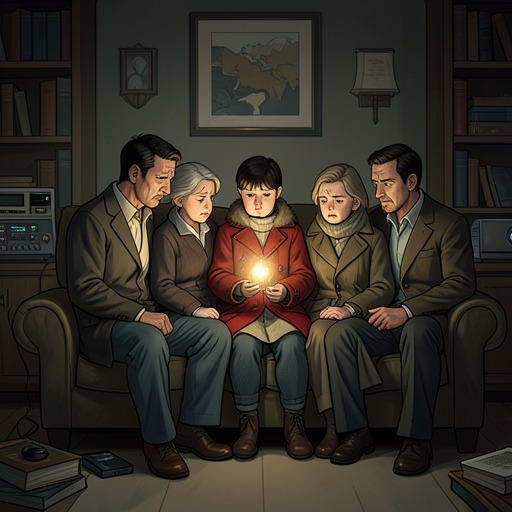
Mrs Bucket belongs to the branch of the family joined to Grandpa George and Grandma Georgina, who are her parents. She lives with Mr Bucket, Charlie Bucket, Grandpa Joe, Grandma Josephine, Grandpa George, and Grandma Georgina in conditions so cramped that Mr and Mrs Bucket and Charlie Bucket sleep on mattresses on the floor. In winter, freezing draughts cross the room throughout the night, yet the family cannot afford either a better house or even another bed. The material setting defines Mrs Bucket’s role: she is not the head of a prosperous home but one of the adults negotiating scarcity day after day.
Mr Bucket is the only family member with a job. He works in a toothpaste factory, sitting at a bench and screwing caps onto filled toothpaste tubes, a repetitive occupation that pays too little for the needs of such a large household. The family’s ordinary meals are bread and margarine for breakfast, boiled potatoes and cabbage for lunch, and cabbage soup for supper; Sundays offer the same food with the rare privilege of a second helping. Mrs Bucket therefore inhabits a household where nourishment itself is carefully distributed, and where parental love is expressed through material sacrifice.
Care, Hunger, and Charlie’s Birthday
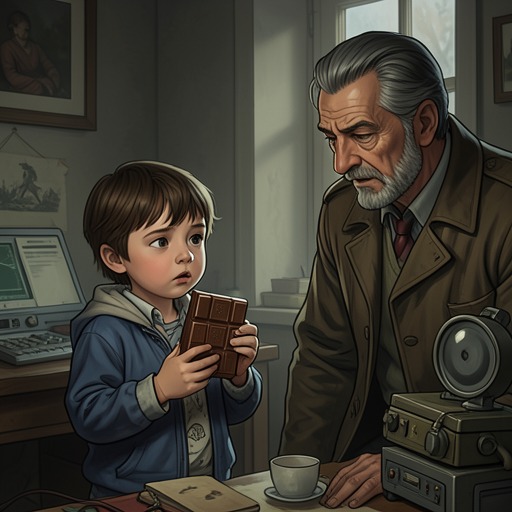
Charlie Bucket feels the family’s hunger most severely because he is a growing boy. Mr Bucket and Mrs Bucket often go without their own share of lunch or supper to give it to him, but even that sacrifice cannot provide enough food. Charlie longs above all for chocolate, which he sees in shop windows and on other children’s lips but can normally taste only once a year. Mrs Bucket participates in the family ritual that makes his birthday significant: the household saves its money so that Charlie can receive one small chocolate bar, which he preserves in a wooden box and consumes in tiny nibbles, making a sixpenny bar last for more than a month.
On the night before Charlie’s birthday, Mrs Bucket reminds him that the next morning he will open his present. When he excitedly asks whether it will be a Wonka bar, she confirms that it is. The exchange is small, but it shows how she protects a modest happiness inside severe deprivation. The gift cannot solve the family’s hunger, yet her promise gives Charlie a rare moment of expectation and preserves the birthday as a shared family occasion rather than merely another reminder of what the household lacks.
The Golden Ticket and the Factory Visit
Mrs Bucket understands that Charlie’s chance of finding a Golden Ticket is almost nonexistent because the family can afford only one chocolate bar a year. Grandpa George explicitly contrasts Charlie’s circumstances with those of children able to buy Wonka bars every day. The contest therefore exposes the unequal economic conditions behind apparently open opportunity: other families can purchase repeated chances, while Charlie’s family must treat a single birthday bar as precious.
When Charlie finds fifty pence beneath the snow, he experiences the money first as food. He plans to buy one luscious bar of chocolate, eat it immediately, and take the remainder home to give to his mother. That instinct reveals the relationship Mrs Bucket has helped create. Charlie’s desire does not exclude family responsibility; even at the point of intense hunger, he thinks of bringing money back to Mrs Bucket. His conduct reflects the household’s pattern of sharing rather than the acquisitive frenzy surrounding the Golden Ticket search, during which affluent adults buy bars by the ten or by the thousands.
After Charlie obtains the final ticket, Mrs Bucket becomes the voice of practical control amid the family’s excitement. Grandpa Joe wants to take Charlie to the factory at once, but she tells everyone to remain calm and asks who will accompany him. Her intervention turns astonishment into an organized decision. At the gates of Wonka’s Chocolate Factory, Grandpa Joe stands beside Charlie Bucket while the other children arrive with both parents. Mrs Bucket is not among the adults entering the factory, but her absence underscores the family’s limited resources: Charlie is accompanied by his grandfather, whereas the wealthier children arrive with complete parental entourages.
Contrast with Wealth and Excess
Mrs Bucket’s domestic world stands in sharp contrast to Veruca Salt’s. Veruca’s father can buy thousands, even hundreds of thousands, of Wonka bars and redirect roughly one hundred peanut-shelling workers to strip their wrappers in a relentless search for a ticket. He continues because Veruca screams, kicks, and demands what she wants, and he treats the removal of her unhappiness as the restoration of a happy home. Mrs Bucket’s family responds to desire differently. Charlie receives one bar, stores it carefully, and shares the emotional meaning of it with the whole household; Mrs Bucket offers reassurance without converting his wish into a demand imposed on others.
The contrast is also visible in the factory’s food abundance. Willy Wonka reveals a Chocolate River of hot melted chocolate, supplied through enormous glass pipes that carry thousands of gallons an hour to other rooms. A waterfall churns and mixes it, while the surrounding trees, bushes, grass, and buttercups are edible inventions. Against this impossible plenty, Mrs Bucket’s family has lived on cabbage soup and measured portions. Her significance is sharpened by the distance between the domestic economy of saving one chocolate bar and the industrial abundance of Wonka’s world.
Change and Ending
Mrs Bucket’s circumstances change radically when Willy Wonka reveals that he has no children or family of his own and wants Charlie to inherit the factory. Wonka does not want a grown-up successor who will reject his methods; he wants a good, sensible, loving child to whom he can disclose his most precious sweet-making secrets while he is still alive. The decision transforms Charlie’s family position from precarious dependence to prospective participation in the factory’s future, while also making the values represented by Mrs Bucket part of the inheritance’s moral background.
When the Great Glass Lift returns with Charlie and Grandpa Joe, Mrs Bucket rushes forward to meet them. Charlie throws himself into her arms and tries to explain that the family will live in Mr Wonka’s factory, help run it, and that the factory has been given to him. Mrs Bucket can only ask what he is talking about, because the news is too extraordinary to absorb at once. Mr Bucket immediately points to the consequence left behind: their old house is in ruins. The ending therefore joins wonder to disruption. Mrs Bucket’s family is offered a new home and future, but the transition arrives through the visible destruction of the cramped house that defined their former life.
Narrative Role and Significance
Mrs Bucket is a quiet ethical counterweight to the novel’s displays of appetite, wealth, and parental indulgence. She does not command the factory, discover a ticket, or dominate the tour. Instead, her actions give concrete form to patience, provision, restraint, and shared responsibility. Her family’s poverty is not romanticized as comfort—the cold, cramped sleeping arrangements and inadequate meals are unmistakably harsh—but within that deprivation Mrs Bucket helps sustain a pattern of care that makes Charlie’s generosity intelligible.
Her presence also keeps the Golden Ticket story connected to ordinary domestic consequences. The contest begins as a public spectacle and a worldwide buying frenzy, but for Mrs Bucket it first means a birthday present, a question of who can accompany Charlie, and the need to keep the household calm. At the end, the factory inheritance returns the spectacle to the family in the form of a practical upheaval: a new place to live, a new responsibility, and the loss of the old house. Through Mrs Bucket, Charlie’s transformation remains a family event rather than merely an individual prize.