Nut Room
Charlie and the Chocolate FactoryThe Nut Room is a specialized chamber inside Wonka's Chocolate Factory, identified by the sign on its door and guarded by an explicit prohibition against entering. It contains one hundred trained squirrels who shell walnuts at extraordinary speed, test each nut, and discard defective ones through a rubbish chute. When Veruca Salt ignores Willy Wonka's warning and enters to seize a squirrel, the room's orderly system turns against her: the squirrels restrain her and carry her toward the same chute used for bad nuts. The room therefore functions not merely as a workplace but as a miniature model of the factory's larger order, where inspection, classification, restricted movement, and punishment are inseparable from production.
Setting and Organization
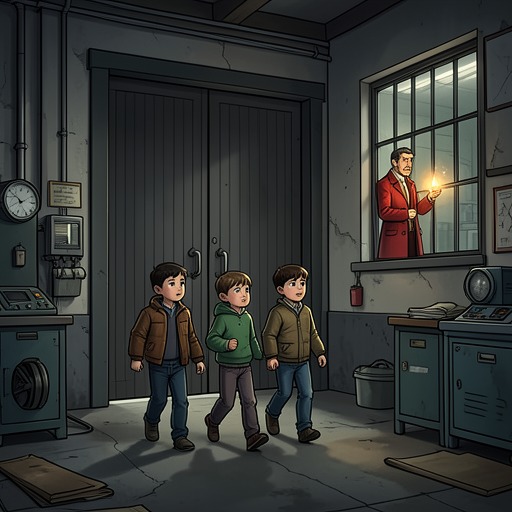
The Nut Room appears along the factory's corridors after Willy Wonka leads the visiting group onward. He tells the children to stop and look through the glass panel, but he specifically orders them not to enter because they would disturb the squirrels. The glass creates a controlled viewing arrangement: the visitors can watch the room's labor, while the workers inside continue their task under conditions that are not meant to be interrupted. The door, its warning, and the observation panel establish a boundary between spectacle and access.
Inside, one hundred squirrels sit on high stools around a large table covered with mounds of walnuts. They work continuously, shelling the nuts at tremendous speed. Their arrangement resembles an organized factory line, yet the workers are animals rather than human employees or Oompa-Loompas. The scale of the group and the precision of its activity turn the room into a carefully staged marvel for the visitors, while also making its labor unmistakably systematic.
The Squirrels' Work
Willy Wonka explains that the squirrels have been specially trained to remove walnuts from their shells in one piece. This requirement is central to the room's purpose: Wonka insists that his factory use only whole walnuts. The squirrels are therefore valued for a precise technical ability that the Oompa-Loompas supposedly cannot perform reliably, because they break the walnut in two. The distinction gives the room its own specialized workforce and shows that the factory assigns different tasks according to particular forms of competence.
The squirrels do not open every walnut indiscriminately. Each one first taps the shell with its knuckles and listens to the sound. A hollow sound identifies a bad nut, which the squirrel does not bother to open; instead, it throws the walnut into a large hole in the floor. The inspection process combines touch, hearing, judgment, and speed. What looks to the children like an amusing spectacle is also a strict system of quality control, with the rubbish chute serving as the immediate destination for material that fails the room's standard.
Veruca Salt's Intrusion
The room's rules become the focus of the scene when Veruca Salt sees the squirrels and suddenly demands one for herself. Willy Wonka tells her that the squirrels are not for sale and that she cannot have one. Veruca rejects both the refusal and the boundary behind it, insisting on entering the room to take a squirrel herself. Her movement is not accidental: she throws open the door and rushes in despite Wonka's warning.
The moment Veruca crosses the threshold, all one hundred squirrels stop working, turn their heads, and stare at her with their small black eyes. Their synchronized reaction changes the room from a productive display into a space of collective surveillance. Veruca then fixes her attention on a pretty squirrel nearby, which is holding a walnut. Her desire narrows from the entire spectacle to a single object she believes can be possessed, and the room's disciplined inhabitants respond to that attempted possession as an intrusion.
The squirrels seize Veruca and hold her with their small but powerful paws. She kicks and screams, but cannot escape. The result is a reversal of the role she expected to play: she enters as a customer demanding a prize, yet becomes an object examined and removed by the room's workers. Willy Wonka identifies her destination by comparing her to the defective walnuts: she is going where the other bad nuts go, down the rubbish chute. Her parents witness the movement through the glass, and their demands that she be saved cannot immediately undo the room's judgment.
Rules, Surveillance, and Punishment
The Nut Room makes the factory's spatial logic unusually visible. Its workers are watched through glass, but they also watch anyone who violates the room's limits. Wonka controls the visitors' movement through spoken instructions, while the door and chute turn those instructions into physical consequences. The warning not to enter is not decorative information; once ignored, it becomes the condition for a rapid change in status, from observer to intruder and from intruder to rejected material.
The squirrels' sorting of walnuts is mirrored by their treatment of Veruca. In both cases, the room distinguishes what belongs within its productive order from what must be expelled. A bad walnut is detected by a hollow sound and sent down the chute; Veruca's selfish demand and unauthorized entry place her symbolically within the same category. The comparison is grotesque and comic, but it also exposes the factory's severe logic: value depends on conformity to a standard, and deviation is handled through removal rather than negotiation.
Narrative Significance
The Nut Room intensifies the mystery that surrounds Wonka's factory. Earlier, the public sees smoke, hears machines, and observes small shadows behind frosted windows while the gates remain locked and Willy Wonka stays out of sight. The Nut Room provides a partial answer to that mystery by revealing hidden workers whose labor sustains the factory's production. Yet the answer is itself strange: the workers are tiny, highly trained squirrels, and their skill is presented as both practical necessity and uncanny spectacle.
The room also condenses the larger tour's pattern of wonder followed by consequence. The visitors are invited to look, but not to cross every threshold; the factory offers access only under rules established by Wonka. Veruca's fate demonstrates what happens when appetite for ownership overrides those rules. In that sense, the Nut Room is a production chamber, an exhibition space, and a disciplinary mechanism at once. Its walnuts, glass panel, locked boundary, trained animals, and rubbish chute turn the abstract idea of factory order into a concrete scene in which labor produces wonder and violation produces expulsion.