Poverty
Charlie and the Chocolate FactoryPoverty is the defining material condition of Charlie Bucket’s household and one of the clearest forces shaping his place in the story. It determines where the family lives, what they eat, how they experience winter, and even how unlikely Charlie’s participation in the Golden Ticket contest appears. Set against the extravagant abundance of Wonka’s Chocolate Factory and the purchasing power of richer families, the family’s deprivation makes Charlie’s eventual advancement both socially improbable and morally significant.
Household Conditions
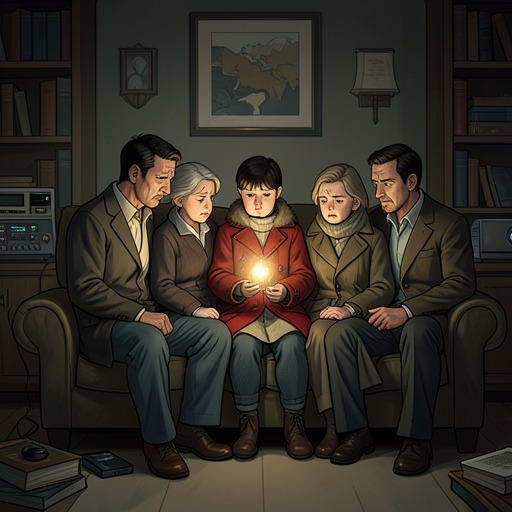
Charlie Bucket lives with the six grown-ups in his family—Mr Bucket, Mrs Bucket, Grandpa Joe, Grandma Josephine, Grandpa George, and Grandma Georgina—in a small wooden house on the edge of a great town. The house contains only two rooms and one bed. Because the four grandparents are old and exhausted, they occupy the bed permanently, while Mr Bucket, Mrs Bucket, and Charlie sleep on mattresses on the floor. The arrangement is already uncomfortable, but winter makes it much worse: freezing draughts blow across the floor throughout the night.
The family cannot improve these conditions. They cannot afford a better house, or even one additional bed, because their poverty leaves no money for such necessities. Their deprivation is therefore structural rather than temporary inconvenience. The cramped rooms, shared sleeping arrangements, and cold floor make poverty visible as a condition that organizes every member’s physical life.
Work, Food, and Hunger
Mr Bucket is the only person in the family with a job. He works in a toothpaste factory, sitting at a bench and screwing small caps onto filled toothpaste tubes. However hard or quickly he works, a toothpaste cap-screwer earns too little to support such a large household adequately. His wages cannot buy even half of what the family needs, and there is not enough money for proper food.
Their ordinary meals are bread and margarine for breakfast, boiled potatoes and cabbage for lunch, and cabbage soup for supper. Sundays offer only a narrow ritual of abundance: the family eats exactly the same food, but everyone is allowed a second helping, making the day something to anticipate. The family does not starve outright, yet every member lives with a persistent empty feeling, including the elderly grandparents, Charlie’s parents, and Charlie himself. The distinction matters: survival is possible, but comfort, fullness, and choice are absent.
Charlie suffers the hunger most intensely because he is a growing boy. Mr Bucket and Mrs Bucket often surrender their own portions of lunch or supper to him, but even their sacrifices do not provide enough food. Poverty thus produces both physical deprivation and a pattern of intimate care. The parents cannot remove the underlying scarcity, but they try to redistribute it so that Charlie bears less of it than they do.
Chocolate as Scarcity and Desire
Chocolate becomes the most powerful symbol of Charlie’s poverty because it is both visible and almost entirely inaccessible. On his way to school, he sees large slabs of chocolate piled in shop windows and presses his nose against the glass, while other children eat chocolate bars in front of him. The ordinary pleasures available to other children become a repeated spectacle of exclusion for Charlie.
Charlie receives chocolate only once a year, on his birthday. The entire family saves money so that he can have one small bar, which he treats as if it were solid gold. He keeps it in a small wooden box, looks at it without touching it for several days, and then eats it by taking tiny nibbles over successive days. The careful prolonging of the bar shows how poverty changes the meaning of food: chocolate is not a casual sweet but a treasured possession whose value lies partly in its scarcity.
This economic reality also governs the family’s expectations about the Golden Tickets. Charlie believes there is no real hope of finding one because he receives only a single bar each year. Grandpa George states the practical reason plainly: the children most likely to find tickets are those who can afford to buy chocolate bars every day, whereas Charlie has almost no opportunity to search. The contest therefore appears to reward not merely luck but access to consumer goods, making wealth a direct advantage in the competition.
Poverty and Unequal Access
The contrast with the other ticket holders makes the social dimensions of poverty especially clear. Augustus Gloop’s mother explains that he eats so many chocolate bars each day that finding a ticket was almost inevitable. His family can treat continuous consumption as normal and even defend it as nourishment. Charlie, by contrast, experiences one bar as an annual event and cannot participate in the worldwide buying frenzy that follows the discovery of the first tickets.
Veruca Salt’s ticket reveals an even greater concentration of resources. Her father, Mr Salt, buys thousands, perhaps hundreds of thousands, of Wonka bars and has them transported to his own factory. He then redirects about a hundred peanut-shelling workers to remove the chocolate wrappers from morning until night. Veruca’s success is thus produced through an industrial mobilization of wealth and labor, while Charlie’s chance depends on an accidental fifty pence found beneath the snow.
That coin immediately becomes food in Charlie’s mind. Shivering, he holds it tightly and thinks of buying one luscious bar of chocolate, eating it at once, and taking the remaining money home to his mother. The find briefly presents a choice between personal hunger and family responsibility. His poverty makes both possibilities urgent: he needs nourishment, yet he also understands that money belongs to the household. The contrast between Charlie’s single coin and Mr Salt’s factory-wide search turns the Golden Ticket contest into an implicit comparison of economic worlds.
From Deprivation to Transformation
Poverty remains central even when Charlie enters Wonka’s Chocolate Factory, because the factory embodies the opposite of his domestic life. Its Chocolate River is made entirely of hot melted chocolate, and enormous glass pipes carry thousands of gallons an hour to other rooms. The waterfall churns and beats the chocolate, while the surrounding trees, bushes, grass, and buttercups are edible inventions. This landscape of extravagant food reverses Charlie’s experience of cabbage soup, measured portions, and a birthday bar preserved like treasure.
The factory’s abundance also exposes the danger of unrestrained consumption. Augustus Gloop, whose household has access to chocolate in quantities Charlie can scarcely imagine, kneels beside the river and scoops hot melted chocolate into his mouth. His appetite carries him into direct physical danger. The pipe he enters leads not to a harmless destination but toward the room where Wonka makes strawberry-flavoured chocolate-coated fudge, prompting the possibility that Augustus could be processed into a confection and sold by the pound. The scene transforms food from a scarce means of survival into an industrial force capable of absorbing the human body.
At the end of the visit, Willy Wonka explains that he wants to give the factory to Charlie. Wonka has no children or family and believes he cannot operate the factory forever; he needs someone to continue it, including for the sake of the thousands of Oompa-Loompas. He rejects grown-ups because he expects them to resist his methods and insists on finding a good, sensible, loving child to whom he can pass his sweet-making secrets. Charlie’s poverty is not erased through ordinary economic improvement but overturned by an extraordinary transfer of ownership. The boy who could afford only one chocolate bar a year is selected to inherit the place where chocolate exists by the thousands of gallons.
Narrative Significance
Poverty gives Charlie’s actions their weight and establishes the moral and social contrast on which the plot depends. He is one of five children in the book, but unlike the others he does not begin with daily consumption, wealthy parents, or the ability to command large-scale searches. His family’s hunger makes his longing for chocolate understandable without making it destructive; he wants food, yet he also preserves what little he receives and considers bringing part of his found money home.
The novel repeatedly places scarcity beside excess: cabbage and chocolate, one annual bar and thousands of purchased bars, mattresses on a cold floor and a factory filled with edible landscapes. Through these contrasts, poverty becomes more than Charlie’s personal hardship. It is the condition that reveals how family sacrifice, money, labor, consumption, and social opportunity are distributed. It also makes the final inheritance a reversal of the story’s opening order: Charlie begins as the child least able to enter the chocolate economy and ends as the person chosen to control its most dazzling institution.