Prince Pondicherry
Charlie and the Chocolate FactoryPrince Pondicherry is a wealthy Indian prince remembered through Grandpa Joe’s story as the customer whose extravagant desire led Willy Wonka to build an entire palace from chocolate. His brief appearance is confined to an embedded tale, yet his fate gives the novel one of its clearest demonstrations of chocolate’s unstable magnificence: the palace can be made, inhabited, and admired, but it cannot survive the conditions of the ordinary world.
Identity and Introduction
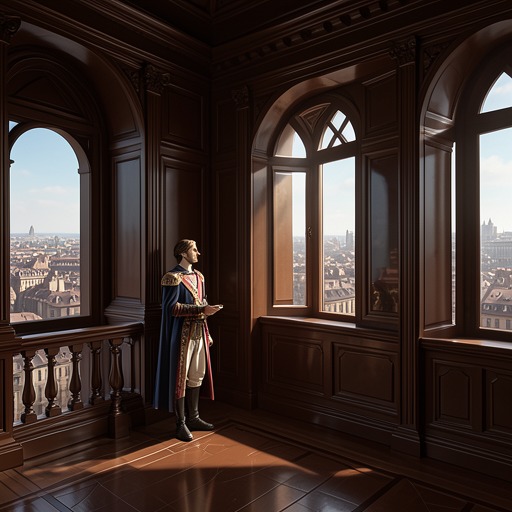
Prince Pondicherry is introduced when Grandma Josephine suggests that Grandpa Joe tell Charlie Bucket about the “crazy Indian prince.” Grandpa Joe identifies him as Prince Pondicherry, while Grandpa George calls him “Completely dotty!” and Grandma Georgina immediately adds the counterpoint that he is “very rich.” These descriptions establish the prince through a comic contradiction: he possesses immense financial power, but his wealth appears alongside extravagant judgment rather than practical wisdom.
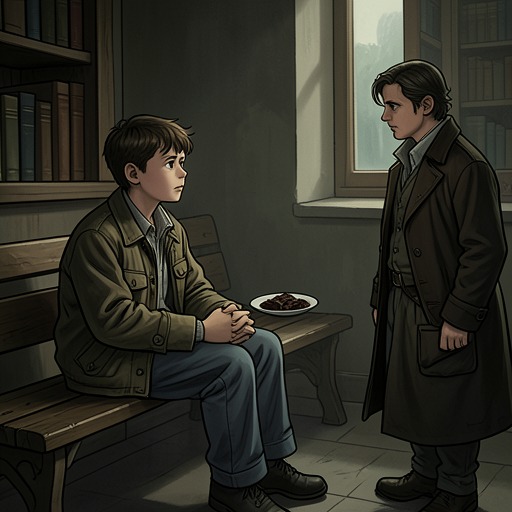
The prince’s story is told to Charlie Bucket while Charlie sits with his grandparents, and Mr Bucket and Mrs Bucket quietly listen from the doorway. It therefore reaches the reader as family narration rather than direct historical documentation. Charlie responds with eager curiosity and asks whether the account is really true, showing how the prince’s impossible commission helps turn Willy Wonka from a mysterious factory owner into a figure associated with seemingly unlimited invention.
The Chocolate Palace
Prince Pondicherry wrote to Willy Wonka and asked him to travel all the way to India to build a colossal palace entirely out of chocolate. Wonka accepted the commission and constructed a palace with one hundred rooms. Its material was not limited to decorative details: the bricks, the cement holding them together, the windows, walls, ceilings, carpets, pictures, furniture, and beds were all made from either dark or light chocolate. Even the bathroom taps produced hot chocolate when turned on.
The palace makes the prince’s wealth visible as a demand for total transformation. Chocolate is no longer a treat placed inside a wrapper or a food served at a table; it becomes architecture, furniture, plumbing, and domestic space. The scale of the undertaking also confirms Wonka’s technical genius, since the commission is presented as something he can actually complete rather than merely imagine. At the same time, the palace turns abundance into absurdity. A substance prized because it is edible is converted into a building whose very usefulness conflicts with its material nature.
Warning and Collapse
After the palace was finished, Willy Wonka warned Prince Pondicherry that it would not last very long and advised him to begin eating it immediately. The prince rejected the warning. He insisted that he was not going to eat the palace, nibble the staircase, or lick the walls; instead, he intended to live in it. His response reveals the central error of his project: he wants chocolate to function as a durable status symbol while refusing the condition that makes it chocolate in the first place.
Wonka’s prediction proves correct when an exceptionally hot day arrives under a boiling sun. The entire palace begins to melt, sinks slowly into the ground, and becomes a huge brown, sticky lake of chocolate. Prince Pondicherry had been dozing in the living room when the collapse occurred, and he wakes to find himself swimming in the melted remains of his residence. The episode converts luxury into physical vulnerability: the palace’s splendor does not merely fade or require repair, but loses its architectural identity altogether.
Relationship to Willy Wonka and Charlie Bucket
The prince’s relationship with Willy Wonka is based on commission and expertise. He has the money to request an impossible palace, while Wonka has the knowledge and manufacturing ability to realize it. Yet the relationship also contains a reversal of authority. The prince is the patron and owner in ordinary social terms, but Wonka understands the material limitations of the palace and accurately predicts its destruction. Wealth can purchase the spectacle, but it cannot overrule the properties of chocolate.
For Charlie Bucket, the tale is especially powerful because chocolate is ordinarily scarce. Charlie’s family can afford only bread and margarine for breakfast, boiled potatoes and cabbage for lunch, and cabbage soup for supper; on his birthday, the family saves enough to give him one small chocolate bar. Charlie treasures that bar in a small wooden box and makes a sixpenny bar last for more than a month by taking tiny nibbles. Against this background, Prince Pondicherry’s one-hundred-room chocolate palace represents an unimaginable surplus, while its melting shows that even the richest person cannot simply command chocolate to become permanent.
Narrative Significance
Prince Pondicherry functions as a cautionary example before the Golden Ticket contest and the factory tour begin. His story prepares Charlie for a world in which Willy Wonka’s inventions are wondrous but governed by strange, easily ignored conditions. The palace is possible, but it is not stable; the prince can obtain nearly everything he wants, but he cannot make a perishable confection into an enduring home.
The tale also establishes a recurring contrast between desire and disciplined understanding. Prince Pondicherry treats chocolate as an object of possession, whereas Charlie’s hunger has taught him to value even a small amount carefully. Grandpa Joe’s story consequently makes the prince memorable not because he changes the main plot directly, but because his failure becomes an early measure of the difference between wealth, appetite, imagination, and wisdom. In the wider world of Willy Wonka’s factory, extravagant promises will again attract attention, but Prince Pondicherry’s fate has already shown that wonder carries its own limits.