The Chocolate River Boat Ride
Charlie and the Chocolate FactoryThe Chocolate River Boat Ride is the first great change of scale in the factory tour: the visitors leave the riverbank and enter a moving confectionery world. Willy Wonka's private vessel, rowed by Oompa-Loompas through the Chocolate River and into a gigantic pipe, makes the factory seem less like a building than a living mechanism. For Charlie Bucket, who has known chocolate chiefly as an almost unattainable hunger and as a carefully rationed birthday treasure, the journey turns the object of his longing into an entire landscape—and then places that landscape under the control of Willy Wonka's unpredictable imagination.
Departure from the Chocolate River
"Off we go!" cried Mr Wonka. "Hurry up, everybody! Follow me to the next room!" The invitation comes immediately after the disappearance of Augustus Gloop into the factory's pipework. Willy Wonka refuses to let the group dwell on Augustus Gloop's fate, assuring them that he is "bound to come out in the wash" and that such things always happen. The boat ride therefore begins with a brisk shift from possible catastrophe to fresh entertainment: the tour's forward motion is itself a method of preventing reflection.
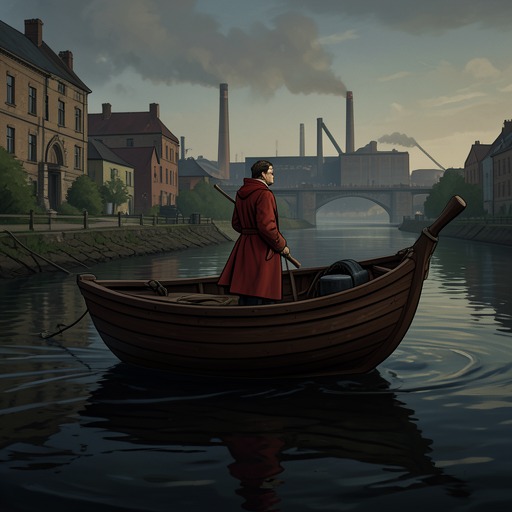
A steamy mist rises from the warm Chocolate River, and out of it emerges a fantastic pink boat. It has a high front and rear, like an old Viking boat, and its shining, sparkling surface makes it appear to be formed from bright pink glass. The boat is not merely decorated with candy; Willy Wonka explains that he made it by hollowing out an enormous boiled sweet. Its construction turns confectionery into architecture and transport, extending the factory's governing principle that ordinary industrial materials can be replaced by edible impossibilities.
The scale of the rowing crew intensifies that spectacle. Masses of Oompa-Loompas pull the oars, with at least ten assigned to each one, and one hundred Oompa-Loompas rest on their oars and stare at the visitors when the boat reaches the bank. Their sudden shrieks of laughter make the scene both festive and disconcerting. Willy Wonka dismisses their reaction by saying that they are always laughing and consider everything a colossal joke, but the laughter also preserves the factory's unstable emotional atmosphere: marvel and menace can occupy the same moment.
The passengers and their desires
Once everyone is aboard, the Oompa-Loompas push away from the bank and row swiftly downstream. The passengers do not respond to the boat in the same way. Mike Teavee is told not to lick its side because his tongue will make it sticky, a small comic intrusion that brings the fantastical vessel back into physical contact with childish appetite. Veruca Salt, by contrast, immediately attempts to convert the spectacle into a possession. She demands a large pink boiled-sweet boat of her own, complete with Oompa-Loompas to row it and a chocolate river for her use.
Grandpa Joe quietly interprets Veruca Salt's demand as deserving "a good kick in the pants." His remark identifies the conflict beneath the extravagance: the boat is a shared experience within the tour, but Veruca Salt sees it as another object that her father should obtain for her. Her response repeats the acquisitive pattern associated with the global Golden Ticket hunt, when people smashed piggy banks, bought Wonka bars in frantic quantities, and treated the hidden ticket as a prize capable of reorganizing their lives. The boat ride thus displays both wonder and the appetite to own wonder.
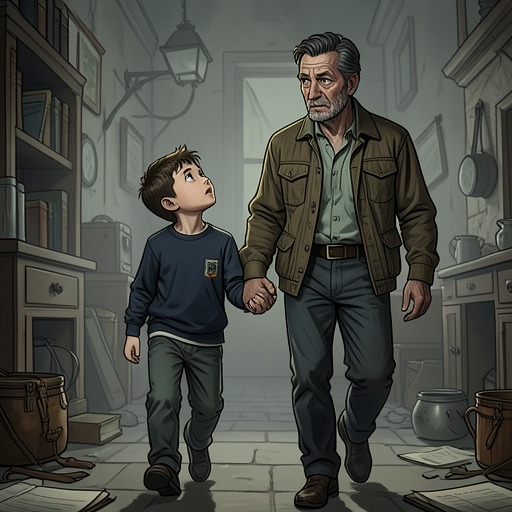
Charlie Bucket occupies a different position among the passengers. Sitting beside Grandpa Joe, he holds tightly to his grandfather's bony old hand and is overwhelmed by the succession of sights: the Chocolate River, the waterfall, the huge sucking pipes, the minty sugar meadows, the Oompa-Loompas, the pink boat, and Willy Wonka himself. His excitement is not acquisitive. He does not ask to possess the boat or its rowers; he is absorbed in the question of what the factory can reveal next. That distinction recalls his earlier relationship with chocolate, which he once kept in a small wooden box and consumed in tiny nibbles so that a single birthday bar would last for more than a month.
Willy Wonka notices Charlie's physical condition as well as his wonder. He reaches into the bottom of the boat, dips a large mug into the Chocolate River, fills it with chocolate, and hands it to Charlie, telling him to drink because it will do him good and he looks starved. The gesture is direct and practical, linking the fantastic journey to the poverty that shaped Charlie's desire for chocolate. Charlie's hunger is not an abstract moral flaw: his family has often lived on bread and margarine, boiled potatoes and cabbage, and cabbage soup, while his parents have sometimes surrendered their own portions for him. The river's abundance therefore carries a different emotional weight for Charlie than it does for the other children.
Speed, darkness, and controlled uncertainty
The boat soon reaches a narrowing section of the river. Ahead lies a dark, round tunnel resembling an enormous pipe, and the Chocolate River runs directly into it. Willy Wonka commands the Oompa-Loompas to row at full speed; the boat shoots into the darkness while the passengers scream with excitement. The scene changes the river from a scenic marvel into a passage through the factory's internal body. The visitors are no longer simply looking at production from the outside. They are being carried through the channels that make the factory's wonders possible.
The darkness produces uncertainty, but Willy Wonka turns uncertainty into a joke. When Violet Beauregarde asks how the rowers can see where they are going, he responds by echoing the logic of the song "There's no earthly way of knowing." The title phrase becomes an apt description of the journey's rules. The passengers are required to trust a guide who appears delighted by speed, secrecy, and disorientation; their lack of knowledge is not a defect in the tour but part of its designed experience.
When Willy Wonka orders the lights switched on, the tunnel is revealed as a gigantic pipe with upward-curving walls that are pure white and spotlessly clean. The Chocolate River is moving very fast inside it, the Oompa-Loompas row with extraordinary intensity, and the boat rockets forward at a furious pace. Willy Wonka jumps, waves his stick, claps, laughs, and urges the rowers to go faster, repeatedly looking toward the passengers to see whether they are enjoying the sensation as much as he is. His authority is expressed through theatrical enthusiasm: he controls the machinery, the workers, the speed, and the audience's attention, yet presents that control as exuberant play.
The factory revealed as a system
The illuminated tunnel makes the factory's hidden organization briefly legible. Charlie Bucket sees a green door set into the wall just above the river, marked "STOREROOM NUMBER 54." The sign lists dairy cream, whipped cream, violet cream, coffee cream, pineapple cream, vanilla cream, and hair cream. In the midst of the impossible river voyage, the door supplies an inventory-like glimpse of the factory's practical infrastructure. Behind the spectacle are rooms, stores, ingredients, and specialized products arranged in an immense production system.
This glimpse also complicates the apparent naturalness of the Chocolate River. The river seems to be a landscape, but it flows through a pipe, past numbered storage rooms, and under the direction of organized labor. The Oompa-Loompas are not incidental decoration: Willy Wonka has described them as workers imported directly from Loompaland, where they lived in tree houses, faced dangerous creatures such as hornswogglers, snozzwangers, and whangdoodles, and longed above all for cacao beans. He says he brought every man, woman, and child of the Oompa-Loompa tribe to the factory, where they became workers, learned English, and continued to make music and songs.
The boat's beauty consequently rests on a labor structure that the visitors experience mainly as entertainment. The pink vessel is Willy Wonka's private yacht, but its movement depends on a hundred Oompa-Loompas pulling oars, while their laughter and synchronized effort are absorbed into the show's atmosphere. The journey presents the factory as generous abundance—especially to Charlie Bucket, who receives a mug of river chocolate—yet it also shows how that abundance is made visible through controlled bodies, controlled routes, and controlled access.
Narrative significance and aftermath
The ride's decisive movement is from open marvel to enclosed velocity. At the riverbank, the passengers can admire the boat as an object; on the river, they become dependent on it; in the tunnel, they surrender ordinary orientation altogether. Willy Wonka's factory tour repeatedly turns movement into a test of trust, and this passage establishes that the next destination will not be reached by ordinary walking or by a clearly explained route. The visitors are carried wherever the factory's hidden channels lead.
For Charlie Bucket, the boat ride deepens the contrast between deprivation and wonder without erasing the former. His starved appearance is visible even inside a place overflowing with chocolate, and Willy Wonka's offered mug momentarily joins the boy's real bodily need to the factory's extravagant abundance. Grandpa Joe's presence gives Charlie a protective companion, while the other children's reactions expose contrasting forms of appetite: Veruca Salt wants to own the experience, Mike Teavee treats it as something to taste, and Charlie receives it with astonished attention.
The journey also establishes the factory's characteristic moral and aesthetic tension. Willy Wonka's inventions are beautiful because they are excessive, but that excess is inseparable from speed, secrecy, labor, and the possibility that a child may vanish into the machinery. The Chocolate River Boat Ride does not resolve that tension. Instead, it carries the passengers farther into it, leaving them in a spotless white pipe, surrounded by chocolate, propelled by Oompa-Loompas, and still unable to know what waits beyond the next door.