The Golden Ticket Contest
Charlie and the Chocolate FactoryThe Golden Ticket Contest is Willy Wonka’s carefully limited invitation to five children to visit Wonka's Chocolate Factory. By hiding five Golden Tickets beneath the wrappers of ordinary chocolate bars, Wonka turns a product purchase into a worldwide hunt whose prize combines privileged access, spectacle, and an apparently inexhaustible supply of sweets. The contest changes the fortunes of Charlie Bucket’s family and supplies the narrative mechanism that carries the children from ordinary consumer desire into the factory’s dangerous wonders.
Announcement and Rules
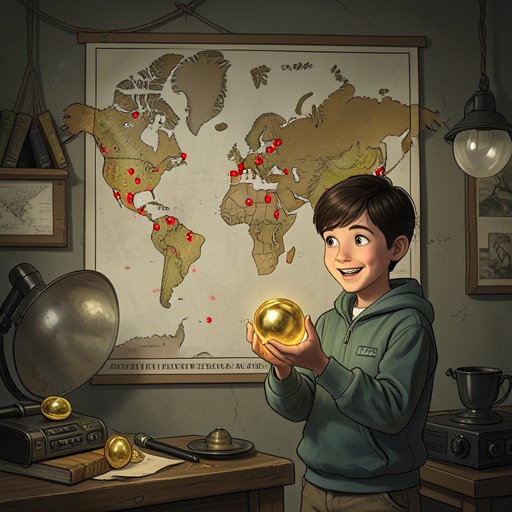
Willy Wonka’s plan is announced through an Evening Bulletin after the newspaper reports that the factory will at last be opened to a lucky few. The announcement identifies the contest as deliberately exclusive: only five children will be admitted, and Wonka will show them the factory’s secrets and magic personally. Each of the five tickets is printed on golden paper and hidden beneath the ordinary wrapping of an ordinary Wonka bar. The bars may be anywhere—in any shop, street, town, country, or nation where Wonka’s Sweets are sold—so the contest gives a local purchase a genuinely global reach.
The prize is designed to exceed the factory visit itself. The five finders are promised enough chocolates and sweets to last for the rest of their lives. In the later invitation read aloud by Mr Bucket, Wonka expands the promise: each winner may bring one or two family members, will be guided around the factory for a whole day, and will be escorted home by large trucks loaded with food for the entire household. If those supplies run out, the Golden Ticket can be brought back to the factory so that Wonka will refill the family’s cupboard with whatever it wants. The ticket therefore functions as both admission pass and continuing claim on Wonka’s production.
The visit is fixed for the first day of February, at ten o’clock sharp in the morning, at the factory gates. The ticket must be present or the finder will not be admitted. Wonka’s wording joins precise procedural rules to promises of “mystic and marvellous surprises,” making the contest feel simultaneously like a contract, a treasure hunt, and a theatrical performance whose final effects are deliberately withheld.
Worldwide Search and Public Frenzy
The contest produces a sudden chocolate-buying spree that extends far beyond the five children. Adults buy ten Wonka bars at a time and tear open the wrappers in sweet shops, while children smash their piggy banks to obtain money for more bars. In one city, a famous gangster robs a bank of a thousand pounds and spends the entire sum on Wonka bars; when the police find him, he is sitting among mountains of chocolate, using a long dagger to rip open the wrappers. The contest thus makes desire visible as excess, turning the ordinary act of buying confectionery into compulsion and spectacle.
The search also generates false solutions and technological attempts to defeat uncertainty. In Russia, Charlotte Russe claims to have found the second ticket, but the discovery proves to be a clever fake. Professor Foulbody invents a machine that supposedly detects gold beneath an unopened wrapper. Its mechanical arm grabs at anything containing even the slightest trace of gold, but while the professor demonstrates it in a department-store sweet counter, the arm seizes the gold filling in a duchess’s back tooth. The crowd smashes the machine, and the contest’s mystery survives the effort to mechanize it.
The publicity escalates each time a ticket is found. Augustus Gloop’s discovery is reported before the second ticket, and the announcement of Veruca Salt’s ticket appears in the newspaper on the day before Charlie Bucket’s birthday. When Charlie Bucket finds the fifth ticket, Mr Bucket’s family is immediately surrounded by newspapermen and photographers who have tracked down the finder for the next morning’s front pages. Their visit creates several hours of pandemonium in the small house and keeps Charlie from bed until nearly midnight. The contest is therefore not merely a private prize scheme: every successful finder becomes news, and every ticket intensifies the public’s appetite for the next revelation.
Charlie Bucket and the Value of the Prize
The contest acquires particular force through Charlie Bucket’s poverty. Mr Bucket is the only member of the family with a job, working in a toothpaste factory screwing caps onto filled tubes, but his wages cannot provide enough food for the large household. The family’s meals consist of bread and margarine, boiled potatoes and cabbage, and cabbage soup; only on Sundays may everyone have a second helping. Charlie feels the hunger most sharply, even though his parents often surrender their own portions to him.
Chocolate is consequently more than a luxury for Charlie Bucket. It is the food he longs for above everything else, and the shop windows where slabs of chocolate are displayed become sites of daily torment. Other children can take creamy bars from their pockets and eat them in front of him, while he can taste chocolate only once a year, on his birthday. His family saves for one small bar, which Charlie places in a wooden box and treats as if it were solid gold. He prolongs the gift for more than a month by taking tiny nibbles, exposing only a little of the chocolate at a time. Against this background, the Golden Ticket turns the object of his most disciplined longing into a possible source of abundance for the whole household.
Wonka’s invitation promises Charlie Bucket not simply sweets for himself but food for his entire family for many years. The contest therefore shifts the meaning of the prize from personal indulgence to collective relief. Its public promise of endless supply appears extravagant to the wealthy and comic to some observers, yet for the Bucket family it answers an immediate material need that no amount of ordinary labor has been able to resolve.
The Factory Visit as the Contest’s Second Stage
The contest reaches its public climax when the five ticket holders gather outside Wonka's Chocolate Factory. Enormous crowds press against the gates, shouting while linked policemen hold them back. The five children stand in a group protected from the crowd, accompanied by the grown-ups who have come with them. Unlike the other children, who have both parents present, Charlie Bucket arrives with Grandpa Joe, holding tightly to his grandfather’s hand.
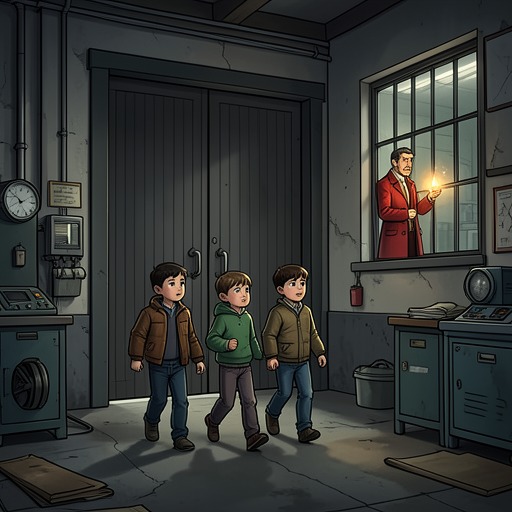
Inside the factory, the terms of the contest become a system of observation, temptation, and elimination. At the Inventing Room, Willy Wonka warns the visitors not to touch, meddle with, or taste anything, describing the room as the most important in the entire factory and insisting that its inventions are secret even from the Oompa-Loompas. His warning establishes that entry is a privilege governed by rules, not unrestricted ownership of the wonders on display.
As the tour proceeds, children disappear after their conduct brings consequences, and Wonka repeatedly recalculates how many remain. After two naughty children are gone, he remarks that three good children are left and urges the group to leave quickly before anyone else is lost. Eventually, when Wonka asks how many children remain, Grandpa Joe tells him that only Charlie is left. The contest has thus changed from a hunt for hidden tickets into a succession of tests whose final survivor is Charlie Bucket.
Advertising, Scarcity, and Narrative Significance
The Golden Ticket Contest demonstrates the power of scarcity as advertising. Wonka limits admission to five children, hides the tickets in ordinary products, and distributes the possible discoveries across the entire world. The restriction makes every wrapper suspenseful, while the ordinary chocolate bar becomes the carrier of an extraordinary promise. Newspapers, crowds, family interviews, false tickets, public demonstrations, and criminal excess all spread the value of the Wonka brand without requiring the contest itself to be repeated in every scene.
The contest also turns consumers into unpaid transmitters of Wonka’s publicity. Each finder supplies a photograph and a story; each crowd gathers at the factory gates; each family discusses the promised lifetime of sweets. Later, Willy Wonka imagines an even more direct form of consumption in which a television commercial would tell viewers to eat Wonka’s chocolates and allow them to reach out from home and take one from the screen. That imagined product extends the contest’s central fantasy: desire should move instantly from advertisement to possession.
At the same time, the contest contrasts sharply with Charlie Bucket’s restrained relationship to chocolate. The public tears wrappers apart in frantic succession, while Charlie preserves one birthday bar in a wooden box and consumes it by tiny increments. The worldwide hunt treats chocolate as a ticket-bearing commodity whose value lies in the chance of winning; Charlie’s experience makes its value intimate, physical, and inseparable from hunger. When only Charlie remains at the factory, the contest’s machinery of publicity and abundance has led back to the child for whom a single small bar once had to last more than a month.