The Golden Ticket Factory Tour
Charlie and the Chocolate FactoryThe Golden Ticket Factory Tour is the decisive journey in which Charlie Bucket and the other four Golden Ticket winners cross from public competition into Willy Wonka's private world. It begins as a spectacular prize advertised to the entire world, but becomes something more demanding: a controlled passage through rooms, rules, temptations, disappearances, and revelations. By the time the Great Glass Lift is ready to move on, Charlie is the only child left, and the promised visit has become the route toward Charlie inherits Wonka's factory.
Origins in Scarcity and Publicity
The tour is made possible by Willy Wonka's announcement that Wonka's Chocolate Factory will be opened at last to five children. The invitation is deliberately narrow: only five Golden Tickets exist, each hidden beneath the ordinary wrapper of an ordinary Wonka chocolate bar, and the tickets may be anywhere in any shop, street, town, country, or country in the world. The finders are promised a personal tour, access to the factory's secrets and magic, and enough chocolates and sweets to last for the rest of their lives.
The announcement converts chocolate into a global hunt. Newspapers present the factory's reopening as sensational news, while the hidden tickets make every Wonka bar a possible gateway to extraordinary privilege. The response becomes a worldwide chocolate-buying spree. Adults buy ten bars at a time, children smash their piggy banks, a gangster spends a thousand pounds stolen from a bank on chocolate, and a failed claim from Russia and Professor Foulbody's destructive ticket-detecting machine add further episodes of public frenzy. The contest therefore markets not only candy but uncertainty: the ordinary wrapper conceals an extraordinary outcome, and the search itself becomes a form of entertainment.
For Charlie, this commercial spectacle is rooted in genuine hunger. His family can afford only bread and margarine, boiled potatoes and cabbage, and cabbage soup, while Mr Bucket is the only family member with a job. Charlie longs for chocolate more than anything else, yet he normally tastes it only once a year, when the family gives him one small birthday bar. He preserves that bar in a wooden box and makes a sixpenny bar last for more than a month by taking tiny nibbles. The Golden Ticket contest thus attaches a world-famous prize to the precise object that represents Charlie's deprivation, longing, patience, and capacity for restraint.
Arrival at the Factory Gates
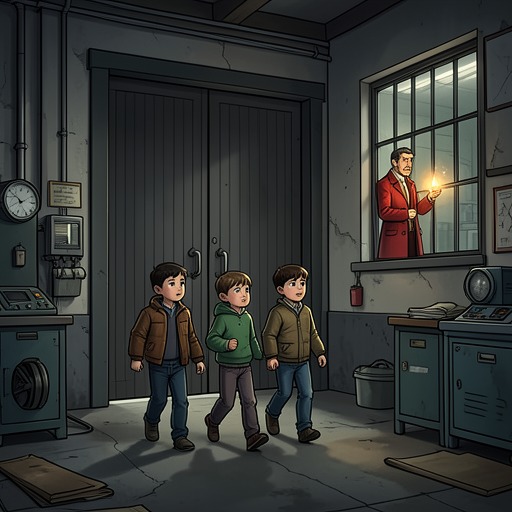
After Charlie finds the fifth Golden Ticket, reporters and photographers invade the Bucket home and keep the family in pandemonium for hours. The tour begins the following morning in winter, with snow on the ground and bitterly cold air. Outside the factory gates, enormous crowds push and shout while policemen link arms to contain them. The five children stand in a group protected from the crowd, accompanied by the adults who have come with them. Charlie is beside Grandpa Joe, holding tightly to his hand; unlike the other children, he does not have both parents present.
The opening is presented like a public ceremony. A church clock strikes ten, and the great iron gates swing open slowly on rusty hinges. The crowd falls silent, the children stop jumping, and all attention fixes on the entrance. Willy Wonka then appears as the personification of the factory's theatrical identity: quick, bright-eyed, bearded, sharply dressed in movement if not described through formal ceremony, and so energetic that he performs a skipping dance in the snow before welcoming the children.
Wonka asks the children to approach one at a time, show their Golden Tickets, and give their names. He greets Charlie with special excitement because Charlie found his ticket only the previous day and has already appeared in the morning papers. His elaborate welcome to Charlie and Grandpa Joe combines personal recognition with performance, making the boy's sudden rise from poverty part of the public drama. Once all five children are inside, Wonka urges them to stay together and warns that he would not like to lose any of them at this stage.
The threshold produces an immediate change in the tour's meaning. Charlie looks back at the crowds as the great entrance gates close behind him with a clang, and the outside world disappears from view. The public contest has brought him into the factory, but the factory is no longer a public spectacle that the crowd can control. It is now Wonka's enclosed domain, governed by his timing, his doors, his warnings, and his undisclosed purposes.
Rules, Rooms, and Controlled Wonder
Wonka leads the group through a large red door into a warm interior. He explains that the factory must be kept extremely hot because his workers are accustomed to an extremely hot climate and would perish in the cold outdoors. When Augustus Gloop asks who these workers are, Wonka refuses to answer immediately, promising that the children will see everything in due course. Even at the entrance, information is released according to the guide's schedule rather than the visitors' questions.
The same structure governs the Inventing Room. After the boat reaches a red door marked INVENTING ROOM — PRIVATE — KEEP OUT, Wonka identifies it as the most important room in the entire factory. His secret inventions are cooking and simmering inside, and rival chocolate makers such as Fickelgruber, Prodnose, and Slugworth would supposedly give their front teeth for three minutes of access. The room is protected not merely by physical privacy but by competitive secrecy: it contains the knowledge on which Wonka's commercial power depends.
Wonka sets out explicit behavioral rules before entry. The children must not touch, meddle with, or taste anything. They agree, but the warning also establishes the tour as a test of obedience. The room has been closed even to the Oompa-Loompas, so entering it is both a privilege and an exposure to danger. The invitation promises access to secrets, yet access is conditional, supervised, and surrounded by prohibitions.
The tour's rules become more ominous as children disappear. At one point, Wonka sighs that two naughty little children are gone and that three good little children remain, then urges the group to leave the room quickly before anyone else is lost. His language turns the missing children into a running score and divides the participants into moral categories. The tour consequently functions like an elimination game: each child's conduct changes the number of remaining contestants, while Wonka's commentary supplies an unsettling interpretation of what has happened.
From Prize to Contest
The tour begins with a straightforward exchange: the children have won entry, and Wonka is supposed to provide the promised marvels. Yet every room makes the reward less passive. Visitors must follow instructions, resist forbidden attractions, and remain within the group. Wonka's warnings imply that the factory contains inventions and processes powerful enough to harm anyone who treats them as ordinary toys or sweets. The value at stake shifts from simple possession of chocolate to safety, self-command, and continued participation.
This shift is also built into the contest's publicity. Grandpa Joe immediately understands the announcement as a commercial triumph, imagining the whole world buying Wonka bars and Wonka selling more than ever before. The factory tour is therefore both a prize and an extension of advertising. The Golden Tickets make consumers search; the winners carry the spectacle into the factory; and the extraordinary rooms provide experiences that can sustain the legend of Wonka's brand. Wonka's later plan for Television Chocolate makes this logic explicit: he imagines a commercial appearing on a viewer's television and a voice ordering the viewer to eat Wonka's chocolates, after which the viewer simply reaches out and takes one. The factory's marvels are inseparable from the dream of making consumption immediate and irresistible.
The visitors are also made into witnesses. The crowds outside, the newspaper coverage of Charlie's last-minute discovery, the carefully staged welcome, the succession of rooms, and the repeated counting of children all turn the tour into a narrative that can be reported and remembered. At the same time, the closing gates prevent the public from seeing the process directly. The world receives the promise and the publicity, but Wonka retains control of the experience itself.
Charlie as the Last Visitor
After the tour has passed through its dangerous episodes, the group reaches a stark numerical turning point. Wonka asks which room should come next and demands that everyone hurry, then asks how many children remain. Grandpa Joe answers that only Charlie is left. Wonka turns and stares at Charlie, who is still holding tightly to Grandpa Joe's hand. His surprise is presented as an act, suggesting that he has been monitoring the outcome more closely than he admits.
Charlie therefore occupies a position unlike that of the other winners. He entered as the poorest child and the latest finder, arriving only just in time, but he endures when the others do not. His endurance is connected to the same restraint already visible in his birthday ritual: he can treasure chocolate without immediately consuming it, and he can remain attached to family rather than treating the factory as an unrestricted playground. The tour changes the meaning of his earlier deprivation. What first appeared to be mere lack has cultivated patience, while the abundance promised by the prize tests whether that patience can survive contact with Wonka's inventions.
The tour's endpoint is not simply that Charlie has seen the factory. It is that the factory has selected him through a sequence whose rules were announced only partly in advance and whose consequences were revealed room by room. With Charlie the sole remaining child, the visit points beyond lifelong supplies of sweets toward Charlie inherits Wonka's factory. The Golden Ticket has carried him from a starving household, through a worldwide commercial spectacle, across a guarded threshold, and into the position of the only child still standing beside Willy Wonka and Grandpa Joe.