The Worldwide Golden Ticket Hunt
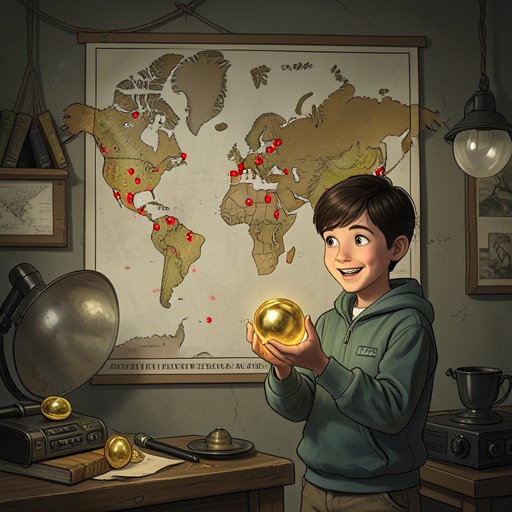
Charlie and the Chocolate FactoryThe Worldwide Golden Ticket Hunt is the worldwide search for five Golden Tickets hidden inside ordinary Wonka chocolate bars. Conceived by Willy Wonka as the sole route into Wonka's Chocolate Factory, it transforms chocolate buying into a global competition: scarcity creates urgency, the newspapers amplify every discovery, and the promise of a factory tour and lifetime supplies of sweets converts consumers into eager participants in Wonka's publicity machine.
Announcement and Rules
Willy Wonka's campaign is announced through a newspaper notice that presents the factory as a sealed mystery. After ten years in which nobody has seen him, Wonka declares that only five children will be admitted, each personally shown the factory's secrets and magic. Five tickets, printed on golden paper, are placed beneath the ordinary wrappers of five ordinary chocolate bars. They may be hidden in any shop, street, town, country, or other place where Wonka's Sweets are sold, and only the children who find them may enter. The reward extends beyond access: each child will receive enough chocolates and sweets to last for the rest of life.
The rules are simple but strategically powerful. The tickets are few, the bars appear ordinary, and their locations are unknown even to the public. The contest therefore makes every wrapper a possible revelation while turning every purchase into an act of hope. Grandpa Joe immediately understands the commercial force of the announcement: the whole world will search, everyone will buy Wonka's chocolate bars, and Wonka will sell more than ever before. The promised reward and the hidden-ticket mechanism make the factory's secrecy itself part of the advertisement.
The Search Becomes a Global Frenzy
The first ticket is found the very next day by Augustus Gloop, a nine-year-old boy whose exceptional appetite has led his mother to describe eating as his hobby and the principal thing that interests him. His discovery confirms that the contest is real and intensifies the public hunt. With only four tickets remaining, the search spreads beyond ordinary family excitement into a worldwide chocolate-buying spree.
Adults buy ten Wonka bars at a time and tear off the wrappers in sweet shops. Children smash their piggy banks and rush to stores with handfuls of money. In one city, a famous gangster robs a bank of a thousand pounds and spends all of it on Wonka bars in a single afternoon; when police enter his house, they find him surrounded by mountains of chocolate, using a long dagger to rip open the wrappers. The campaign thus reaches across age and social position, making the same compulsive ritual visible in children, grown women, and a criminal who converts stolen money directly into chances at the prize.
The search also produces false leads and technological fantasies. In Russia, Charlotte Russe claims to have found the second ticket, but it proves to be a clever fake. Professor Foulbody invents a machine intended to detect a Golden Ticket without opening a wrapper. Its mechanical arm seizes anything containing even the slightest trace of gold, but during a public demonstration it grabs the gold filling in a duchess's back tooth. The resulting ugly scene ends with the crowd smashing the machine. The failed device reveals how completely the contest has redirected ingenuity toward the hunt: even scientific invention becomes an attempt to bypass the ordinary uncertainty of buying and unwrapping chocolate.
Veruca Salt and Industrialized Desire
The second genuine ticket is found on the day before Charlie Bucket's birthday by Veruca Salt, a small girl from a wealthy family living in a distant great city. Her father, Mr Salt, does not leave the search to chance or to individual purchases. He buys thousands, perhaps hundreds of thousands, of Wonka bars, sends them by truck to his own factory, and orders roughly one hundred women who normally shell peanuts to remove chocolate wrappers instead.
For three days the workers strip wrappers from morning until night without success. Veruca responds by screaming that she wants her Golden Ticket and by lying on the floor, kicking and yelling. Mr Salt then vows to continue until he has obtained what she demands. On the fourth evening, one of the workers finally shouts that she has found a ticket. Mr Salt takes it immediately, rushes home, and gives it to Veruca; in his account, the household becomes happy again as soon as her demand is satisfied.
This discovery exposes a sharp contrast within the hunt. The contest is presented as a chance hidden anywhere in the world, but wealth allows Mr Salt to turn chance into mass purchasing power and paid labor. Veruca's ticket is not merely found by a child opening a bar; it is secured through her father's factory, trucks, and workforce. The episode makes the Golden Ticket a measure of family power as well as luck, while Veruca's tantrums show how the promised prize feeds an already uncontrolled appetite for possession.
Publicity, Witnesses, and the Factory's Wider System
The hunt continually produces news, photographs, and public witnesses. When Charlie Bucket finds the fifth Golden Ticket, swarms of newspapermen and photographers track down his family and pour into the small house. They demand the full story for the morning papers, creating several hours of pandemonium before Mr Bucket can send them away near midnight. The Golden Ticket therefore functions as a news event as much as a prize: each finder becomes a public image, and each discovery renews the campaign's reach.
The five successful children eventually gather outside Wonka's Chocolate Factory, where enormous crowds push and shout behind linked police lines. The winners and their accompanying adults are carefully shielded beside the gates. Charlie Bucket stands holding Grandpa Joe's hand, while the other children arrive with both parents, who must physically restrain them from climbing over the gates before ten o'clock. The contest has moved from private unwrapping to a public spectacle whose audience, security arrangements, and anticipation are all part of the event.
The factory tour extends the same logic of controlled revelation. Willy Wonka brings the visitors through spaces governed by secrecy and explicit restrictions, including the Inventing Room, which he calls the most important room in the entire factory because his secret inventions are being developed there. He warns the children not to touch, meddle with, or taste anything and says that nobody else, not even an Oompa-Loompa, has previously been allowed inside. The Golden Ticket hunt thus culminates in access to an organized sequence of wonders, where Wonka controls both what the winners see and the rules by which they may respond.
Global Production Behind the Global Prize
The hunt's apparently magical abundance rests on an international production system. Willy Wonka says that the Oompa-Loompas were imported directly from Loompaland, a country he describes as a dangerous jungle inhabited by hornswogglers, snozzwangers, and whangdoodles. The Oompa-Loompas live in tree houses, struggle to improve a diet of green caterpillars, and long especially for cacao beans, the essential ingredient from which chocolate is made.
Wonka recruits them by offering unlimited cacao beans and chocolate, even proposing that wages could be paid in cacao beans. He then ships every man, woman, and child of the Oompa-Loompa tribe to his country in large packing cases with holes. At the factory they become workers, speak English, make music, dance, and compose songs, while retaining the clothing associated with the jungle. Their labor helps sustain the factory whose products are distributed widely enough for hidden tickets to reach shops around the world.
The contrast is central to the hunt's design. Consumers experience the Golden Tickets as rare treasures concealed in familiar commodities, while Wonka presents the factory as a place of inexhaustible chocolate, secret technology, and carefully managed labor. The campaign joins scarcity and abundance: five children must struggle to obtain entry, but the winner's reward promises sweets for life, and Wonka later imagines television viewers reaching out from home to take a chocolate directly from the screen after seeing an advertisement. The hunt is therefore both a contest and a demonstration of brand power, making desire itself the most widely distributed product of Wonka's factory.