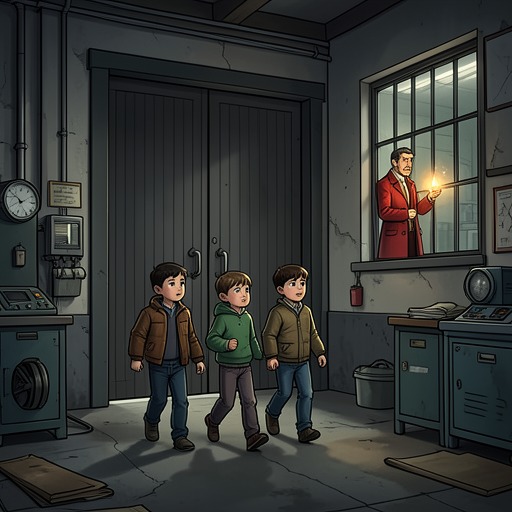
The five children visit Wonka's factory
Charlie and the Chocolate FactoryThe five children visit Wonka's factory is the decisive event created by Willy Wonka's Golden Ticket contest. What begins as a newspaper announcement promising five children a personal tour, access to the factory's secrets, and a lifetime supply of sweets becomes an extraordinary passage from public consumption into private invention. The visit gathers Augustus Gloop, Veruca Salt, Violet Beauregarde, Mike Teavee, and Charlie Bucket under Willy Wonka's authority, and its successive wonders and dangers turn the factory into both a playground and a test of conduct.
Causes and Public Spectacle
The visit is made possible by Willy Wonka's decision to open his factory to exactly five children. His notice insists on the number—five, and no more—and hides five Golden Tickets beneath the wrappers of ordinary Wonka's chocolate bars anywhere in the world. The winners alone may enter the factory and see what it is like inside. The promised reward is deliberately extravagant: Willy Wonka will conduct the tour himself, and the children will receive enough chocolate and sweets to last for the rest of their lives.
The announcement produces a worldwide chocolate-buying spree. Adults buy ten bars at a time, children smash their piggy banks, and a famous gangster spends a thousand pounds stolen from a bank on Wonka bars before being found amid mountains of chocolate, opening wrappers with a long dagger. A claimed ticket from Charlotte Russe proves to be a fake, while Professor Foulbody's ticket-detecting machine causes a public scandal when its mechanical arm attacks the gold filling in a duchess's tooth and is smashed by the crowd. The contest therefore turns the factory visit into a global media event before any child has reached the gates: scarcity creates urgency, and the hidden ticket converts an ordinary commodity into a chance at wonder.
The discovery of the fifth ticket intensifies that spectacle. Newspapers track down Charlie Bucket, and swarms of newspapermen and photographers invade his small house to obtain the story for the morning papers. The resulting pandemonium lasts for hours and keeps Charlie from bed until nearly midnight. By the time the visit occurs, the children are not merely private guests; they are famous figures watched by crowds and made into public symbols of the contest.
Arrival at the Factory Gates
The big day arrives in winter, with bright sunshine, snow-covered ground, and bitterly cold air. Enormous crowds gather outside the factory gates, pushing and shouting while linked-arm policemen hold them back. The five children stand in a group protected from the crowd, accompanied by the adults who have come with them. Charlie Bucket is beside the tall, bony Grandpa Joe, holding tightly to his grandfather's hand. Unlike the other children, Charlie does not have both parents present; the other four children are accompanied by their mothers and fathers, whose physical restraint is necessary because their children are eager to climb over the gates before the appointed time.
As a distant church clock strikes ten, the great iron gates begin to open slowly, their rusty hinges creaking loudly. The crowd falls silent, the children stop jumping, and every eye turns toward the entrance. Willy Wonka then appears as the figure at the center of the spectacle. He has a small pointed black goatee, bright eyes that seem constantly to sparkle, and quick, jerky movements that make him resemble a clever squirrel. His first act is a skipping dance in the snow, followed by a direct welcome to the five children.
Willy Wonka examines each Golden Ticket and asks each child to give a name. When Charlie's nervous voice identifies him, Willy Wonka recognizes him as the boy who found his ticket only the day before and says that he has read about him in the morning papers. His delighted reception singles out the lateness and improbability of Charlie's arrival. He also welcomes Grandpa Joe with extravagant enthusiasm before directing all five children and their companions to follow him and remain together.
Crossing into the Hidden Factory
Charlie looks back as the enormous entrance gates close behind him. The crowds outside continue pushing and shouting, but the closing gates cut off his view of the outside world with a clang. This movement is more than a change of location: the public contest ends at the threshold, and the children enter a space governed by Willy Wonka's private rules. The factory is warm because, as Willy Wonka explains, its workers are accustomed to an extremely hot climate and would perish in the cold outdoors. When Augustus Gloop asks who the workers are, Willy Wonka refuses to answer immediately, postponing the explanation until the tour reaches the relevant place.
Inside, the visitors encounter a corridor filled with mixed smells of roasting coffee, burnt sugar, melting chocolate, mint, violets, crushed hazelnuts, apple blossom, caramel, and lemon peel. From deep within the factory comes a muffled roar of energy, like a gigantic machine spinning at tremendous speed. Willy Wonka identifies the passage as the main corridor, tells the visitors to hang their coats and hats on pegs, and then hurries ahead in his plum-coloured velvet coat. The party consists of fourteen people—nine adults and five children—so the group must push and bustle to keep up with him.
The route soon leaves the main corridor and becomes a labyrinth of passages leading in every direction. Grandpa Joe warns Charlie not to let go of his hand, while Willy Wonka points out that all the passages slope downward. The tour is therefore also a descent into the factory's concealed structure. He explains that the most important rooms are underground because they are enormous, larger than football fields, and could not be housed in any building above ground. Beneath the surface, he says, there is no limit so long as the space can be hollowed out.
Rules, Inventions, and Elimination
The factory tour combines hospitality with strict control. At the Inventing Room, Willy Wonka uses a key to open a door marked "INVENTING ROOM — PRIVATE — KEEP OUT." He calls the room the most important in the entire factory because his secret new inventions are cooking and simmering there. He warns the visitors not to touch, meddle with, or taste anything, and emphasizes that nobody else, not even an Oompa-Loompa, has ever been admitted. The room's exclusivity makes entry a privilege, but the warning also establishes the danger of treating the tour as an unrestricted amusement park.
Violet Beauregarde violates that rule when she demands a piece of chewing gum. Willy Wonka gently tells her that he would rather she did not take it because the invention is not quite perfected. Violet ignores the warning, removes her own world-record piece of gum from behind her ear, and grabs the experimental stick from a drawer before putting it into her mouth. Her action makes the contest's structure visible: the children are offered access to wonders, but their reactions to limits determine what happens next. After the tour has already cost the group two naughty children, Willy Wonka remarks that three good children remain and urges everyone to leave the room quickly before another child is lost.
The language of the tour thus shifts from admission to attrition. The children are not simply shown a sequence of marvels; they are repeatedly confronted with forbidden objects, instructions, and consequences. Willy Wonka's cheerful manner does not remove the rules. Instead, it makes the contrast sharper between the brightness of the factory and the seriousness of disobedience, while the adults' presence raises questions about supervision and responsibility.
The Factory as Brand and Performance
The visit is also an elaborate performance of the Wonka brand. The Golden Ticket promises not only entry but a personal encounter with the mysterious confectionery genius whom nobody has seen for ten years. At the gates, Willy Wonka's dancing, sparkling eyes, rapid movements, high voice, and extravagant welcome turn his personality into part of the attraction. The children are being introduced to a factory, but they are equally being introduced to its creator as a living legend.
The contest's commercial logic continues inside the tour. Grandpa Joe celebrates the idea that everyone in the world will buy Wonka's chocolate in the hope of finding a ticket, correctly recognizing that the promotion will sell more chocolate than ever before. Later, Willy Wonka imagines a television commercial that would allow someone watching at home to reach out and take a Wonka chocolate directly from the screen. The fantasy extends the factory's power beyond its walls: chocolate becomes not merely something purchased but a form of immediate, almost magical communication between brand and consumer.
Yet the tour also exposes the tension beneath that spectacle. Its wonders depend on secrecy, restricted access, hidden workers, underground rooms, and Willy Wonka's unilateral control over information. He decides what the children may see, delays answers, locks important inventions behind a private door, and warns the visitors when curiosity crosses into interference. The factory's magic is therefore inseparable from its system of concealment and discipline.
Charlie as the Remaining Guest
The visit's trajectory culminates in the dwindling number of children. After Willy Wonka asks which room should come next and rushes toward the lift, Grandpa Joe calls after him that only Charlie is left. Willy Wonka turns and stares at Charlie, creating a silence in which Charlie remains physically attached to Grandpa Joe's hand. The fact that Charlie is the sole remaining child changes the meaning of the tour: what began as a group adventure has become a final encounter between Willy Wonka and the child who has endured it.
Charlie's position is defined by contrast. The other children arrive with wealth, notoriety, forceful parents, or conspicuous habits, while Charlie arrives with a nervous voice and Grandpa Joe as his companion. He is nevertheless admitted alongside the famous winners, receives Willy Wonka's special recognition for finding his ticket only the previous day, and survives as the others disappear from the tour. The factory visit consequently functions both as a spectacle of invention and as a process of selection. Its final emphasis is not the number of wonders displayed but the single child still capable of moving forward.
As an event, the factory visit converts the Golden Ticket contest's public promise into a private test. It begins amid newspaper headlines, frantic buying, police barriers, and a crowd hungry to witness entry; it proceeds through warm corridors, secret rooms, underground passages, experimental inventions, and enforced rules; and it narrows until Charlie Bucket stands as the only child left. The tour's decisive significance lies in that movement from mass attention to individual judgment, from ordinary chocolate wrappers to a hidden world, and from an advertised reward to the possibility that the visitor himself will become the factory's most important discovery.