Veruca Salt song
Charlie and the Chocolate FactoryThe Veruca Salt song is the Oompa-Loompas’ rhymed response to Veruca Salt’s disappearance down the rubbish chute at Wonka’s Chocolate Factory. Its decisive significance is that it transforms a dangerous factory incident into a compact lesson about spoiled-child behavior, parental responsibility, and the narrative’s harsh idea of corrective justice.
Performance and Immediate Setting
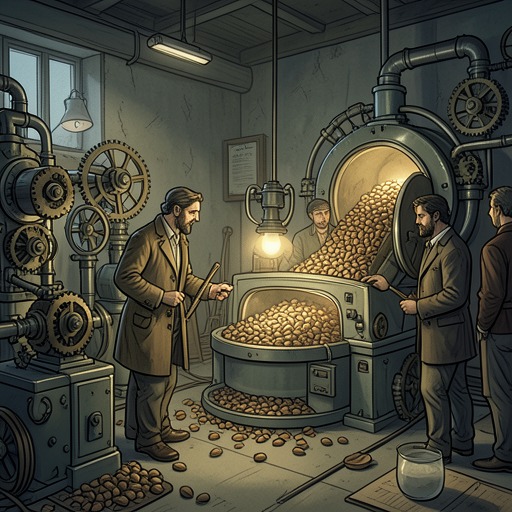
The song begins after Willy Wonka has led the visitors to the Nut Room and explicitly warned them not to enter because the squirrels must not be disturbed. One hundred squirrels sit on high stools around a large table, rapidly shelling walnuts. Veruca Salt, fascinated by the scene, goes into the room despite the warning and is judged by the squirrels to be bad; they carry her to the chute used for rubbish. As the group hears drums from far down the corridor, Grandpa Joe identifies the approaching performance, and the Oompa-Loompas begin by naming her: “Veruca Salt!”
The song therefore arrives as an immediate aftermath rather than as a detached commentary. Its drums and distant voices make the punishment public even after Veruca has vanished from view. The factory’s machinery of sorting, shelling, and disposal is followed by a musical machinery of interpretation: the Oompa-Loompas explain what has happened and invite the listeners to understand it as the consequence of behavior.
Moral Accusation
The opening identifies Veruca as “the little brute” and states that she has gone down the rubbish chute. The blunt label reduces her conduct to an observable pattern of aggression and entitlement, while the rhyme gives the accusation a memorable, almost nursery-like form. The song does not ask the audience to investigate the event or to question the squirrels’ judgment; it presents the verdict as settled and directs attention toward the conduct that supposedly caused it.
Its central argument is that Veruca’s demanding behavior has carried her “so very far astray.” The wording frames the chute as the endpoint of a moral deviation, not merely as an accident inside a hazardous room. In this way, the song links physical descent with ethical descent: Veruca goes downward through the factory because, in the Oompa-Loompas’ account, her character has already moved away from acceptable conduct.
Parents and Shared Responsibility
The song broadens blame beyond Veruca. It asks whether it is right to place every bit of blame on the child, then answers by identifying her parents as “her loving parents, MUM and DAD.” The apparent affection in that description is edged with irony, because the parents’ love is presented as indulgence rather than effective guidance. The song concludes that the parents too should fall into the rubbish chute, making their fate part of the same judgment imposed on their daughter.
This conclusion echoes the earlier public defense of Augustus Gloop by his mother. She treats his extreme chocolate consumption as a harmless hobby, even suggesting that he would not eat so much unless he needed nourishment. Against such adult excuses, the Veruca Salt song offers a different model of parenting: children’s conduct is not isolated from the habits their parents permit and rationalize. The punishment is consequently collective, assigning responsibility to the family rather than treating Veruca as a self-created offender.
Narrative Function and Discipline
The song belongs to the recurring Oompa-Loompa pattern in which a child’s removal from the tour is followed by drumming and a highly structured explanation. Earlier, the Oompa-Loompas begin singing after Augustus Gloop and his parents leave; later, they sing again after Veruca’s fall. These performances give rhythm and repetition to the factory’s sequence of warnings, transgressions, punishments, and lessons.
The song also guides the audience’s emotional response. Its rhyme, repetition, and direct address make the episode entertaining even while it concerns a frightening fate. The child listener is encouraged to see the punishment as deserved and to connect disobedience, appetite, arrogance, or indulgence with bodily consequences. The theatrical form softens the narrative’s severity without removing it: drums and verse make discipline memorable, while the imagery of the rubbish chute keeps the consequences concrete.
Place in the Factory’s Moral Order
The Veruca Salt song clarifies that the factory is not only a site of marvels. Willy Wonka repeatedly announces rules before exposing the visitors to dangerous or secret spaces: the Inventing Room is private, its inventions must not be touched or tasted, and the Nut Room must not be entered because the squirrels are working. Veruca’s episode shows what happens when fascination and entitlement override those instructions.
The song’s final emphasis on parents completes that moral structure. The factory’s warnings are explicit, but responsibility does not end with the person who disobeys them. Through its public performance, the Oompa-Loompas connect personal misconduct to the adults who have cultivated or excused it. Veruca’s fall is thus both a plot consequence and a didactic spectacle, one that turns the factory’s mechanical dangers into an instrument for judging the social habits surrounding the child.